




What Is a Suspension Clamp and How to Choose One
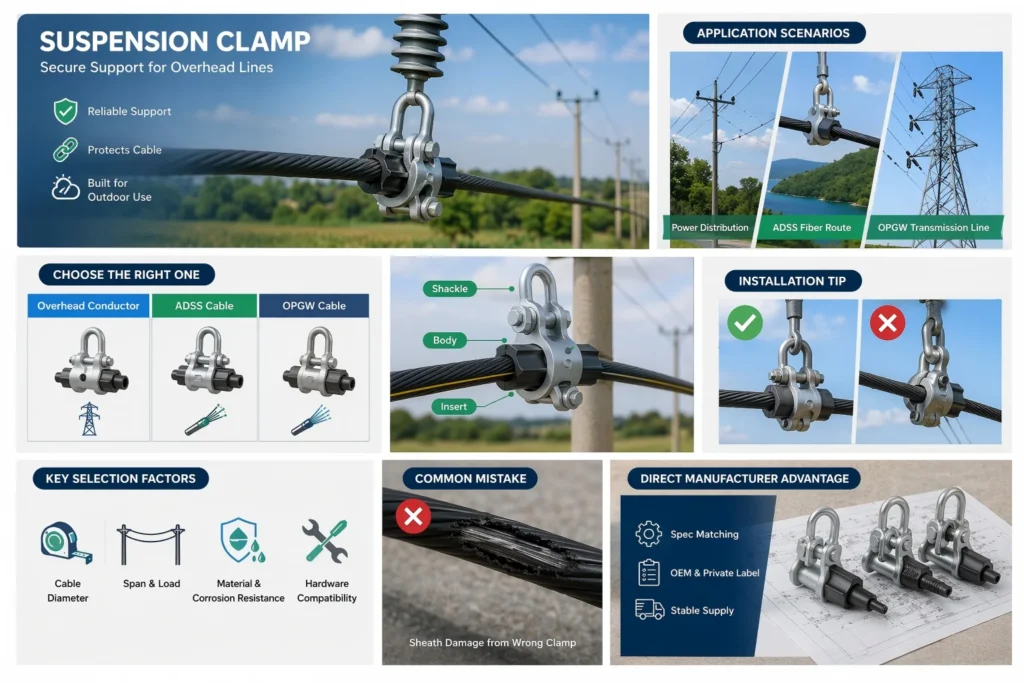
A suspension clamp is a pole line hardware fitting used to support overhead conductors, ADSS fiber optic cables, or OPGW cables at suspension points on poles or towers. Its job is not only to “hold” the cable, but to support mechanical load, distribute stress, reduce local pressure, and help protect the line from long-term damage.
For engineers, EPC contractors, telecom installers, and procurement teams, choosing the right suspension clamp is a technical decision. A clamp that fits the cable diameter may still be unsuitable if it does not match the span length, load requirement, cable structure, installation angle, or environmental conditions.
This article explains what a suspension clamp does, where it is used, how ADSS, OPGW, and overhead line suspension clamps differ, and what B2B buyers should check before selecting one.
What Is a Suspension Clamp?
Basic Function in Overhead Line Systems
A suspension clamp is used at intermediate support points where an overhead cable or conductor needs to be suspended from a pole, tower, bracket, or insulator assembly. Unlike dead-end fittings, which are designed to terminate and tension a line, suspension clamps are mainly used to support the line while allowing it to continue across the route.
In overhead power and communication systems, a suspension clamp typically helps with:
- Supporting the conductor or cable at suspension points
- Distributing mechanical load over a controlled contact area
- Reducing localized stress on the cable
- Protecting the cable sheath, strands, or optical fiber structure
- Maintaining line alignment over spans
- Improving long-term reliability in outdoor environments
Why Suspension Clamps Are Not Just “Cable Holders”
A common mistake is to treat suspension clamps as simple holding accessories. In reality, the clamp interacts directly with the cable under mechanical tension, wind load, vibration, temperature variation, and sometimes corrosive outdoor conditions.
If the clamp applies excessive local pressure, it may deform the conductor or damage the cable sheath. If the grip is insufficient, the cable may slip. If the material or surface treatment is unsuitable, corrosion can reduce service life. This is why suspension clamp selection should begin with project requirements rather than product appearance.
Where Are Suspension Clamps Used?
Suspension clamps are used across power distribution, transmission, telecom infrastructure, and utility maintenance projects. The application scenario determines which clamp design, material, and technical parameters should be considered.
Overhead Power Distribution Lines
In overhead distribution systems, suspension clamps support conductors on poles or towers while keeping the line properly positioned. These projects may include urban distribution upgrades, rural electrification, feeder lines, and utility pole line construction.
For this application, the key concerns are conductor diameter, mechanical load, installation angle, pole hardware compatibility, and outdoor durability.
ADSS Fiber Optic Cable Routes
ADSS stands for All-Dielectric Self-Supporting cable. ADSS cables are commonly installed along utility poles for telecom and power communication networks. Since they do not contain metallic strength members in the same way as some other cable types, proper cable protection is especially important.
An ADSS suspension clamp must support the cable without crushing the outer sheath or creating excessive bending stress. For ADSS suspension clamp installation, span length, cable diameter, cable sheath protection, and load distribution are critical.
OPGW Transmission Line Installations
OPGW stands for Optical Ground Wire. It combines optical communication fibers with grounding functionality and is typically installed on high-voltage transmission towers.
An OPGW suspension clamp must consider both mechanical support and the protection of the optical fibers inside the cable. Because OPGW is part of a transmission line system, clamp selection often depends on tower structure, span conditions, grounding-related requirements, and long-term outdoor performance.
Utility Pole Line Construction and Maintenance
Suspension clamps are also used in repair, replacement, and upgrade projects. In these cases, contractors may need to match new fittings with existing poles, insulators, brackets, or cable routes. The challenge is not only choosing a clamp that fits the cable, but also confirming that it works with the existing pole line hardware assembly.
| Application Scenario | Typical Cable or Conductor | Main Risk | Key Selection Factor |
|---|---|---|---|
| Overhead distribution line | Power conductor | Slippage, poor alignment, corrosion | Diameter, load, material, hardware compatibility |
| ADSS fiber route | ADSS optical cable | Sheath damage, local pressure, bending stress | Cable protection, span length, grip design |
| OPGW transmission line | OPGW cable | Fiber damage, mechanical stress, vibration | Cable structure, tower condition, load requirement |
| Maintenance replacement | Existing conductor or cable | Mismatch with old hardware | Specification confirmation, fitting compatibility |
| Rural electrification | Overhead conductor | Outdoor exposure, inconsistent pole conditions | Durability, installation adaptability |
Main Types of Suspension Clamps
Different line systems require different suspension clamp designs. ADSS, OPGW, and general overhead line applications should not be treated as interchangeable.
Suspension Clamp for Overhead Line Conductors
A suspension clamp for overhead line conductors is designed to support electrical conductors on poles or towers. It is commonly used in power distribution and transmission support points.
The main considerations are conductor size, mechanical load, installation angle, material strength, and resistance to corrosion. These clamps are often selected as part of a larger pole line hardware system.
ADSS Suspension Clamp
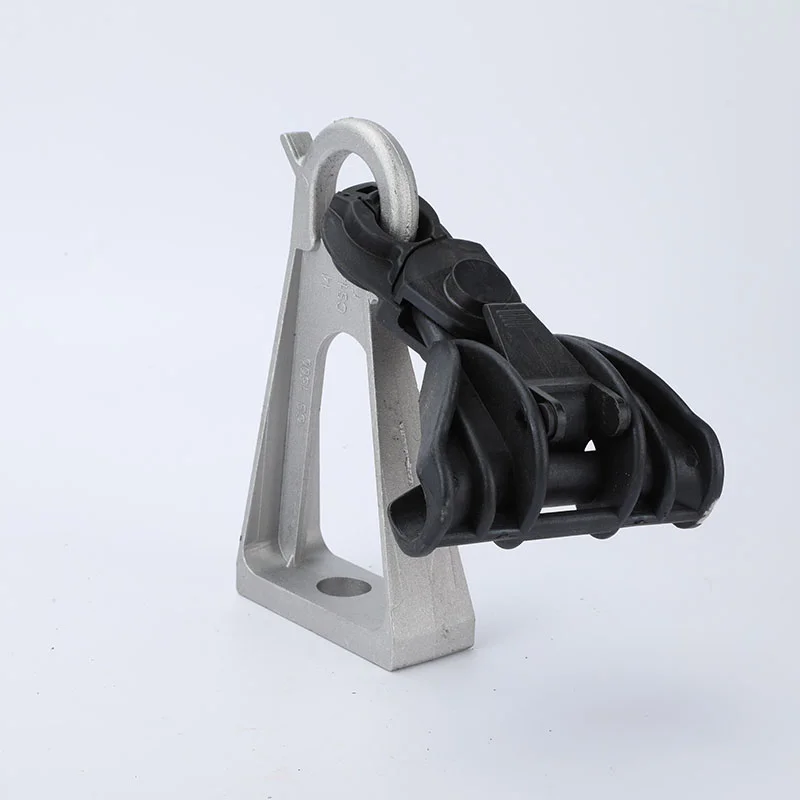
An ADSS suspension clamp is designed for ADSS fiber optic cable. The clamp must provide enough holding strength while avoiding excessive pressure on the cable sheath.
In many ADSS applications, preformed rods or protective components are used to spread stress over a larger contact area. This helps reduce the risk of sheath deformation and cable damage during long-term outdoor service.
OPGW Suspension Clamp
An OPGW suspension clamp is used for optical ground wire on transmission towers. OPGW requires careful handling because it contains optical fibers inside a cable structure that also performs grounding functions.
The clamp must provide mechanical support while protecting the internal fiber units. It must also work reliably under tower-line conditions such as wind load, vibration, tension, and environmental exposure.
Why the Cable Type Changes the Clamp Design
Cable type affects how the clamp should grip, support, and protect the line. A conductor, an ADSS cable, and an OPGW cable may look similar from a distance, but their structures and performance requirements are different.
| Clamp Type | Used For | Main Function | Selection Priority | Wrong Selection Risk |
|---|---|---|---|---|
| Overhead line suspension clamp | Power conductors | Support and suspend conductor | Diameter, load, corrosion resistance | Slippage, conductor deformation, poor fit |
| ADSS suspension clamp | ADSS fiber optic cable | Support cable while protecting sheath | Cable protection, span length, grip design | Sheath damage, cable slip, local stress |
| OPGW suspension clamp | Optical ground wire | Support OPGW and protect optical fibers | Mechanical strength, cable structure, tower condition | Fiber damage, vibration issues, line reliability risk |
Key Technical Parameters to Check Before Selection
A suspension clamp should be selected based on technical compatibility, not only price, appearance, or catalog category.
Cable or Conductor Diameter
Diameter is the first parameter to confirm, but it is not the only one. The clamp must match the cable or conductor diameter range, but it also needs to match the cable structure and application type.
For example, an ADSS cable and an OPGW cable may have similar diameters, but they may require different clamp designs because their internal structures and protection requirements are different.
Span Length and Mechanical Load
Span length affects the mechanical load applied to the cable and clamp. Longer spans usually increase tension and may require a clamp with better load distribution and stronger gripping performance.
A clamp selected only by diameter may fail if the span length or tensile requirement is ignored. For B2B procurement, span length and rated load should be confirmed before ordering.
Grip Strength and Load Distribution
Grip strength determines whether the clamp can hold the cable securely without slippage. However, stronger grip is not always better if it creates excessive local pressure.
Good suspension clamp design balances holding strength with load distribution. This is especially important for ADSS and OPGW applications, where cable damage may not be visible immediately but can affect long-term performance.
Material, Corrosion Resistance, and Outdoor Durability
Suspension clamps are often exposed to rain, humidity, UV exposure, temperature variation, and polluted or coastal environments. Material selection and surface treatment influence service life.
Depending on the project, buyers may need to consider aluminum alloy, galvanized steel components, rubber inserts, preformed rods, or other protective materials.
Compatibility with Pole Line Hardware
A suspension clamp does not work alone. It connects with brackets, insulators, bolts, links, towers, or pole line assemblies. Compatibility with the existing or planned hardware system should be checked before final selection.
| Parameter | Why It Matters | Risk If Ignored | What to Confirm Before Purchase |
|---|---|---|---|
| Cable/conductor type | Determines clamp structure | Wrong clamp category | ADSS, OPGW, or conductor application |
| Diameter range | Ensures physical fit | Loose grip or over-compression | Exact cable or conductor diameter |
| Span length | Affects mechanical stress | Slippage or overload | Route design and span data |
| Rated load | Confirms support capacity | Mechanical failure | Tensile and suspension load requirements |
| Material | Impacts durability | Corrosion or early wear | Outdoor environment and exposure conditions |
| Hardware compatibility | Ensures assembly fit | Installation delay or mismatch | Pole, tower, bracket, and fitting details |
ADSS Suspension Clamp Installation: What Matters Most?
ADSS suspension clamp installation is not only about mounting the clamp correctly. It starts with selecting a clamp that matches the cable and span conditions.
Protecting the Cable Sheath
ADSS cables rely on their outer sheath for protection. If the clamp compresses the cable too aggressively, the sheath may be damaged. This can reduce cable life and create maintenance problems.
A suitable ADSS suspension clamp should distribute pressure evenly and avoid sharp contact points.
Avoiding Excessive Local Pressure
Local pressure is one of the main risks in ADSS installations. Even if the cable does not fail immediately, excessive pressure can lead to long-term deformation or performance issues.
Protective rods, cushion inserts, or properly shaped clamp bodies may be used depending on the cable and project requirements.
Matching Clamp Design with Span and Cable Diameter
For ADSS applications, diameter alone is not enough. The span length, tension level, cable weight, and installation environment should all be reviewed.
A short-span telecom route may not require the same clamp design as a longer utility pole route exposed to wind and changing weather conditions.
Common Installation Mistakes
Many installation issues come from incorrect product selection before the work begins. Over-tightening, using the wrong clamp type, ignoring cable diameter tolerance, or failing to consider load distribution can all lead to problems.
| Installation Issue | Possible Cause | Prevention |
|---|---|---|
| Cable sheath damage | Excessive clamping pressure | Use a clamp designed for ADSS cable protection |
| Cable slippage | Insufficient grip or wrong diameter range | Confirm diameter, span, and load requirement |
| Local stress concentration | Poor contact area or incorrect installation | Use proper protective components and alignment |
| Clamp mismatch | Selection based only on appearance | Match by cable data and application scenario |
| Long-term instability | Span and environmental factors ignored | Review route conditions before selection |
OPGW Suspension Clamp: What Makes It Different?
OPGW suspension clamp selection requires special attention because OPGW is not only a cable; it is part of both a communication and grounding system.
Mechanical Support and Grounding Considerations
OPGW is installed on transmission towers and may be exposed to significant mechanical loads. The suspension clamp must support the cable without compromising its functional role in the line system.
The clamp should match the cable structure, span, tower conditions, and project requirements.
Protection of Optical Fibers Inside the Cable
The optical fibers inside OPGW must be protected from mechanical stress. Improper clamping pressure, vibration, or poor load distribution may affect the optical unit.
This is why an OPGW suspension clamp is usually selected according to cable construction and project specifications, not just outer diameter.
When OPGW Requires Project-Specific Clamp Matching
OPGW projects often require more detailed confirmation than standard distribution line projects. Transmission tower conditions, mechanical loading, vibration exposure, and environmental factors can all influence the final clamp specification.
| Selection Priority | ADSS Suspension Clamp | OPGW Suspension Clamp |
|---|---|---|
| Cable protection focus | Outer sheath protection | Optical fiber and cable structure protection |
| Typical installation | Utility poles, telecom routes | Transmission towers |
| Key risk | Sheath damage or slippage | Fiber stress, vibration, mechanical mismatch |
| Selection basis | Diameter, span, load, sheath protection | Cable structure, tower condition, mechanical load |
How to Choose the Right Suspension Clamp for a Project
The right suspension clamp is the one that matches the cable, route, load, hardware assembly, and procurement conditions.
Start from Cable Type, Not Product Appearance
The first question should be: what is being supported?
A suspension clamp for overhead line conductor, ADSS cable, and OPGW cable may have different structures even if they appear similar in photos. Start with the cable or conductor type, then move to diameter, load, and span conditions.
Match Load, Span, and Environmental Conditions
After confirming the cable type, review mechanical and environmental requirements. Span length, line angle, wind exposure, humidity, corrosion risk, and temperature variation can all affect clamp performance.
For long service life, the clamp should be selected for the actual operating environment, not only the installation drawing.
Check Compatibility with Existing Pole Line Hardware
For utility upgrades or replacement projects, the clamp must fit the existing pole or tower hardware. This includes brackets, bolts, links, insulators, and other fittings.
If compatibility is not checked early, the result may be installation delays, field modification, or repeat purchasing.
Consider Manufacturer Support for OEM or Private Label Projects
For projects that require matching suspension clamps by cable type, span length, load requirement, or OEM specification, working with a direct pole line hardware manufacturer can help simplify technical confirmation and sourcing. Dafa provides a suspension clamp product category for B2B buyers who need to evaluate options for overhead line, ADSS, OPGW, OEM, or private-label requirements.
| Project Requirement | Recommended Selection Focus |
|---|---|
| Standard overhead conductor support | Diameter, load, material, pole hardware fit |
| ADSS fiber route | Cable sheath protection, span length, grip design |
| OPGW transmission project | Cable structure, tower conditions, vibration and load |
| Replacement or maintenance project | Existing hardware compatibility and matching dimensions |
| OEM/private-label procurement | Specification files, repeatable quality, packaging and branding needs |
Common Mistakes When Selecting Suspension Clamps
Good selection often means avoiding the wrong assumptions.
Treating ADSS, OPGW, and Conductor Clamps as Interchangeable
This is one of the most serious mistakes. These applications have different cable structures, mechanical requirements, and protection priorities. A clamp suitable for a conductor may not be suitable for ADSS or OPGW.
Selecting Only by Cable Diameter
Diameter matters, but it is only one part of the decision. A clamp that fits the diameter may still fail if the load, span length, or cable protection requirement is wrong.
Ignoring Span Length and Mechanical Load
Span length affects tension and stress. A clamp used in a short-span route may not be suitable for a longer, more exposed route.
Choosing a Clamp Without Considering Installation Environment
Outdoor fittings must withstand real environmental conditions. Corrosion, humidity, wind, and temperature changes can affect performance over time.
| Common Mistake | Technical Risk | Better Practice |
|---|---|---|
| Using one clamp type for all cable applications | Cable damage or unreliable support | Select by cable type and structure |
| Choosing only by diameter | Slippage or over-compression | Check diameter, load, span, and grip |
| Ignoring span length | Mechanical overload | Review route design before selection |
| Overlooking corrosion risk | Shorter service life | Confirm material and surface protection |
| Buying without hardware compatibility check | Installation mismatch | Review pole, tower, and fitting assembly |
When Should You Work with a Direct Suspension Clamp Manufacturer?
A distributor may be suitable for simple, standard purchases. However, direct manufacturer sourcing is often more practical when the project involves technical matching, repeated orders, or customized requirements.
Projects Requiring Specification Matching
If the project involves specific cable data, long spans, mixed cable types, or strict installation requirements, technical confirmation becomes important. A direct manufacturer can help align the product with the required specifications.
OEM and Private Label Procurement
For OEM or private-label buyers, consistency matters. Packaging, branding, documentation, and repeatable specifications may need to be coordinated before bulk purchasing.
Large-Scale Utility or Telecom Infrastructure Supply
Large projects often require stable supply, batch consistency, and technical communication. Direct sourcing can reduce uncertainty when multiple pole line hardware items must be matched together.
| Sourcing Option | Best For | Limitation |
|---|---|---|
| Distributor purchase | Small quantity, standard items, urgent local supply | Limited customization and technical matching |
| Direct manufacturer sourcing | OEM, private label, project-specific specifications, bulk orders | Requires clearer technical data before ordering |
Conclusion
A suspension clamp should be selected as part of the overhead line system, not as an isolated accessory. The right choice depends on cable type, span length, mechanical load, installation environment, and compatibility with pole line hardware.
For ADSS projects, the main concern is cable protection and proper load distribution. For OPGW projects, the clamp must protect the optical structure while meeting transmission line conditions. For overhead conductor applications, mechanical strength, corrosion resistance, and hardware fit are key.
Before purchasing, prepare the cable or conductor data, span information, load requirement, installation conditions, and any OEM or private-label needs. This gives engineers, procurement teams, and manufacturers a clear basis for selecting a suspension clamp that supports both installation efficiency and long-term line reliability.
FAQ
What is a suspension clamp used for in overhead lines?
A suspension clamp is used to support an overhead conductor or cable at a suspension point on a pole or tower. It helps hold the line in position while distributing mechanical load and reducing stress on the cable or conductor.
What is the difference between an ADSS suspension clamp and an OPGW suspension clamp?
An ADSS suspension clamp is designed mainly to protect and support all-dielectric fiber optic cable. An OPGW suspension clamp is used for optical ground wire, where both mechanical support and protection of internal optical fibers are important.
How do I choose a suspension clamp for overhead line projects?
Start by confirming the cable or conductor type, diameter, span length, rated load, and installation environment. Then check whether the clamp is compatible with the pole, tower, bracket, or other line hardware used in the project.
What should be checked before ADSS suspension clamp installation?
Before ADSS suspension clamp installation, check cable diameter, span length, cable sheath protection requirements, tension level, and hardware compatibility. The clamp should support the cable without crushing the sheath or creating excessive local pressure.
Can the same suspension clamp be used for different cable types?
Not always. ADSS, OPGW, and overhead conductors have different structures and mechanical requirements. Even if the diameter looks similar, the clamp design may need to be different.
Why should B2B buyers source suspension clamps from a direct manufacturer?
Direct manufacturer sourcing is useful when buyers need specification matching, OEM or private-label support, bulk supply, or technical confirmation before ordering. It can reduce mismatch risks in projects with specific cable, load, or hardware requirements.