



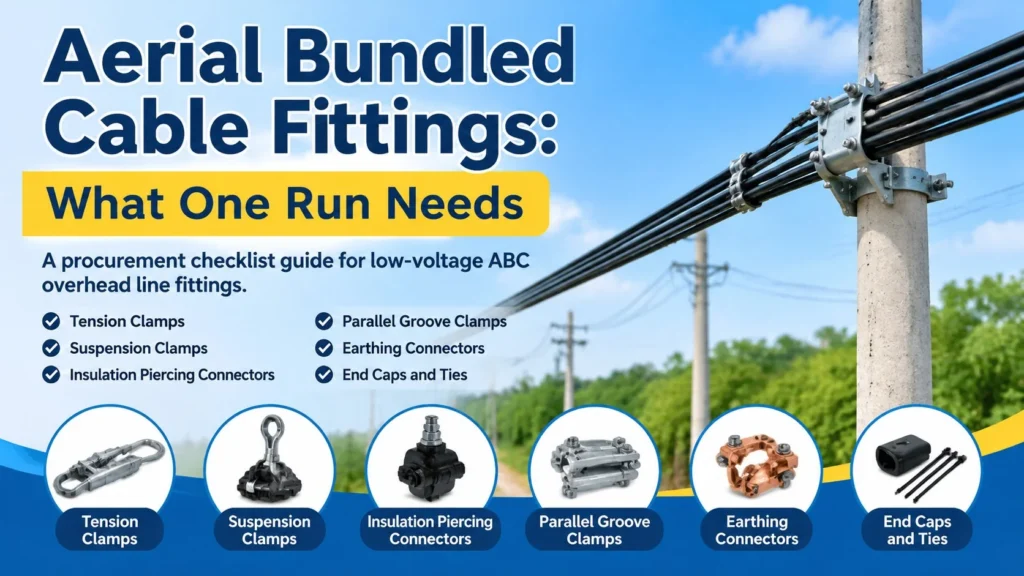
Accesorios para cables agrupados aéreos: lo que se necesita para un tramo
An aerial bundled cable run is not bought as a product. It is bought as a set of positions: every pole where the bundle terminates, every pole where it merely passes through, every service drop that leaves it, every place two lengths meet, and every place the insulation has to be closed again afterwards. Each position has its own fitting family and its own selection logic, and the ordering mistakes that cause the most trouble on site are rarely about one part – they are about a position nobody listed, or a part ordered by model name instead of cable size.
This guide walks a single low-voltage ABC run from the first dead-end pole to the last cap, in the order a stringing crew would meet it, and names what belongs at each stop. It is written for buyers who have a route and a conductor size and need to turn that into a purchase list. If you want the component-level background first, the Guía de componentes de líneas eléctricas aéreas covers where each family sits in the network; this article stays on the shopping decision.
Read the run before you read the catalogue
Before any part number, three facts decide most of the list: the conductor construction and cross-section of the main bundle, measured rather than taken from a nameplate; the number and type of structures, split between dead-ends or angles where the conductor is anchored and intermediates where it is only supported; and the environment, meaning coastal salt, industrial atmosphere, or long exposed spans that see steady vibration.
Those answers set the tension clamp size, the suspension clamp body material, and whether corrosion-resistant finishes or vibration protection belong on the order. They also set the quantities, because the count follows from the pole schedule and not from a rule of thumb. Mixing the two up is the most common reason a shipment arrives short of one item and long on another.
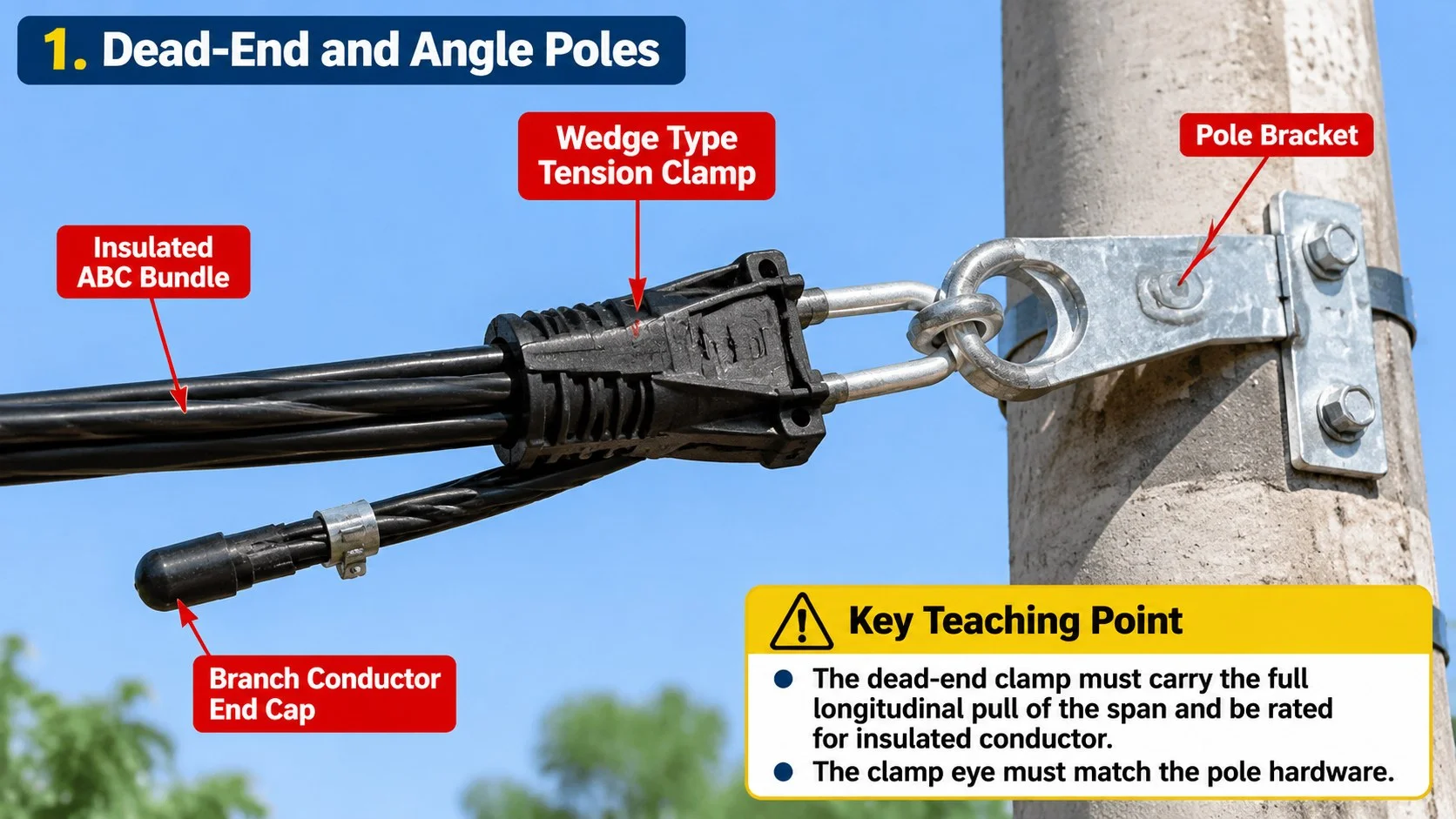
1. Dead-end and angle poles: tension clamps
Every point where the bundle is anchored rather than carried needs a tension clamp, also called a dead-end clamp. This is the only fitting in the run that carries the full longitudinal pull of the span, so it is the one place where getting the size wrong has consequences beyond inconvenience. The clamp has to hold the conductor at the mechanical load the span produces without stripping the insulation or crushing the aluminium underneath it.
Three constructions cover most ABC work, chosen by conductor size and span condition rather than by preference. Wedge types use a self-tightening wedge body that grips harder as load rises; they install quickly and are the usual default on medium spans. Bolted types clamp the conductor between shells with fasteners tightened to the value given for that model, and are generally preferred where loading is higher or the section larger, because grip is set by the installer rather than developed by the load. Plastic tension clamps, a moulded body with an internal wedge or shim, suit the smaller service-drop sections and light spans where a metal body is unnecessary and the insulated surface matters most.
Selection comes down to two numbers and one judgement. The numbers are the conductor cross-section and the span condition from which the mechanical load is derived, both checked against the model’s own specification sheet rather than assumed from a similar-looking part. The judgement is the insulation: ABC is gripped through its insulation in many designs, and a clamp that holds bare conductor of the same diameter will not necessarily hold an insulated one. Confirm the clamp is stated for insulated conductor and that its stated cable range brackets your measured outside diameter. The comparison of tension clamp types sets out where each construction is normally used, and the gama de abrazaderas de tensión lists sizes and ratings by model.
One thing buyers routinely forget here: the dead-end clamp is only half the assembly. The pole needs the matching bracket, hook or band that the clamp eye attaches to, and eye dimensions are not universal. Clamps whose eye does not match the hardware on site turn into a day of returns.
2. Intermediate poles: suspension clamps, brackets and ties
At a straight-line pole the bundle is not anchored; it is carried. The fitting there is a suspension clamp, sometimes called a support clamp, and its job is different from the dead-end: it carries the vertical weight of the span plus wind and ice loading, while still allowing the conductor a small amount of lengthwise movement so tension equalises as the line heats and cools. It is not a tension device, and substituting one for the other is a genuine error rather than a shortcut.
The clamp is selected by measured cable diameter against its stated range, and by body and insert material against the environment. The elastomer insert is what lets the clamp grip without damaging the insulation; on coastal or high-UV routes the insert material and body finish deserve a specific question, since a hardened insert and a corroded bracket are the two conditions that put these fittings back on the replacement list early. Long exposed spans that hum in steady wind are where vibration becomes part of the specification, and that belongs in the order rather than in the first patrol report.
The supporting parts are as easy to miss here as at the dead-end. The clamp needs a bracket, hook or pole band appropriate to the pole type – wood, concrete or steel – and has to sit so its pivot can actually move. Where the design calls for it, ties secure the conductor at the support. Sizing and material are covered in the gama de abrazaderas de suspensión; the selection logic by diameter and construction is set out in Cómo elegir una abrazadera de suspensión, and the on-pole sequence, including the checks that catch a badly seated clamp, is in the Guía de instalación de la abrazadera de suspensión.
3. Service and branch connections: insulation piercing connectors
Every point where a branch or service conductor leaves the main bundle needs a connector that makes electrical contact without the crew stripping insulation first. That is what an insulation piercing connector does: teeth penetrate the insulation of both the main and the branch conductor under controlled compression, and the body seals around the contact once it is closed. On ABC this is the standard branch method, and it is usually the highest-count item on the whole list.
The selection variables are the two cross-sections, not one. An IPC is specified by a main-side range and a branch-side range, and the two are rarely the same. Ordering by the branch size alone is the classic error: the connector arrives, the branch conductor fits, and the main side either will not close over the bundle or closes without gripping it. Read both ranges off the model’s specification sheet and check your actual measured sizes against both.
The second variable is the blade arrangement. Single-blade connectors pierce one contact set and suit simpler service take-offs; double-blade designs separate the main and branch contact paths and are the usual choice where the two sides differ substantially in section, or where the joint will carry more than a light service load. Both types are normally supplied with a shear-head or torque-limiting fastener so that the installer reaches the designed compression without a torque wrench, and the value is fixed by the model – it comes with the drawing, not from a generic table.
Water ingress is what ends the service life of these joints, so sealing belongs on the order: the connector specified with its sealing arrangement intact – gel, grease-filled body or skirts depending on design – and an end cap on any cut conductor. Connectors for ABC service are covered in the gama de conectores con perforación de aislamiento; the construction and sealing features specific to ABC work are described in the IPC for ABC cable overview; the step sequence and the checks that catch an under-compressed joint are in the Guía de instalación del IPC; and the underlying mechanism is explained in qué es un conector de perforación de aislamiento.

4. Joining two lengths: parallel groove clamps and compression sleeves
Where a run changes drum, where a repair replaces a damaged section, or where two ends have to be made continuous, the joint is mechanical rather than piercing. A parallel groove clamp holds two conductors side by side in grooved bodies under bolted compression. It is selected by the two diameters it has to accommodate – and, as with the IPC, both sides matter – plus the bolt configuration and the body material against the atmosphere.
Compression sleeves are the alternative where the design calls for a permanent, compact joint: the sleeve is crimped onto the butted ends with a die matched to sleeve and conductor size. The ordering distinction is that a crimped joint is tooling-dependent – if the crew does not hold the correct die and press, the sleeve is unusable on site however suitable it is on paper. Confirm what crimping equipment exists before choosing between the two families.
Both families are listed with size ranges in the Gama de abrazaderas de ranura paralela, and the construction differences are set out in parallel groove clamp types. Either kind leaves the question of insulation: the bare metal of the joint is no longer covered by the cable’s own insulation, so the cover or sleeve over it belongs on the same order.
5. Earthing and surge protection
Earthing is a separate shopping line, and it is frequently left to the end and then discovered. Where a metallic part is bonded to earth, or where the neutral or a metallic screen is earthed at a pole, an earthing piercing connector makes the contact without stripping the conductor, in the same way a standard IPC does but sized and rated for the earthing path. These are not interchangeable with branch IPCs; they are specified as earthing types and should be ordered as such.
Surge arresters, where the design includes them, add the arrester itself plus the leads that connect it to line and earth. The lead is where termination hardware comes in – the conductor end needs a lug appropriate to the conductor material and section and to the terminal it lands on, covered by Tipos de terminales para cables. The earth down-lead, the rod connection and any mechanical protection at the pole base also sit in this section, and none of them appear on a fitting-only list drawn from a clamp catalogue.
6. The parts that get left off the list
Almost every shortage reported after a first ABC order is one of the following, and none of them are major items.
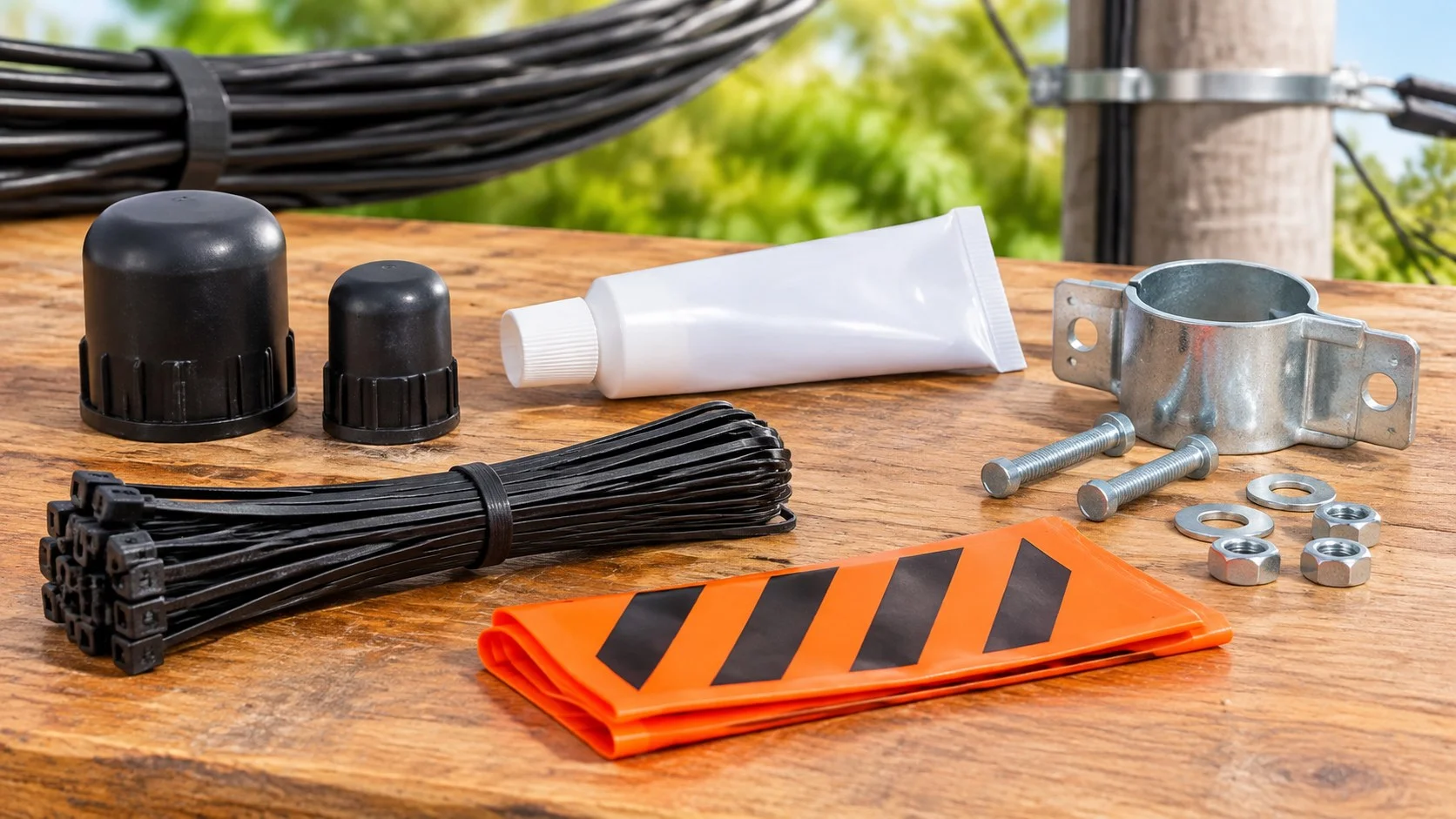
End caps. Every cut end of insulated conductor, and every stub left for a future connection, needs one. They are specific to conductor size and are the item most often ordered as “a few” and then needed in the hundreds.
Sealing compound or gel. Where a joint or termination is not self-sealing by design, the compound is a separate line. Confirm which joints need it and how it is supplied.
Ties and bindings. Where the design secures the conductor with a tie rather than a clamp body, the tie must suit that diameter and material. Improvised ties are a recurring inspection finding.
Warning sleeves and marker covers. Specified where the line needs to be visible or a joint needs to be identified later. This is a route-design question, so it only appears if someone asks.
Pole hardware. Brackets, hooks, bands, bolts and washers for the pole type on the route. The fitting never arrives alone, and the pole schedule sets the count.
Spare allowance. Joints get re-made, caps get dropped, a damaged clamp gets replaced. An allowance on high-count consumables – IPCs, caps, ties – costs little against a second shipment. The figure depends on run length and crew experience, so state it in the enquiry rather than assuming it is included.
Position-to-fitting selection table
| Position on the run | Fitting used | Key selection parameters | Most common buying mistake |
|---|---|---|---|
| Dead-end or angle pole | Tension (dead-end) clamp – wedge, bolted or plastic body | Conductor cross-section, span loading, rated for insulated conductor, eye size against pole hardware | Ordering by conductor size alone and receiving a clamp rated for bare conductor, or with an eye that does not fit the bracket |
| Intermediate support | Suspension or support clamp with bracket, hook or band | Measured outside diameter against the clamp range, body and insert material against the atmosphere, vibration exposure | Using a suspension clamp where the position anchors the conductor, or ignoring insert material on a coastal route |
| Branch or service take-off | Insulation piercing connector (IPC) | Main-side and branch-side cross-section ranges, single or double blade, sealing arrangement, end cap for the branch end | Specifying the connector by branch size only, so the main side does not close or does not grip the bundle |
| Drum change or repair joint | Parallel groove clamp or compression sleeve | Both conductor diameters, body material, bolt configuration; for sleeves, the die and press the crew holds | Ordering compression sleeves without confirming the crimping die and tool exist on site |
| Earthing point | Earthing piercing connector, earth lead, cable lug | Conductor section, earthing rating of the connector, lug bore and material against the terminal | Substituting a standard branch IPC for an earthing type, or omitting the lug and lead entirely |
| Surge arrester position | Arrester plus line and earth leads | System voltage and arrester rating as stated on the project drawings, lead section, termination hardware | Buying the arrester and discovering the leads and lugs were never on the list |
| Every cut end | End cap, sealing compound where required | Conductor size, cap type for that insulation, whether the design calls for sealing compound | Ordering caps in token quantities on a run that needs hundreds |
Mistakes that repeat across orders, and what each one costs
The table below collects the failures that show up in completed orders rather than in specifications. All of them are visible on paper before anything ships.
| Error | Consecuencia | How to avoid it |
|---|---|---|
| Selecting a clamp from a model name rather than a measured diameter | Clamp will not close correctly on the cable; the position is unusable until replacements land | Put the measured outside diameter and cross-section on the enquiry and check it against the stated cable range |
| Using a tension clamp rated for bare conductor on insulated ABC | Grip is developed on the insulation rather than the conductor, and the joint slips under load | State that the conductor is insulated ABC when asking for the model, and confirm the rating applies to insulated conductor |
| Specifying an IPC by branch size only | Branch fits, main side does not close or does not grip; joints have to be re-made across the route | Give both cross-sections; check the main-side and branch-side ranges separately on the specification sheet |
| Ignoring the pole hardware when counting fittings | Brackets, bands and bolts do not match the pole type or the clamp eye, and installation stops | Work from the pole schedule: pole material, bracket type, and eye dimension for each position |
| Ordering a compression joint without the tooling | Sleeves cannot be installed; the joint is either redone mechanically or waits for a tool | Confirm the die set and press held by the installation crew before choosing sleeve over mechanical clamp |
| No allowance for consumables | Caps, ties and spare connectors run out partway through the route, and a second shipment is raised for a low-value item | Add an explicit spare percentage on high-count consumables at enquiry stage and state it in the order |
| Leaving earthing and surge items off the fitting list | The line is strung and energised before the earthing hardware is on site | Give earthing its own section: connector, lead, lug and down-lead hardware named separately |
| Assuming one atmosphere category across the route | Standard finish corrodes early on the coastal or industrial section | Split the list by route section where the exposure changes, and specify body material and finish per section |
What to put in the enquiry
A specification that can be quoted accurately is short: conductor construction, cross-section and measured outside diameter; how many dead-end or angle positions and how many intermediates, with pole material; the number of take-offs with main and branch cross-sections; coastal, industrial or inland exposure and whether any spans are long and exposed; and the crimping equipment available. Any value – a rating, a range, a torque figure – comes back against the model’s specification sheet and the project drawings, not from a generic table.
With those points the list can be built by position and the counts follow from the pole schedule. What remains is the consumables and the spare allowance, the two lines that decide whether the order completes the route or stops two-thirds along it.
Preguntas frecuentes
Can a standard tension clamp be used on insulated ABC conductor?
Not by default. A clamp designed for bare conductor develops grip differently from one made to hold through insulation, and the stated cable range means something different in each case. Ask for a model whose specification states insulated conductor, and check your measured diameter against its range; the gama de abrazaderas de tensión is organised by that distinction.
What if the branch conductor and the main bundle are different sizes?
That is the normal case, and it is exactly why an IPC has two ranges. Give both cross-sections when enquiring and check them against the main-side and branch-side ranges on the model’s specification sheet. Where the two differ substantially, a double-blade arrangement is the usual choice because it keeps the two contact paths independent.
Do I need spare fittings, and how many?
Yes, on the high-count consumables at least – connectors, end caps and ties. The figure depends on run length and expected re-work; there is no universal percentage. State it in the enquiry so it is quoted rather than assumed, since a second shipment for a low-value item costs more than the allowance does.
Should every intermediate pole use a suspension clamp?
Yes where the conductor is only being supported and no anchoring is required. Where a pole terminates the conductor, or where the line changes direction enough to put longitudinal load into the fitting, the position is a dead-end and takes a tension clamp. The distinction is structural and comes from the pole schedule, not from the parts available.
Can the same clamp family cover the whole route if the atmosphere changes?
Sometimes, but the body material and finish may need to change between sections. A route that starts inland and finishes on the coast is better ordered as two sections with the finish specified for each, rather than as one list at the lower specification.
Where to start
Work the positions, not the catalogue: anchor points, supports, take-offs, joints, earthing, then the small parts – and count each line from the pole schedule. The fittings are straightforward once the position is named; what goes wrong in practice is a position that was never listed, or a size taken from a nameplate instead of a measurement.
If you have a route and a conductor size and want the list built by position, send the cross-sections, the pole count by type, the branch count and the atmosphere. For individual families, the gama de abrazaderas de tensión, the gama de abrazaderas de suspensión y el gama de conectores con perforación de aislamiento are the places to confirm sizes and ratings against your own drawings.