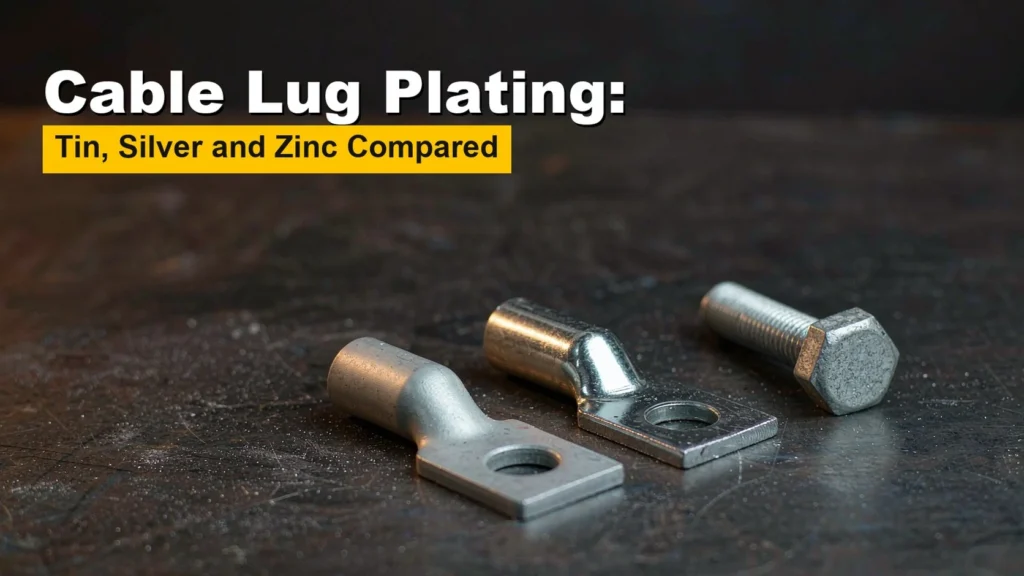
Cable Lug Plating: Tin, Silver and Zinc Compared
A cable lug is ordered by its barrel size and its stud hole, and the finish is the line almost nobody reads. That is where the surprises come from. The plating is the only part of the lug that touches both the conductor and the equipment pad, and it is doing two jobs at once: surviving a compressed joint on one end and a bolted contact on the other.
Tin, silver and zinc are not three grades of the same coating. They solve three different problems, they fail in three different ways, and one of them does not belong on a copper terminal at all. What follows is what each finish is for, which face of the part it protects, and how to write the requirement so two quotations describe the same thing.
The Finish Is a Specification Item, Not a Default
When a purchasing sheet says only “copper cable lug, M12”, the supplier fills in the finish from his own standard. Two suppliers can quote the same lug with two different platings and neither is wrong, because neither was asked. The gap shows up later: at the crimping die, at the torque wrench, or two wet seasons into service on a coastal pole.
The finish changes contact resistance at the bolted face, how the barrel behaves under a compression die, and how the part behaves when the air carries salt or sulphur. A lug with the right barrel and the wrong finish is still the wrong lug. The fields on a supplier sheet are covered in How to Read a Cable Lug Specification Sheet; this article takes one of them — the finish — and works through it.
What Each Plating Is Actually For
Tin: The Working Finish for Crimped Copper
Tin over copper is the default for a crimped lug, and it earns that on three counts: it stops the copper oxidising in storage, it deforms with the barrel under a compression die without cracking away from the copper, and it keeps the joint’s resistance stable instead of climbing as bare copper turns to oxide.
Tin is not a low-resistance finish the way silver is, and on a bolted joint the difference is real. But a crimped joint is not a bolted contact; what matters there is ductility and protection of the copper, not the lowest millivolt drop. That is why tin sits on almost every crimp lug in a distribution network.
Its weaknesses are metallurgical: it can grow whiskers under compression and change phase at low temperature, both handled at the coating level, and both reasons to ask what alloy the tin is, not just whether it is tin.
Silver: Low Resistance, Not a Higher Grade
Silver has the lowest contact resistance of the common platings, and that is the whole of its case. On a bolted joint, where current crosses a pressed interface, silver keeps resistance low and stable under bolt pressure and resists fretting from thermal cycling and vibration. That is why it appears on switchgear contacts, equipment pads, and bolted lugs carrying heavy current through a removable joint.
What silver is not is one grade up from tin. It is softer, costs more, tarnishes, and on a crimped barrel brings no advantage the crimp does not already provide. A silver-plated lug is right when the joint is bolted and contact resistance matters; it is an unnecessary cost when the joint is crimped inside a terminal box.
Silver also needs a barrier under it: silver and copper diffuse into each other over time, and a thin nickel layer between them is the usual way to stop that. Asking whether that underlayer exists separates a controlled process from a decorative one.
Zinc: A Steel Coating That Has No Business on Copper
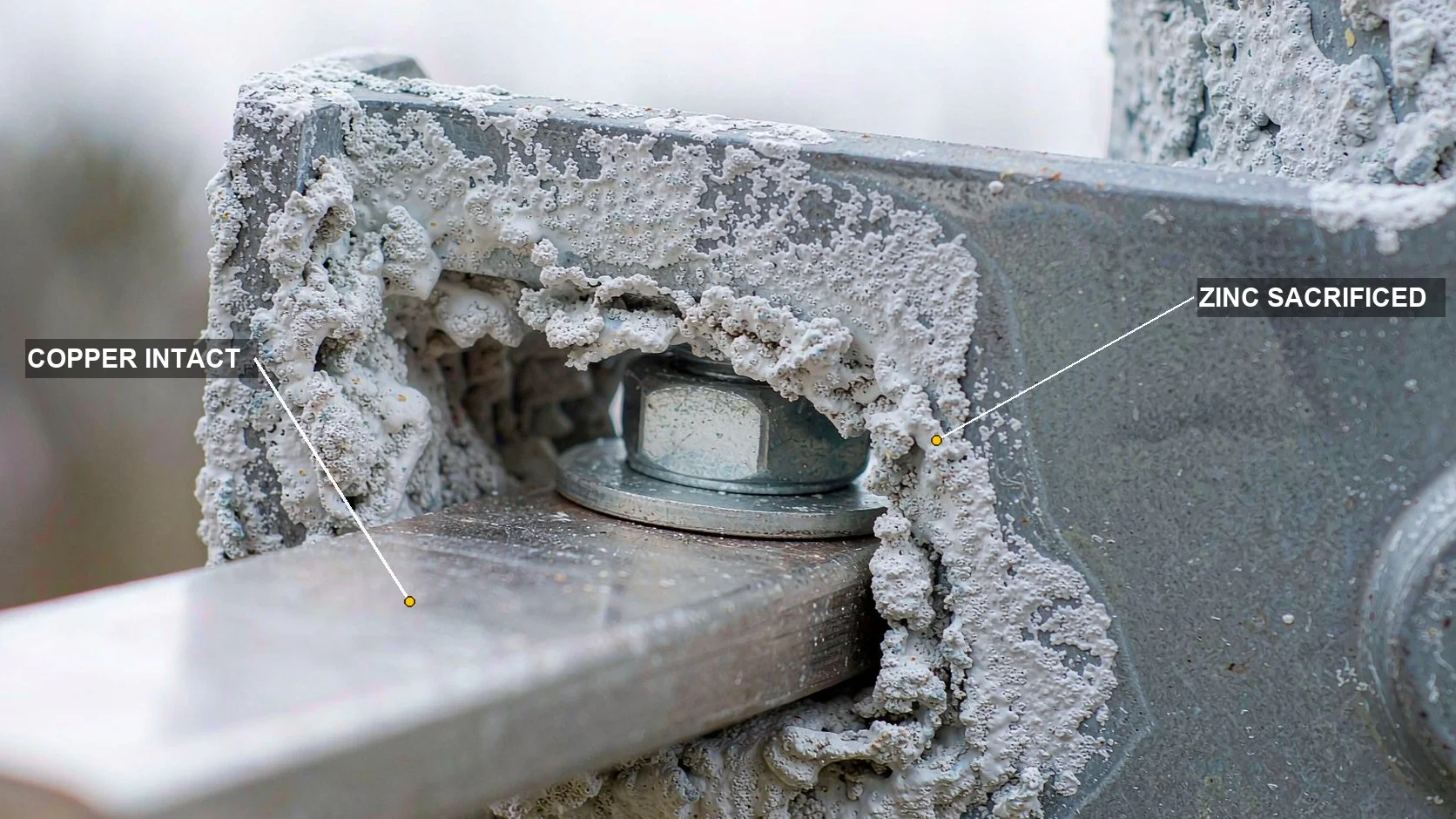
Zinc is a sacrificial coating: it protects steel by corroding in place of it, which is right on a galvanised bracket, a bolt, or a pole step. On a copper terminal it is wrong on three grounds: poor conductivity compared with copper or tin, bulky corrosion products that can push a joint apart, and a galvanic couple in which the zinc is the anode and disappears first, leaving bare copper behind.
So when a finish is described as “zinc plated”, the first question is the base metal. On a steel fastener or bracket, zinc is correct. On a copper lug, it signals a part not made for the duty. Zinc legitimately appears near a termination only on the steel hardware around it, and even there electroplated zinc and hot-dip galvanising are separate decisions.
Plating Compared: Function, Service Condition, Misuse
Read the last column first. Most plating problems on a project are not a coating that was too thin — they are a coating chosen for the wrong face or the wrong metal.
| Завершить | Для чего это нужно | Where it belongs | What goes wrong when misused |
|---|---|---|---|
| Tin over copper | Protects copper from oxidation, stays ductile through the crimp, keeps crimped resistance stable | Crimped lugs and ferrules, conductor entry, distribution work | Higher bolted-face resistance than silver; pure tin can grow whiskers under stress; soft surface marks in handling |
| Silver over copper (usually over a nickel barrier) | Lowest stable contact resistance, resists fretting at a bolted interface | Bolted lugs, switchgear and equipment pads, heavy-current removable joints | Tarnishes black in sulphur-bearing air; soft and easily scratched; wasted cost on a crimped joint that never sees a bolted face |
| Zinc (electroplated or hot-dip) | Sacrificial protection of steel | Steel bolts, washers, brackets, support steel | On copper: poor conductivity, bulky corrosion products, and the zinc is consumed as the anode of a galvanic couple |
Thickness, and Which Face the Plating Protects
Plating thickness is quoted on datasheets, and buyers read a bigger number as a better part. That is only half right: the thickness that matters depends on which face is protected and what is attacking it, and a lug has two very different environments on its two ends.
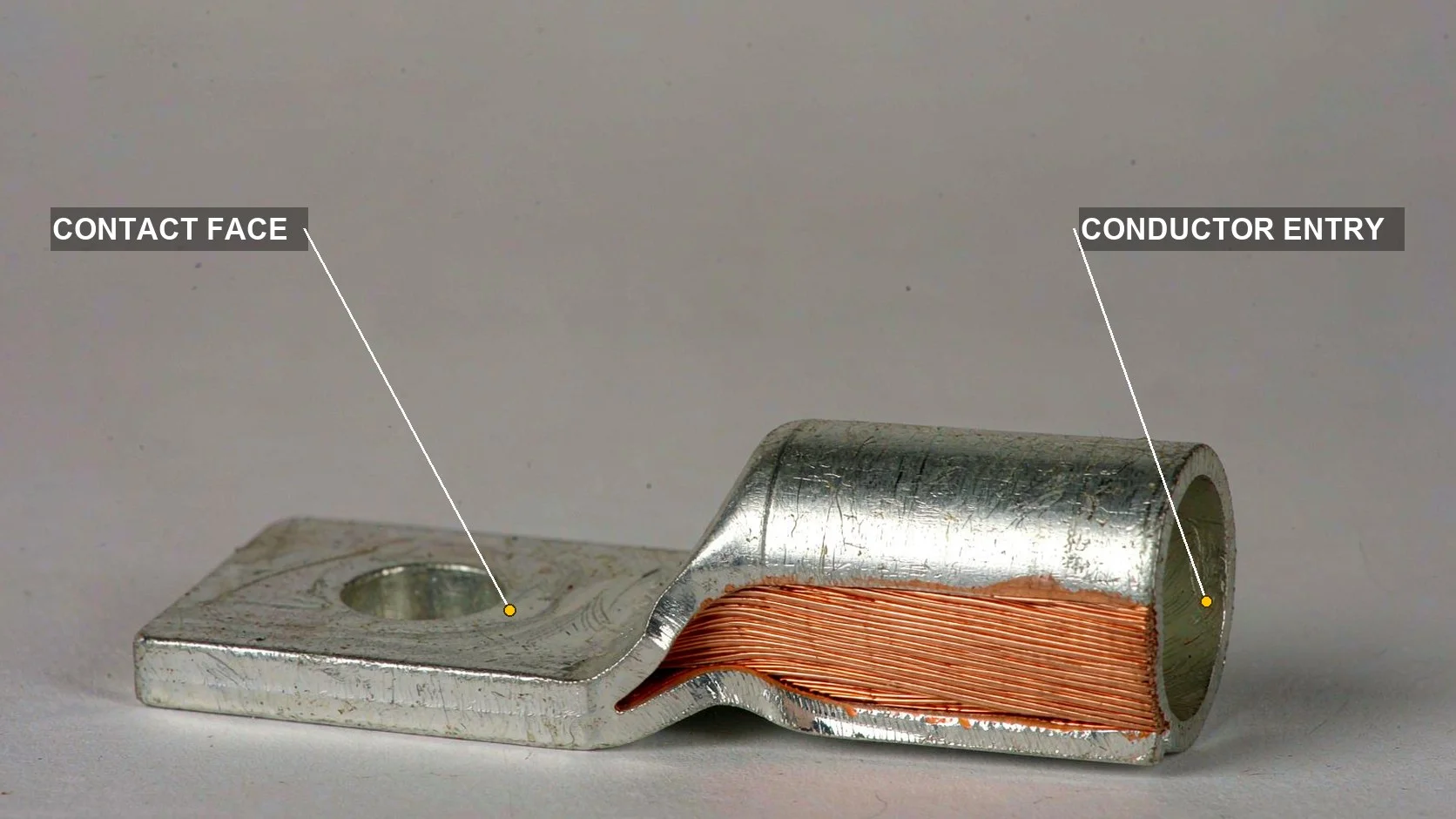
The Bolted Contact Face
The palm is pressed against an equipment pad or busbar and held by a bolt. Once tightened, the joint shields that face from the air, so the enemy is not atmospheric corrosion but fretting, bolt pressure, and the build-up of oxide or sulphide film that raises resistance. Plating here is chosen for electrical stability under pressure, which is why silver appears. Thickness helps only until the coating can survive assembly abrasion and service fretting; past that, more silver buys nothing.
The Barrel and the Conductor Entry
The barrel, and the point where the conductor enters it, are exposed. Moisture, salt and industrial fallout reach this end, and after crimping the plating has to survive both the compression of the die and the galvanic couple with the conductor inside. That is why the barrel’s plating is chosen for ductility and corrosion protection, and why tin appears here. A thick but brittle coating will crack at the crimp and let moisture reach the copper exactly where the joint is most stressed.
The conductor material enters here too: copper and aluminium put different demands on the barrel, and a bimetal lug has to manage the transition. That comparison is in Copper vs Aluminium Cable Lugs, and the bimetal construction in Bimetallic Cable Lugs. The point here is narrower: whatever the barrel is made of, its plating is chosen for the crimp and the conductor, not the bolted face.
Electroplated and Hot-Dip Are Not Interchangeable
Electroplating deposits a thin, uniform layer that can be controlled closely on small parts, which is why it is the normal process for copper terminals. Hot-dip immerses the part in molten zinc and produces a thick layer bonded to steel, which is why it belongs to structural steel and not to copper terminals or fine threads.
Both are called “plating”, but they are not substitutes. A hot-dip finish on a copper lug is not a thicker electroplated one; it is the wrong process on the wrong metal. A specification that asks for a coating thickness also needs to name the process, because the same number means different things depending on how the layer was put down.
Two Failure Modes That Get Misread
Silver That Has Gone Black Is Sulphide, Not Oxide
A silver-plated lug turning black in service is not rusting. The black film is silver sulphide, formed when silver meets hydrogen sulphide and other sulphur compounds in the air, common in industrial areas and near rubber or insulation that off-gasses. It is a reaction with sulphur, not oxygen.
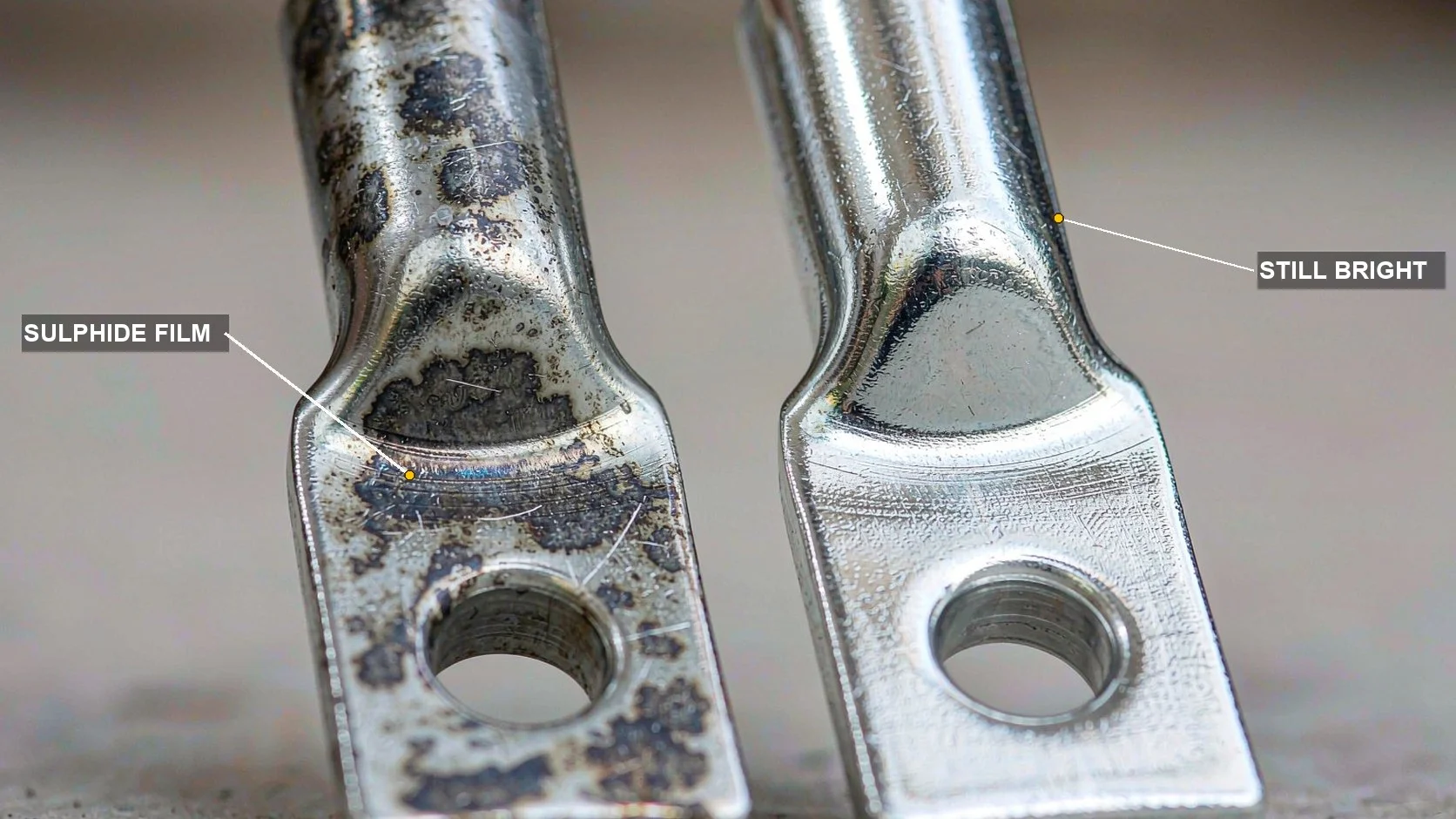
This matters because the two are treated differently. A black surface is not evidence the silver has gone; the metal is still under the film. But silver sulphide is not the barrier copper oxide is, and the film does raise contact resistance at a bolted face if left to build. The practical response is not to polish the silver off — that removes the layer doing the job — but to clean the contact face before reassembly and keep the joint sealed against further sulphur ingress. If silver is specified for a heavy-sulphur site, that is a decision for the specification stage, not a problem to solve by scrubbing at every maintenance visit.
Tin Whiskers and Tin Pest
Tin has two failure modes specific to it. The first is whiskering: a pure tin coating under compression can grow thin filaments that bridge two live parts in a crowded terminal box, and the fault looks like a mystery short rather than a coating problem. The second is tin pest, a slow structural change in pure tin at sustained low temperature that makes the coating crumble.
Both are managed at the coating level. Alloying the tin and controlling the plating process are the usual ways to suppress them, which is why the alloy matters and not just the word “tin”. Where a project runs cold or packs terminations tightly, what the tin is alloyed with belongs in the technical discussion with the supplier; the exact alloy and process are datasheet items and should not be guessed.
Why a Tin-Plated Crimp Lug Is Not a Substitute for a Silver-Plated Bolted Lug
The two finishes get swapped most often when one part is out of stock and the other is on the shelf. The swap looks harmless because both are plated copper lugs, but the joint each was designed for is different, and the substitution fails on the side that was not considered.
A silver-plated lug moved onto a crimped barrel brings a softer, more expensive coating into a compression die. The silver can flow and scratch under the die, and the nickel barrier under it was never meant to be deformed by a crimp. A tin-plated lug moved onto a bolted contact brings a higher-resistance surface into the one place resistance matters most, and its softer surface cold-flows under bolt pressure and needs re-tightening sooner.
There is a third problem when the two are mixed in one joint. A tin-plated lug bolted against a silver-plated busbar puts two metals and two hardnesses in contact at the same interface, and that combination frets and corrodes in ways neither finish would alone. The joint works, but less predictably than a matched pair, and the maintenance interval shortens. Match the finish on both sides of a bolted joint where the design allows.
Selecting a Finish for a Coastal or Industrial Site
The finish decision changes with the air around the installation, and the air on a coastal plain differs from an inland industrial zone. How a site’s environment should be graded, and which components fail first, is covered in Fittings for Coastal and Industrial Areas, which works at the level of the whole fitting; this section stays at the copper terminal’s own coating.
On a coastal site the dominant attack is chloride in salt spray. It attacks tin slowly and, once the coating is breached, reaches the copper underneath. Silver in marine air forms silver chloride, a weaker barrier that can creep across a surface. In practice a coastal site pushes toward a sound, well-bonded tin coating on crimped lugs, with silver only where contact resistance genuinely requires it.
On an industrial site the dominant attack is often sulphur, which turns silver black. Heavy sulphur loading is where the tin-versus-silver choice becomes a genuine trade: silver gives lower contact resistance but tarnishes faster, while tin tolerates sulphur but gives up some resistance at the bolted face. There is no universal answer, and a supplier who gives one without asking about the site has not understood the question. Select against the specific pollutant, and name it in the requirement.
In both environments the same discipline applies: clean the contact faces, remove any film formed in storage, and tighten to the specified value with the specified hardware. A good coating cannot compensate for a dirty joint, and a dirty joint makes a good coating look bad.
Как выбрать подходящую модель
Selection runs in a fixed order. The joint type comes first because it decides which face does the electrical work; the conductor comes next because it sets the galvanic couple; the environment comes last because it decides how much protection that face needs. Any other order produces a lug that is right on one count and wrong on the others.
| Decision step | What to establish | Finish it points to | What to confirm with the supplier |
|---|---|---|---|
| 1. Joint type | Crimped to the conductor, bolted to a pad, or both? | Crimped end: tin. Bolted face under pressure: silver. | Which faces carry which finish on a lug that does both |
| 2. Conductor | Copper or aluminium; single-metal or bimetal transition | Tin is the default over copper; a bimetal lug has its own transition treatment | How the transition is made and what finish each side carries |
| 3. Environment | Coastal chloride, industrial sulphur, indoor, or buried | Tin for chloride-heavy air; a deliberate trade for sulphur-heavy air | Whether the standard finish is adequate or a project-specific one is needed |
| 4. Hardware interface | What the lug is bolted against — busbar, equipment pad, another lug | Match the finish on both sides of the joint where possible | Whether the mating surface is tinned or silvered |
| 5. Verification | What the datasheet says about coating, alloy and process | Whatever the model’s own data states, not a number carried over from another part | Coating process, alloy, and any underlayer; confirm against the drawing |
Where a step cannot be answered from the drawing, leave it open and confirm it rather than filling in an assumed value: a guessed coating requirement is worse than one queried.
What to Write on the Purchase Order and Check on Arrival
Most finish disputes are settled by the wording on the order, not the argument after delivery. Three items do most of the work: the finish, the process, and the face it applies to; a fourth, the alloy where tin is specified, closes the gap that lets a supplier substitute pure tin.
| Item on the order | What good wording looks like | Почему это важно |
|---|---|---|
| Завершить | Name the metal and the base metal, e.g. “tin over copper” rather than “plated” | “Plated” alone lets the supplier choose zinc, tin or silver without being wrong |
| Process | State electroplated or hot-dip; for copper terminals expect electroplated | The same thickness means different things under the two processes |
| Face | State which faces the finish applies to on a lug that is both crimped and bolted | A lug can legitimately carry different finishes on barrel and palm |
| Alloy (tin) | State the tin alloy where whiskers or cold service are a concern | Pure tin and alloyed tin behave differently under stress and at low temperature |
| Verification | Require the coating and alloy to appear on the datasheet for the exact model | Lets arrival inspection compare the part against a stated figure, not an assumption |
On arrival, the checks that catch most finish problems are simple: the colour and sheen of the barrel against the palm, whether the coating is continuous into the conductor entry, and whether the finish matches the order. A lug bright on the palm and dull at the barrel mouth is not necessarily wrong — it may be two finishes by design — but it is a reason to read the datasheet before accepting the shipment. The full arrival check is in Incoming Inspection of Line Hardware.
How the Finish Fits the Rest of the Lug
The material of the lug body — copper, aluminium, or a bimetal of the two — is a separate question from its surface finish; that comparison is in Line Fitting Materials Compared. Installation matters too: crimping practice and die selection decide whether the coating survives, as covered in Cable Lug Crimping, and for a bolted lug the mechanical side is in Mechanical Cable Lugs. A lug can be made of the right metal and still be finished wrongly.
Часто задаваемые вопросы
Is silver plating always better than tin?
No. Silver has the lower contact resistance, which matters at a bolted interface, but it is softer, tarnishes in sulphur-bearing air, and adds cost a crimped joint does not recover. On a crimped lug, tin is usually the better-matched finish. The question is which joint the lug is making, not which finish sounds more premium.
Does blackened silver mean the joint has failed?
Not by itself. The black film is silver sulphide, formed by sulphur in the air, and the silver is still present beneath it. It does raise contact resistance if left to build, so clean the contact face before reassembly and keep the joint sealed. Polishing the silver away removes the layer protecting the copper, so that is not the fix.
Can a zinc-plated lug be used on a copper cable?
Not as a copper terminal finish. Zinc is a sacrificial coating for steel, and on copper it becomes the anode of a galvanic couple and is consumed, while its corrosion products are bulky and poorly conductive. Zinc belongs on the steel hardware around a termination, not on the copper terminal itself.
Why do some lugs have a nickel layer under the silver?
The nickel acts as a barrier between the copper and the silver. Without it, the two metals diffuse into each other over time, which degrades the plating. A silver-plated lug with a nickel underlayer is the more controlled construction, and asking whether it exists tells a process-controlled part from a decorative one.
Getting the Finish Right on the Order
The finish is the cheapest line on a cable lug order and the one most often left to the supplier. Naming it explicitly — metal, process, the face it applies to, and the alloy where tin is used — costs a sentence and removes the ambiguity two quotations hide. A lug with the right barrel and the wrong finish is still the wrong lug, and the cost is paid at the joint, not at the invoice.
If you are specifying lugs and want the finish matched to the joint, the conductor and the site, send the barrel size, the stud or hole size, the conductor material, whether the joint is crimped or bolted, and the environment. The models currently listed are on the cable lugs category page, and any requirement not covered can be confirmed against a drawing before quotation. Where a figure is not on the datasheet, it will be queried rather than assumed.