

Fittings for Coastal and Industrial Areas: What to Specify
Most catalogues quote one finish. A project on a coastal plain and one in an inland industrial zone can buy the same clamp in the same galvanised finish, and one will still be serviceable when the other is being replaced. The difference is not the clamp: one specification named the environment, the other left the finish to the default.
This article covers the environmental side of that decision: how salt, sulphur and standing moisture attack fittings differently, which components fail first, and what has to be written down before two quotations can be compared. The material families themselves are compared in Matériaux des raccords de canalisation : acier galvanisé, aluminium, acier inoxydable, and that comparison is assumed here.
What Changes When the Site Is Coastal or Industrial
On an inland rural line the corrosion question is mostly about time. Zinc weathers slowly, and a fitting reaches the end of its design life roughly when the line does. On a coastal or industrial site the same fitting is being consumed from the day it is installed, and the rate is set by conditions the buyer can measure before ordering: chloride deposition, sulphur dioxide, time of wetness, and how often the surface dries.
Two consequences follow. The finish stops being a default and becomes a line item with a measurable requirement. And the components that fail are not the ones the drawing dimensions: a clamp body with generous section and a large exposed surface can lose zinc for years and still hold, while a split pin of the same coating cannot.
Nor does the atmosphere stop at the last tower. The same air attacks the connections at the end of the run — cosses de câble and their bolted joints at plant equipment — and the same specification logic applies there.
Three Environments, Three Different Attacks
Salt Spray: Chloride Against Zinc
Airborne chloride settles on the surface and, with moisture, forms a conductive film. The zinc is then consumed protecting the steel beneath: that is the mechanism working as designed, and its limit is the mass of zinc available. Chloride also keeps a surface wet at humidities where clean air would let it dry, which extends the time of wetness.
Two details matter when buying. Zinc loss is not uniform — it is fastest at edges, cut ends and thread roots, which on a fastener is everywhere the thread tolerance limited how much zinc could be applied. And chloride migrates into crevices and stays there, so a lap joint that looks sound is wet inside for most of the year.
Industrial Sulphur: Acid That Keeps Renewing Itself
Sulphur dioxide from combustion and from some process plant forms sulphurous and sulphuric acid in moisture. On zinc the resulting sulphate film is more soluble than the carbonate film that forms in clean air, so it washes away and the surface keeps being renewed instead of passivating.
The practical difference from salt is where the attack lands. Deposition is often highest on sheltered and downward-facing surfaces, where rain does not wash the surface clean but condensation still forms. A fitting tucked under a tower arm can be worse off than one fully exposed.
Humid Heat and Wet-Dry Cycling
In tropical service the driver is condensation rather than deposition. Surfaces drop below dew point overnight, water condenses, and by mid-morning it has evaporated. Each cycle concentrates whatever salts were left behind and pushes them deeper into crevices. The visible result is pitting under washers and coatings that blister from the inside out.
This is also where inspection intervals go wrong most often, because the damage is invisible on the surfaces a patrol sees first.
| Environment | Dominant attack | First components to fail | What the specification must state |
|---|---|---|---|
| Coastal, surf zone or exposed ridge | Chloride deposition; zinc consumed by sacrificial action; crevices stay wet | Split pins, spring washers, thread roots, cut ends | Corrosivity category with its basis; coating mass per part; thread treatment after coating |
| Industrial, sulphur-bearing | Acid film that renews rather than passivates; attack on sheltered faces | Downward-facing plate edges, bolt heads under covers, contact faces | Same category requirement plus a statement on sheltered surfaces and contact-face protection |
| Humid tropical, heavy dew | Condensation cycling; salts concentrated in crevices; coating blistering | Under washers, inside joint gaps, bottom of any water-holding shape | Drain-or-seal decision per shape; isolation at dissimilar joints; baseline inspection record |
Where the Class Boundary Actually Falls
Projects generally have a way of grouping sites by corrosivity, and the finish should follow that grouping. The useful discipline is to state which category a site is in and what the basis for that judgement is, rather than to argue about distance from the coast.
Distance alone is a poor proxy. Prevailing wind, terrain roughness, elevation, whether the structure sits in the surf zone and whether the shoreline is rock or mudflat all change deposition at the same distance. A line on a ridge behind a coastal town can receive more chloride than one sheltered behind a headland considerably closer to the water.
Where a project has no classification, the fallback should be measured rather than argued: deposition samples or a corrosion coupon on a representative structure will settle it. Failing that, photographs of an existing line on the same corridor — showing which parts have already been replaced — are more informative than any generic table.
The Parts That Fail First Are Rarely on the Drawing
Walk a coastal line that has been in service for some years and count what has actually been replaced. It is seldom the clamp body. It is fasteners, washers, split pins, clevis pins, hinge pins, the threaded end of a ball eye and the ears of a yoke plate.
Those parts share three properties. They are thin, so the zinc available per unit of surface is small. They are coated as an afterthought, because thread tolerances limit coating thickness and a galvanised nut still has to run onto a galvanised bolt. And they are damaged at installation: a wrench removes coating at the hex corners, and a split pin opened twice has cracked its coating at the bend.

So these parts need their own line items. “Fasteners galvanised” states almost nothing. The requirement has to name the coating for bolt, nut and washer separately, and say whether the nut is tapped after coating. On a coastal project it is often cheaper to specify stainless at the clamp and isolate the interface than to replace galvanised fasteners twice in the life of the line — but read the next section first, because the couple at that interface is the reason the fasteners were failing.
A second group is easier to forget: anything cut, drilled or welded after coating. Site-drilled holes, cut-to-length threaded rod, field-welded brackets and sheared plate edges expose bare steel, and they are where rust appears first. The specification should say who repairs them, with what, and at which stage.
Galvanic Couples and the Area-Ratio Trap
When two metals in contact are wetted, the less noble one corrodes. The rate depends less on which pair it is than on the ratio of their wetted areas. A small anode facing a large cathode corrodes fast and locally, because all the current is concentrated on a small area. A large anode facing a small cathode loses metal slowly, spread over a big surface.
That rule explains most of the surprises. A small aluminium bracket bolted to a large galvanised steel member is the bad case: the aluminium is the anode and it is small. A large aluminium clamp body with a small stainless bolt is better in ratio terms, but the aluminium still pits in a ring around the fastener head — under the washer, where nobody looks.
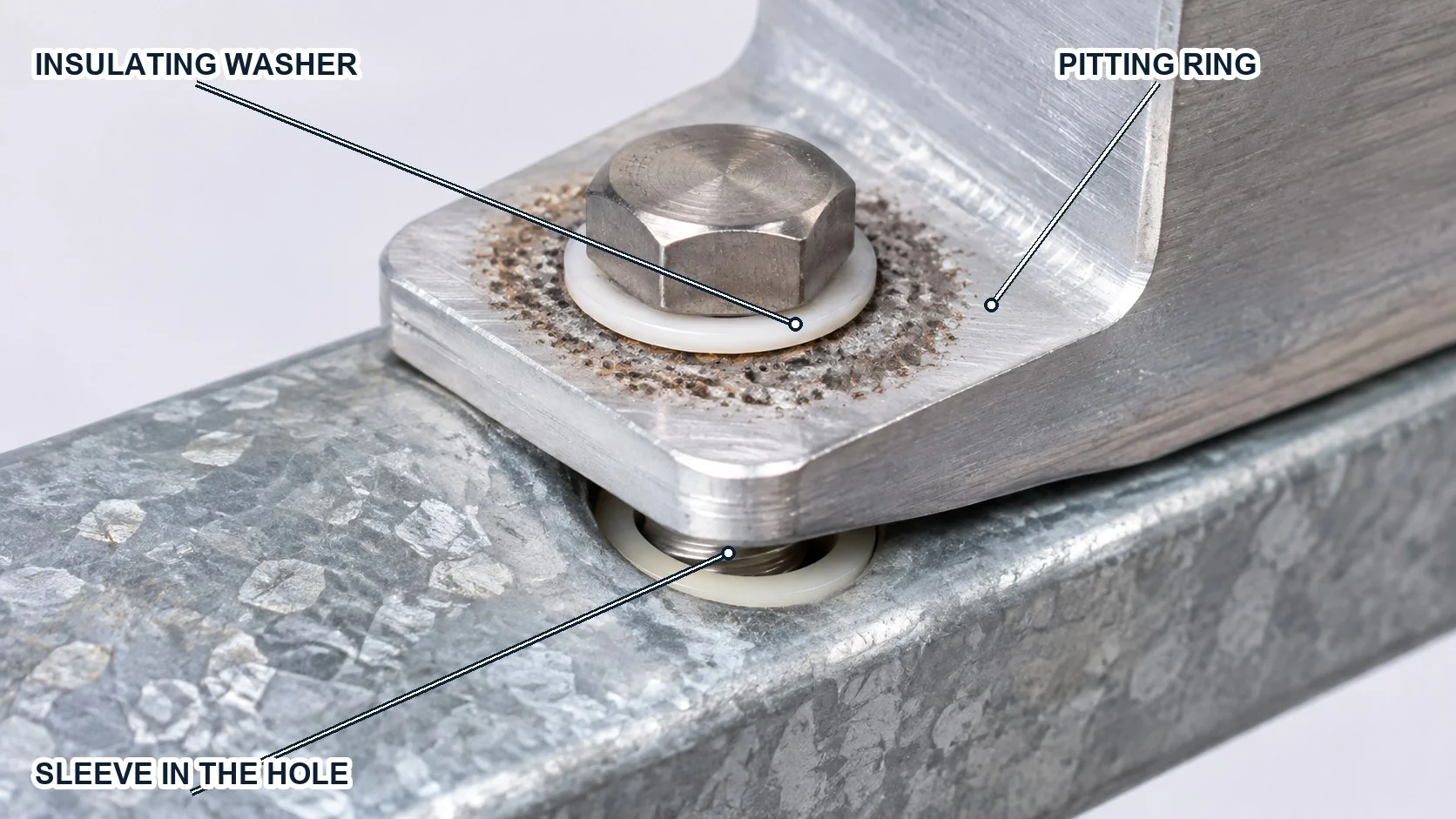
The usual fixes are to break the metallic path or change the ratio: an insulating washer and sleeve, a coated interface, or a fastener in a metal closer to the part it bears on. Isolation only works if it survives installation. A nylon washer squeezed under a torque wrench is not isolation, and a painted faying surface scratched during fit-up is not either.
Corroding joints also do something mechanical. Corrosion product occupies more volume than the metal it came from, so a joint corroding inside a crevice pushes itself apart. That is why a corroded connection can be loose and seized at once, and why torque checks after corrosion is found mislead.
Geometry: Water Traps, Crevices and Drainage
Before the finish is discussed, the shape has to be right, because no coating survives a part that holds water. The familiar case on overhead line hardware is the conductor seat of a pince de suspension: a cup facing the sky, with water standing in it against the conductor and the keeper.
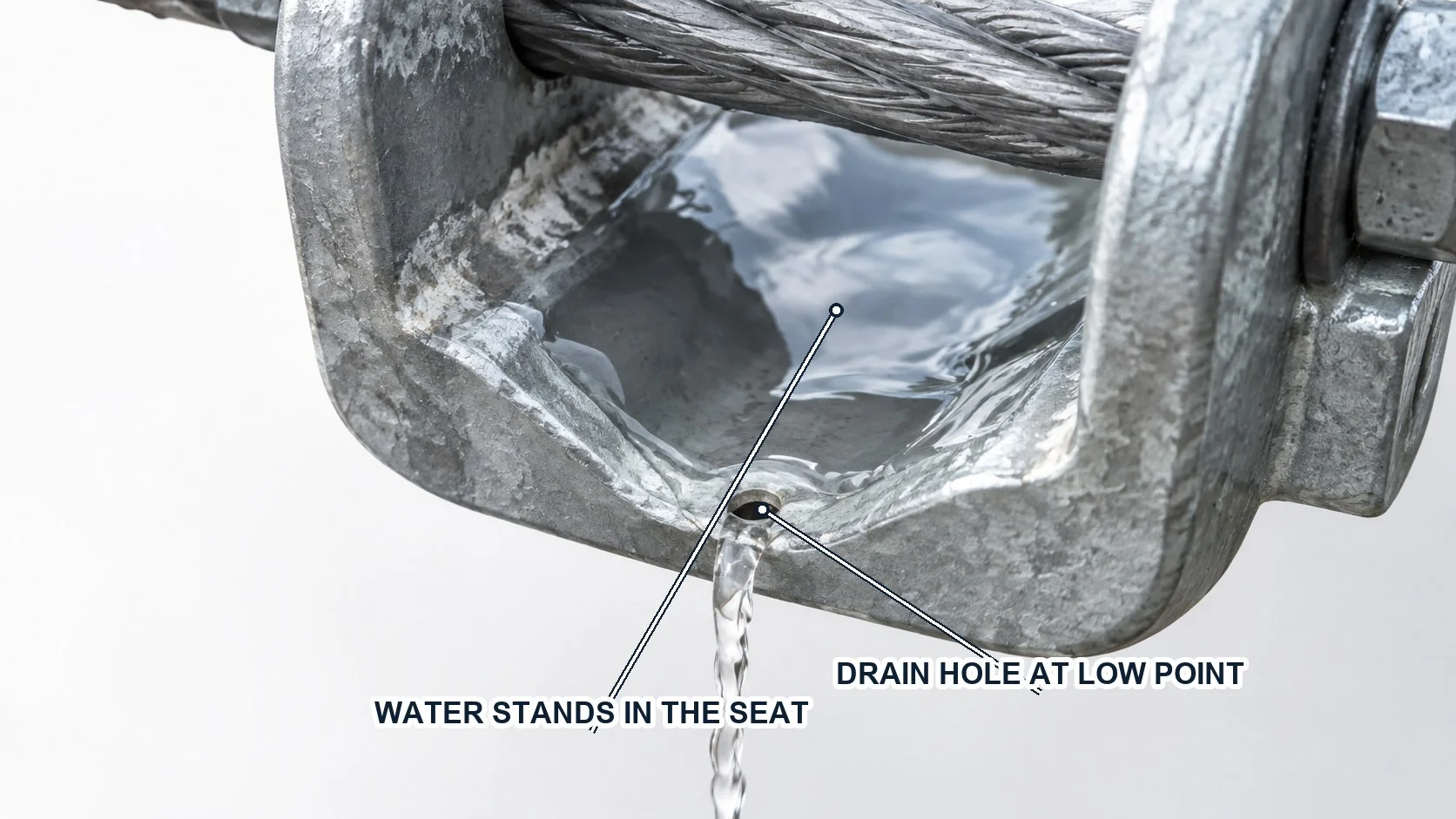
Three habits help. Drill a drain hole at the lowest point of any closed or partly closed shape, at the drawing stage rather than on site. Avoid upward-facing cups, or give them a drain path. And avoid horizontal runs of tube or channel with closed ends, which are reservoirs with a lid.
Sealing is all or nothing. A crevice that is genuinely sealed holds no water and does not corrode. A crevice with a pinhole in the seal is a reservoir that never dries, which is worse than an open crevice that dries after rain. Half-sealed joints — sealant around three sides of a bracket foot, a gasket that stops short of the edge — are the most common form of this error and the hardest to see in a photograph.
Where a joint cannot be sealed, the alternative is to make it drain and keep the contact faces accessible. Both decisions belong on the drawing; discovering at the first inspection that a joint has held water for years leaves only replacement.
Coating: What to Require and How to Verify It
The requirement should be written per part, not per order. A tension clamp body, its bolt, its nut, its washer and its cotter pin are four different coating problems and may need two or three different answers.
For hot-dip galvanising, three things decide service life: coating mass on the finished part, the condition of threads after coating, and the treatment of cut ends and weld areas. Coating mass should be a value drawn from the project’s corrosivity category or the applicable coating standard, not the words “hot-dip galvanised”. Threads should be checked with a go/no-go gauge, and the specification should say whether nuts are tapped or centrifuged afterwards — an over-thick coating on a thread is a fit problem, and chasing it on site destroys the coating.
Verification at goods-in is straightforward with a thickness gauge and a visual standard. What is worth insisting on is sampling by part type rather than by carton: the parts most likely to be under-coated are the smallest, and a carton-level sample is dominated by the large parts that pass. The wider routine is in contrôle à la réception du matériel de ligne.
Repair of damaged coating needs a named method and a named party — zinc-rich compound on a scratch, or re-galvanising, and whether that happens before packing or on site. Without that sentence, the default is that the scratch ships.
| Field on the drawing or enquiry | What to state | What goes wrong if it is omitted |
|---|---|---|
| Site corrosivity category | Category plus its basis — project table, measured deposition, or records from the same corridor | Supplier quotes the default finish; offers cannot be compared; the cheapest offer has the thinnest coating |
| Coating, per part | Separate requirement for body, bolt, nut, washer and pin | Fasteners under-coated; first failures appear within the early years of service |
| Thread treatment after coating | Tapped or centrifuged; go/no-go check | Nuts will not run, or are chased on site and the coating is destroyed |
| Dissimilar joints | Isolation washer and sleeve, coated interface, or bare contact with a stated reason | Small-anode corrosion in a ring under the washer, invisible at patrol distance |
| Drain or seal, per shape | Drain hole location and size on the drawing, or an explicit “drain, do not seal” | Water trap; crevice corrosion; the joint fails from the inside |
| Coating repair | Method, and whether the works or the site is responsible | Scratches, site-drilled holes and cut ends ship bare |
| Marking | Model and coating batch legible after years of exposure | The correct spare cannot be identified, so the wrong one is fitted |
| Emballage | Dry packing; dissimilar metals kept apart in the crate | White rust in transit, before the parts are even installed |
Service Life, Spares and Replacement
Service life in a corrosive environment is set by the thinnest coated part in the assembly, not by the body. That makes the replacement list short: fasteners, washers, pins and any spring component. Treating them as consumables with a stock level, rather than hardware to be ordered when one fails, is the difference between a maintenance task and an outage.
It also means parts must be identifiable years later. A body with a cast-in model number and a coating batch mark can be matched to the correct spare from a photograph; an unmarked body cannot, and marking is cheap at the works and close to impossible afterwards.
Third, replace by inspection interval rather than by failure. A pin that has lost its zinc is a scheduled replacement; a pin that has disappeared is a conductor drop waiting for the right wind. The same applies to guy termination hardware, where the parts are small, highly stressed and hard to see from the ground.
Inspection in a Corrosive Environment
Corrosion inspection is mostly a question of looking in the right places. Surfaces that face the weather are self-cleaning and usually the last to fail. What matters is the sheltered side, under washers, inside joint gaps, at cut ends, and at the bottom of any shape that holds water.
Read the corrosion product before deciding. White or grey powder on galvanised steel is zinc doing its job. Red rust at an edge or a thread means the zinc is gone locally, and the question becomes how much section remains. On aluminium, white deposit with pitting is attack; a ring of it around a fastener is the area-ratio case.
Two practical points. Establish a baseline in the first year with dated photographs of the same joints, so later visits compare like with like. And check fasteners whenever corrosion is found, because rust jacking in a joint loosens what the torque wrench set. The patrol routine is covered in inspection des accessoires des lignes aériennes, and the checks that overlap with mechanical failure in suspension clamp failure causes.
| Stage | What appears | What it means and what to do |
|---|---|---|
| First-year baseline | Uniform dull grey; isolated white spots at cut ends | Normal early weathering; record it as the reference, do not treat it |
| Early service | Red rust at hex corners and thread ends; white powder in crevices | Installation damage and thin coating on fasteners; schedule replacement, do not re-torque alone |
| Mid life | Rust streaks below a joint; loose fasteners; seized nuts | Rust jacking plus section loss; replace the fastener set, inspect the faying faces |
| Any stage | Pitting ring on aluminium around a steel fastener | Area-ratio corrosion; correct the interface, not just the bolt |
| Any stage | Coating blistering or lifting on a painted part | Attack from underneath; probe the edge, assess remaining section |
Protective hardware belongs in the same routine. Corona rings and arcing horns corrode faster than their neighbours when they are discharging, because the acid by-products concentrate where the field is highest — so a corroded ring is a symptom as much as a maintenance item.
What to Put in the Enquiry
An enquiry that names the site, the corrosivity category and the coating requirement per part can be quoted properly. One that says “galvanised, for export” cannot, and the price gap between offers will be a gap in coating, not in price.
The checklist is short: environment and category with its basis; coating per part; thread treatment; isolation at dissimilar joints; drain or seal decision per shape; coating repair responsibility; marking; packing. Each is one sentence on a drawing and removes a decision from supplier and site.
There is a commercial argument for doing this early. Coating is a small fraction of the price of an order and a large fraction of the maintenance cost of a line that has to be revisited. The wider question is covered in Comment préciser les accessoires pour lignes aériennes dans un appel d'offres. The environmental section is the one most often left blank, and on a coastal or industrial project it is the one that decides the specification.
Foire aux questions
Is hot-dip galvanising enough for a coastal site?
It depends on the category and on the part, not on the label. Galvanising protects by consuming zinc, so the real questions are how much zinc is on the finished surface and how much the site will take per year. On a severe category the body may be sound while fasteners and thin components are not — a coating-per-part decision, not a galvanising-or-not decision.
Should I use stainless fasteners throughout a coastal assembly?
Not by default. Stainless removes the coating-thickness problem and the wrench damage, but brings its own issues: galling during assembly, chloride stress corrosion cracking in some grades at elevated temperature, and a stronger couple against aluminium and galvanised steel. Where it is used, isolate the interface and choose the grade for the environment rather than the cheapest one listed.
Why do the bolts rust when the clamp body is still sound?
Because the coating on a thread is limited by the thread tolerance, and because hex corners are exactly where a wrench removes what coating there is. The body has thick coating over a large area and sits in the open where rain washes it. The fastener has thin coating, is damaged at installation, and sits in a crevice under a washer that stays wet.
Can corrosion protection be improved after the line is built?
Only marginally. Touching up damaged coating is worthwhile and should be specified. Coating over a joint that is already corroding is not, because it traps moisture and hides section loss. The decisions that determine service life — coating per part, isolation, drain holes, marking — are made on the drawing and cannot be retrofitted economically.
How soon should a coastal line be inspected for corrosion?
Earlier than a generic patrol interval, and for a different reason: the first visit establishes the baseline. Inspecting a coastal line on the same schedule as an inland one means the first useful comparison arrives years later, by which time the parts most worth tracking may already have been replaced. Set the interval from the project’s procedure, then use the first visit to record rather than to judge.
Corrosion is not a property of a fitting. It is the result of a fitting, an atmosphere and a detail — and of those three, the detail is the only one a buyer controls. Naming the environment, coating each part rather than each order, isolating dissimilar joints and putting a drain hole where water would otherwise stand costs almost nothing at quotation stage. Done the other way round, it is paid for on a structure, in weather, with a crew.