



Copper vs Aluminum Cable Lugs: Which One Should You Choose?
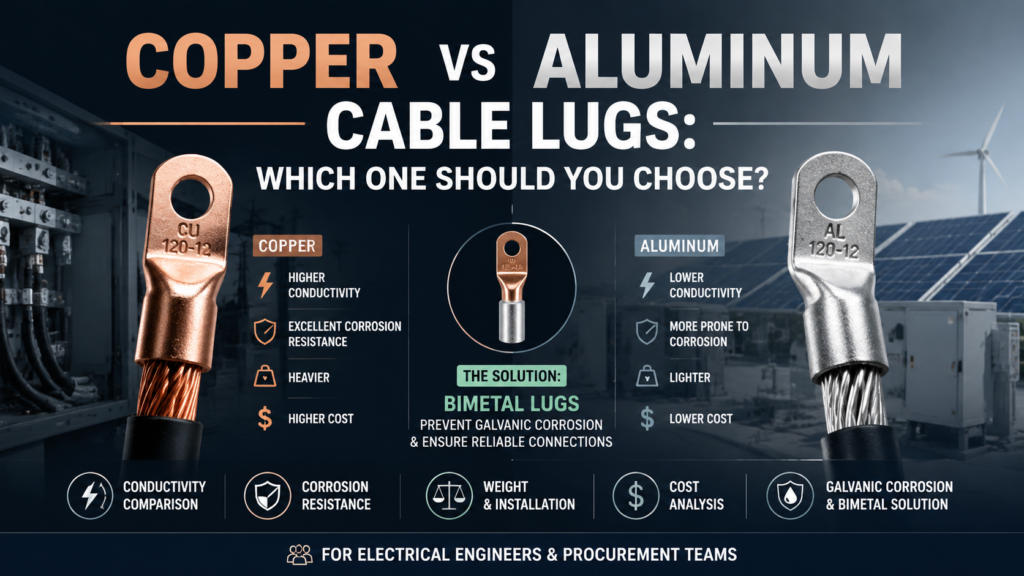
Copper and aluminum are the two standard materials for cable lugs, and the choice between them shapes the cost, weight, and long-term reliability of every electrical connection. The short answer: copper lugs win on conductivity, corrosion resistance, and mechanical strength, while aluminum lugs win on price and weight. Choose copper for critical, high-current, or harsh-environment connections; choose aluminum for large utility and budget-driven projects; and when the conductor and terminal are different metals, use a bimetal lug instead of mixing them directly.
This guide compares copper and aluminum cable lugs across the factors that matter on real projects, explains the galvanic corrosion problem you must avoid, and gives a practical decision path for procurement teams and engineers.
The Quick Answer
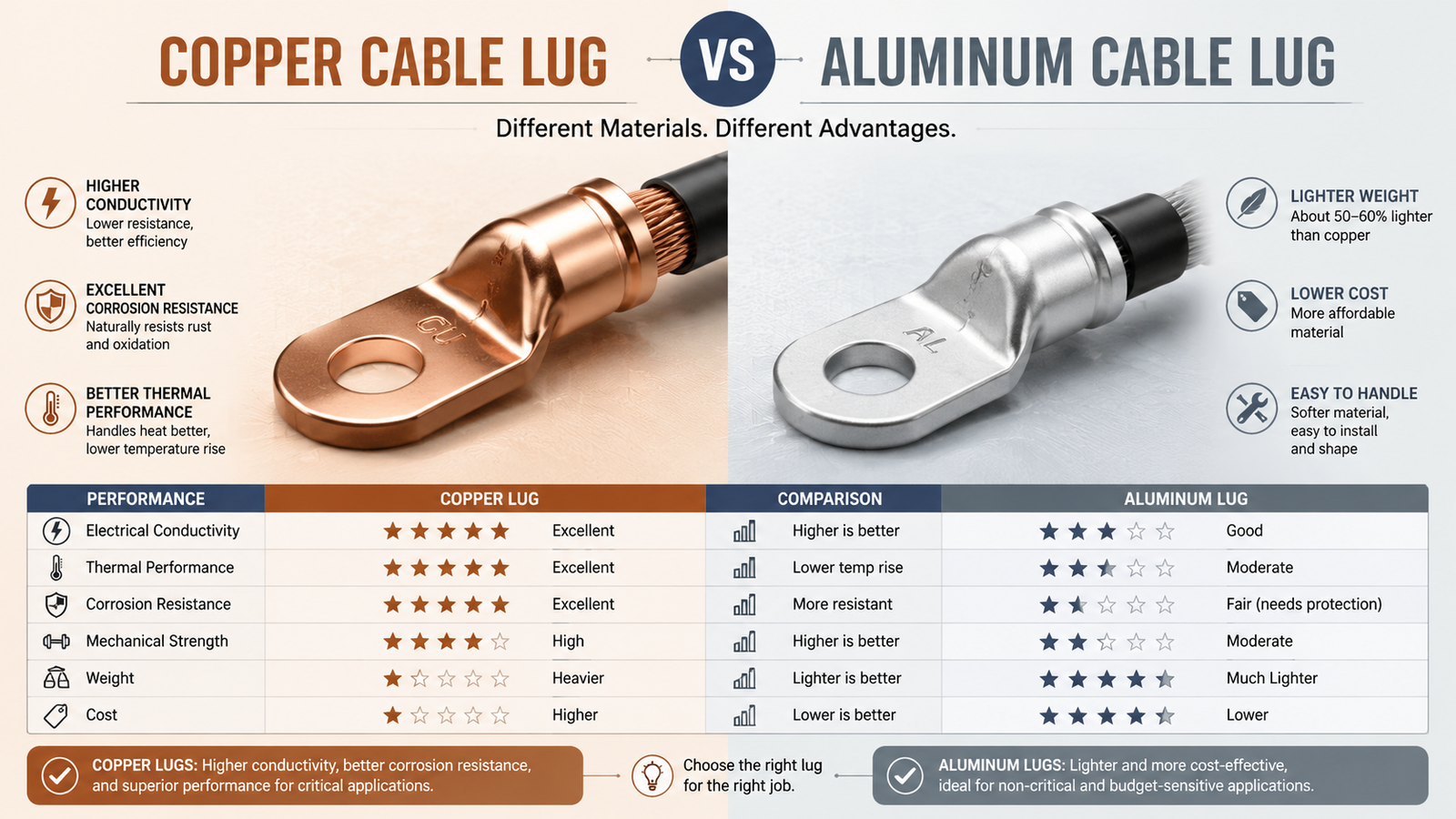
| Criterion | Copper Lug | Aluminum Lug |
|---|---|---|
| Electrical conductivity | ~100% IACS | ~61% IACS |
| Corrosion resistance | High; protective oxide layer | Moderate; oxide raises contact resistance if unmanaged |
| Mechanical strength | High, resists vibration and deformation | Lower, needs careful torque and crimp control |
| Weight | Heavy | About one-third of copper |
| Relative cost | Higher | Lower |
| Best for | Critical, high-current, harsh environments | Utility networks, long runs, cost-sensitive projects |
What Are Copper Cable Lugs?
Copper cable lugs are made from high-conductivity electrolytic copper, usually 99.9% pure and often tin-plated to improve corrosion resistance. They deliver roughly twice the conductivity of aluminum, so a copper lug of the same physical size carries more current with less voltage drop and less heat. For a broader introduction to lug materials and shapes, see our guide to what cable lugs are.
Copper also handles mechanical stress better. It has higher tensile strength, stays dimensionally stable under vibration and thermal cycling, and is more forgiving during crimping. That is why copper lugs are the default specification in switchgear, control panels, solar and battery systems, data centers, and industrial machinery, where a failed connection means expensive downtime.
What Are Aluminum Cable Lugs?
Aluminum cable lugs are made from electrical-grade aluminum alloys and are used mainly with aluminum conductors. Their advantages are simple: they cost less and weigh about one-third as much as copper, which cuts material spend and structural load on long overhead runs and large cable tray systems.
Aluminum’s downsides follow from its material properties. Its oxide layer protects the metal but adds contact resistance at the joint, so aluminum terminations need surface preparation, anti-oxidation compound, and careful torque or crimp control. A sloppy installation fails faster with aluminum than it does with copper.
For utility transmission, substations, and large-scale distribution projects where budget and weight dominate, aluminum lugs are the established choice. GGLDF’s DLS aluminum cable lugs are designed for these applications.
Copper vs Aluminum: Side-by-Side Comparison
Electrical conductivity
Copper runs at about 100% IACS; aluminum at about 61%. In practice this means an aluminum lug must be physically larger to carry the same current as a copper lug. In dense panels, the extra barrel size can create clearance problems that offset the material savings.
Corrosion and environment
Copper forms a thin protective oxide layer and performs reliably in humid, coastal, and chemically aggressive environments, especially when tin-plated. Aluminum needs controlled, dry conditions or surface treatment; in outdoor or damp locations, plan for periodic inspection of oxide buildup.
Mechanical strength and installation
Copper is easier to crimp and less sensitive to installation error, with stronger mechanical retention under vibration. Aluminum demands stricter procedures: surface preparation, anti-oxidation compound, and correctly matched torque or dies. If your workforce or site conditions make precise installation difficult, copper reduces risk.
Weight and space
Aluminum is about one-third the weight of copper, a real benefit for overhead lines, cable trays, and large-scale runs. Copper is heavier but more compact for the same ampacity, which matters in space-constrained cabinets.
Cost
Aluminum has a lower upfront material cost, which compounds on large projects. Copper usually delivers lower lifecycle cost in critical systems because it needs less maintenance and lasts longer. Treat the comparison as upfront price versus total cost of ownership.
The Galvanic Corrosion Problem
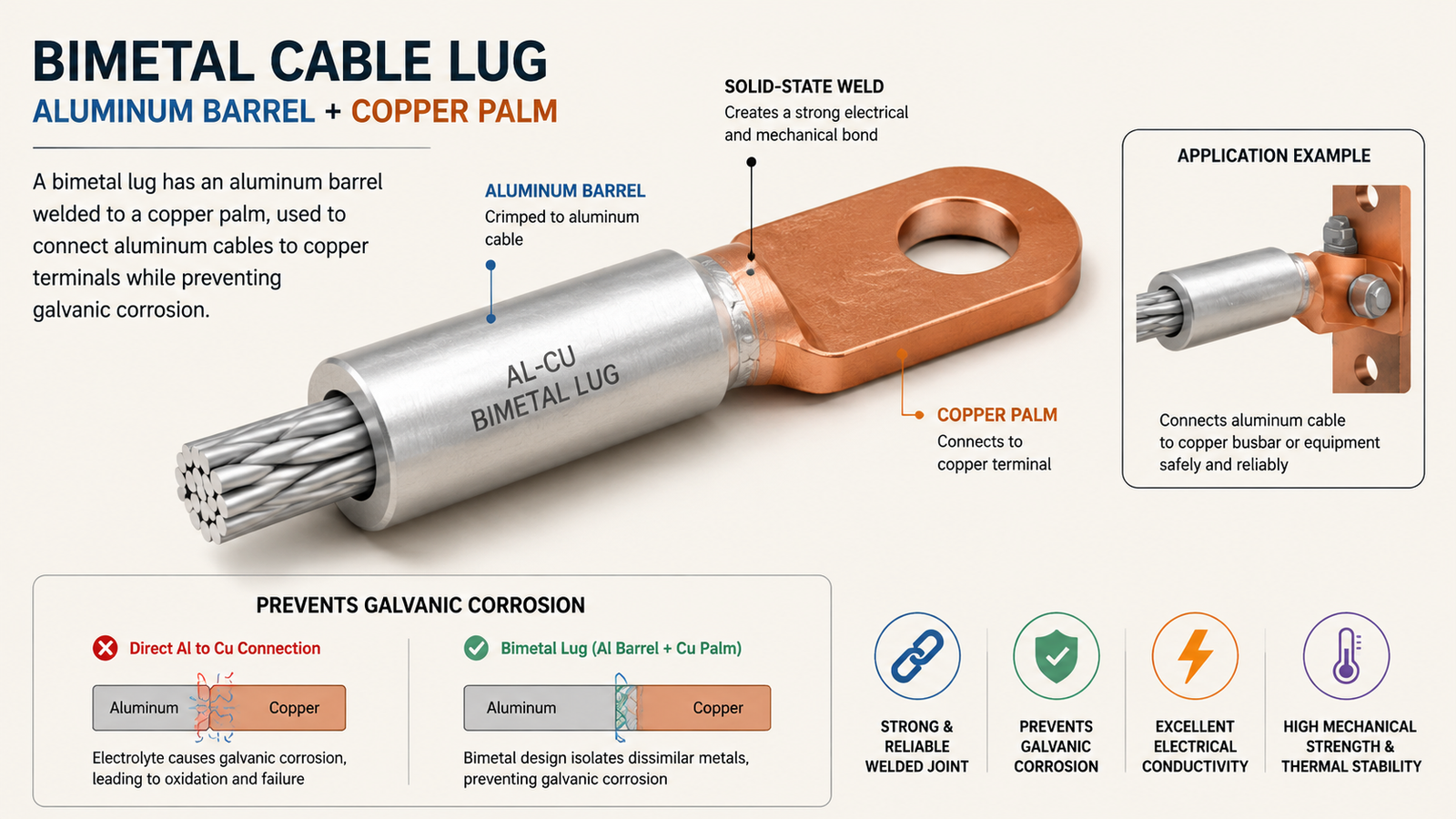
Never connect a copper lug directly to an aluminum conductor, or an aluminum lug directly to a copper busbar. Dissimilar metals in contact form a galvanic cell; with moisture present, the aluminum side corrodes quickly, the joint resistance climbs, and the connection overheats and fails.
The standard fix is a bimetal lug, which has an aluminum barrel on one end and a copper palm on the other, joined by friction or explosion welding. The aluminum end matches the aluminum conductor and the copper end matches the copper terminal, with no direct copper-aluminum contact. If you are joining aluminum cable to copper equipment, specify bimetal lugs such as the DLT bimetal cable lugs.
How to Choose: Which Lug Material Do You Need?
- Match the lug to the conductor. Copper cable needs a copper lug; aluminum cable needs an aluminum lug or a bimetal lug. This is the first rule and it is not optional.
- Check the terminal material. If the terminal or busbar is copper and the cable is aluminum, choose a bimetal lug to prevent galvanic corrosion.
- Assess the environment. Coastal, humid, or chemically aggressive sites favor copper or treated bimetal designs. Dry, clean, controlled environments are fine for aluminum.
- Look at the load. Continuous high-current circuits and critical infrastructure favor copper for lower resistance and better heat dissipation.
- Check space and weight budgets. Compact panels favor copper; long overhead or tray runs with weight limits favor aluminum.
- Be honest about installation quality. If the installation crew or conditions cannot guarantee strict preparation and torque control, copper is the safer default.
Common Mistakes to Avoid
- Mixing copper and aluminum without a bimetal transition. This creates galvanic corrosion at the joint.
- Sizing by eye instead of matching the conductor cross-section. Aluminum lugs need a larger barrel for the same current as copper.
- Buying on material price alone. Copper often wins on total cost of ownership in critical systems; aluminum wins where weight and volume budgets dominate.
- Installing aluminum lugs without surface preparation. Oxide buildup raises resistance and leads to overheating.
- Ignoring environment. Aluminum lugs in coastal or humid locations corrode faster than copper.
- Over-tightening aluminum connections. Aluminum is softer and deforms more easily; torque and crimp control matter more than with copper.
FAQ
Are copper cable lugs better than aluminum lugs?
Copper lugs are better for conductivity, corrosion resistance, and mechanical strength, and they suit critical or high-current systems. Aluminum lugs are better for cost and weight on large utility-scale projects. Neither is universally superior.
Can I use aluminum lugs on copper cables?
No. Aluminum and copper in direct contact form a galvanic cell that corrodes over time. Use a copper lug on a copper cable, or a bimetal lug if the terminal is the other material.
Why are copper lugs more expensive?
Copper is a higher-value raw material with superior electrical and mechanical properties. The higher upfront cost often pays back through lower maintenance and longer service life.
When should I use aluminum cable lugs?
Use aluminum lugs when the conductor is aluminum, when weight reduction matters (overhead lines, cable trays), or when project budget is a hard constraint and the environment is controlled.
What is a bimetal lug and when is it needed?
A bimetal lug has an aluminum barrel welded to a copper palm. It is needed whenever an aluminum conductor must connect to a copper terminal or busbar, because it prevents galvanic corrosion between the dissimilar metals.
Are tin-plated copper lugs worth the extra cost?
Tin plating prevents oxidation and improves compatibility in humid or aggressive environments. For coastal, offshore, and high-humidity installations, tin-plated copper lugs are a good investment.
Conclusion
There is no single winner between copper and aluminum cable lugs; the right material depends on your conductor, terminal, environment, load, and budget. Match the lug to the conductor, use bimetal lugs when the metals differ, and let the application rather than the price tag drive the decision.
If you are sourcing lugs for a project, compare the cable lugs range, or contact our engineers with your conductor and terminal details for a recommendation.