



Cable Lug Types Explained: Materials, Shapes, and How to Choose
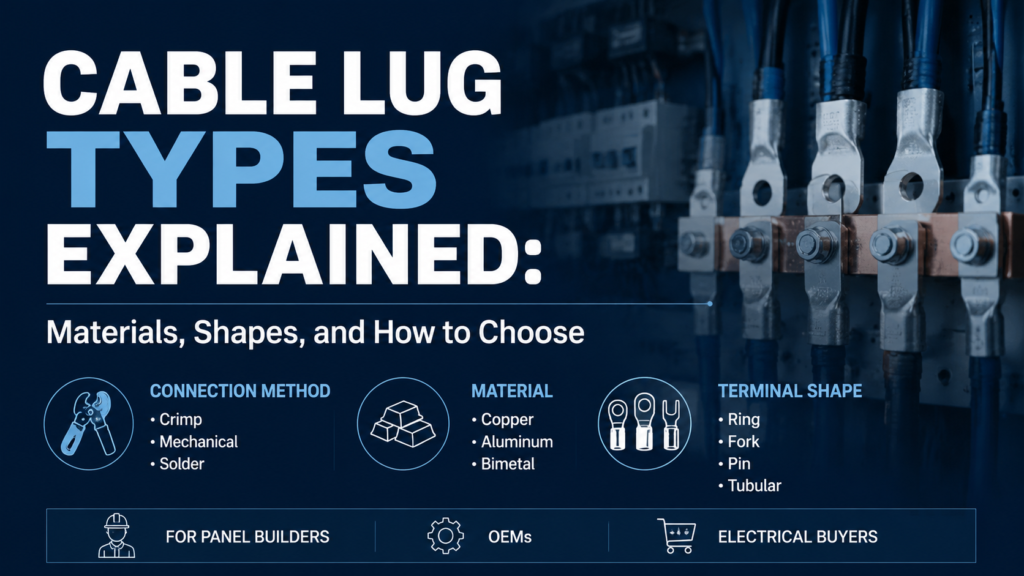
Cable lugs are the small metal fittings that connect a cable to a terminal, busbar, or piece of equipment, and choosing the wrong type is one of the fastest ways to create a high-resistance joint that overheats and fails. The short answer: cable lugs are classified by connection method (crimp, mechanical, or solder), material (copper, aluminum, or bimetal), and terminal shape (ring, fork, pin, tubular, and more). Match all three to your conductor and terminal, and the joint will stay cool, tight, and reliable for years.
This guide walks through the common cable lug types in each category, explains when each one is used, and ends with a practical checklist for selecting lugs on real projects.
What Is a Cable Lug?
A cable lug, sometimes called a cable terminal or cable connector, is a fitting attached to the end of a conductor so the cable can be securely bolted or clamped to equipment such as a distribution panel, transformer, switchgear, or busbar. The barrel of the lug accepts the stripped conductor, and the palm or eye end provides the bolted connection.
A good lug does three things: it creates a low-resistance electrical path, it holds the conductor strands together so they cannot fray or spread, and it transfers mechanical stress away from the cable. Failures almost always trace back to a lug that does not match the conductor size, the material, or the connection method.
Cable Lug Types by Connection Method
The first decision is how the lug attaches to the conductor. This affects the tools you need on site and how the joint performs over time.
Crimp lugs
Crimp lugs are permanently attached with a crimping tool that deforms the barrel around the conductor. The compression creates uniform contact pressure and a strong, vibration-resistant joint. Crimp lugs require a matched die and tool, and large cross-sections (50 mm² and up) need a hydraulic or battery-powered crimper because hand tools cannot generate enough force.
Mechanical lugs
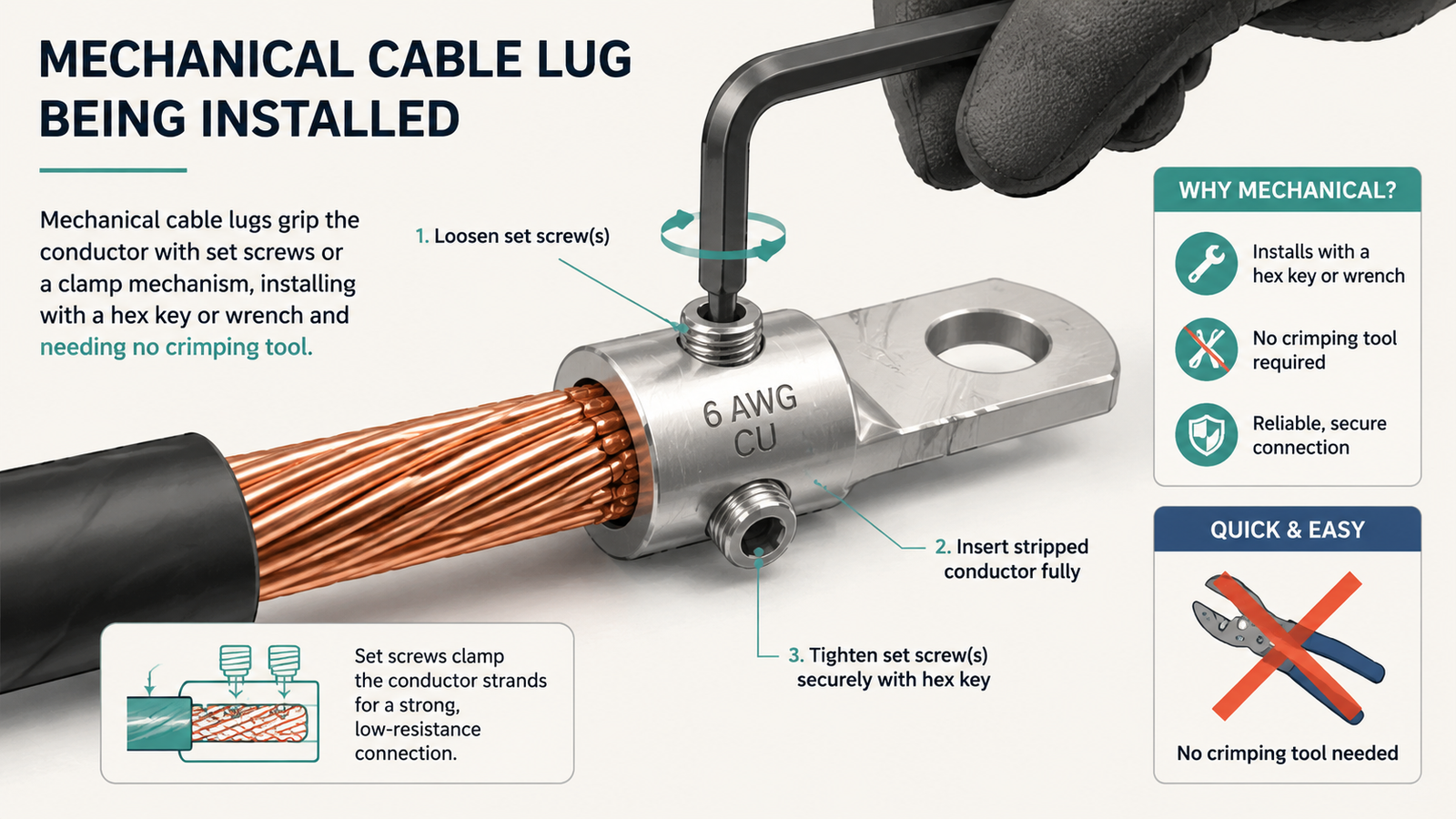
Mechanical lugs, also called screw-type or bolted lugs, grip the conductor with set screws or a clamp mechanism instead of a crimping tool. Installation only needs a hex key or wrench, which makes them popular for field repairs, OEM assembly, and situations where a crimper is not available. Good mechanical lugs distribute pressure evenly so the conductor is held firmly without being crushed. GGLDF’s mechanical cable lugs cover copper and aluminum conductors in many sizes.
Solder and weld lugs
Soldered and welded lugs form a metallurgical bond with the conductor, giving the lowest connection resistance of any method. They are used in high-current or high-reliability applications, but they require skilled labor and are rarely the first choice for general installation work.
Cable Lug Types by Material
The material of the lug must match the material of the conductor. Mixing metals without the right transition creates galvanic corrosion at the joint.
| Lug Material | Best Used With | Key Characteristics |
|---|---|---|
| Copper | Copper conductors | Highest conductivity (~100% IACS), excellent ductility, usually tin-plated to resist oxidation |
| Aluminum | Aluminum conductors | Lightweight and economical, conductivity about 61% of copper, needs oxidation control at the joint |
| Bimetal (copper-aluminum) | Aluminum cable to copper busbar or terminal | Friction- or explosion-welded transition that stops galvanic corrosion between dissimilar metals |
Bimetal lugs solve one of the most common field problems: connecting an aluminum conductor to a copper terminal. The aluminum barrel joins the aluminum cable, and the copper palm joins the copper terminal, with a welded transition in between that prevents the galvanic cell from forming. For cable-to-cable transitions in distribution work, bimetal lugs such as the DLT bimetal cable lugs are a direct fit.
Cable Lug Types by Terminal Shape
Once the connection method and material are fixed, the shape of the palm determines how the lug mounts on the terminal.
Ring lugs
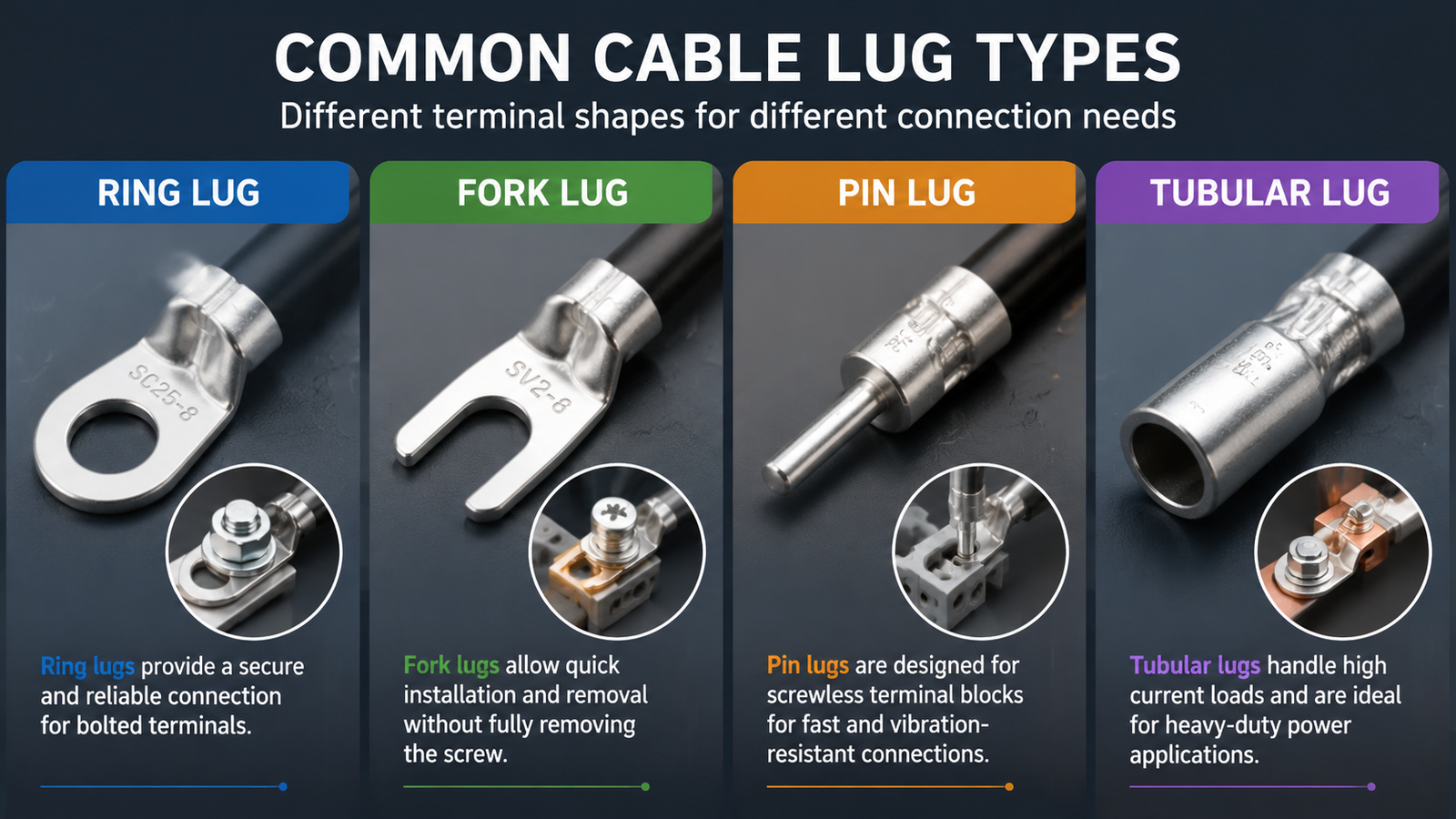
Ring lugs have a closed circular eye that slides over the terminal stud. The closed loop cannot slip off even if the nut works loose, which makes ring lugs the most secure choice for high-vibration environments such as motors, generators, and industrial machinery.
Fork (spade) lugs
Fork lugs have a U-shaped opening so the lug can be installed or removed by loosening the terminal screw without taking it fully out. This speeds up maintenance and testing in crowded panels, but the open shape is slightly less secure under vibration than a ring lug.
Pin lugs
Pin lugs form the conductor into a solid pin that plugs into screwless or clamp-style terminal blocks. They contain every strand of a fine-stranded conductor, preventing stray strands from shorting against adjacent terminals. Pin lugs are common in control panels and PLC wiring.
Tubular lugs
Tubular lugs are built for heavy-duty power connections. The long barrel accepts large cross-sections and allows multiple crimps, giving a larger contact area and higher mechanical strength. They are used on main feeders, transformers, switchgear, and large distribution panels.
Butt splices and other shapes
Butt splices join two cable ends in a straight line instead of terminating to a terminal. Other specialized shapes include angled lugs (45° or 90°) for tight spaces, twin-bore lugs with two bolt holes for extra stability, battery lugs, and waterproof lugs with sealing features for outdoor use.
How to Choose the Right Cable Lug
Work through these steps in order. They cover the decisions that panel builders, OEMs, and maintenance teams actually make.
- Match the material to the conductor. Copper conductor needs a copper lug; aluminum conductor needs an aluminum or bimetal lug. If the terminal is copper and the cable is aluminum, choose a bimetal lug.
- Match the cross-section (CSA). The lug barrel is rated for a conductor size in mm² or AWG. An oversized barrel gives a loose, high-resistance crimp; an undersized barrel will not accept the conductor.
- Match the stud hole. The palm hole must fit the terminal bolt or stud (for example M6, M8, M10). A wrong stud size forces field modification, which weakens the joint.
- Choose the connection method. Crimp lugs for permanent, high-current joints with the right tooling available; mechanical lugs when installation speed, tool-free assembly, or re-termination matters.
- Pick the palm shape. Ring for vibration-prone and critical connections, fork for quick service access, pin for screwless terminal blocks, tubular for large power feeders.
- Check the plating and environment. Tin plating prevents oxidation in normal use; silver plating suits high-temperature duty; nickel adds corrosion resistance in harsh environments.
Common Mistakes to Avoid
- Using a copper lug on an aluminum cable. The galvanic pair corrodes quickly in the presence of moisture and creates a high-resistance joint.
- Guessing the size by eye. Two cables can look identical and have completely different cross-sections. Always check the printed rating or measure the conductor.
- Undersized or oversized barrels. A loose fit means poor contact and overheating; a tight fit that forces the conductor in damages strands.
- Wrong crimp tooling. Using a die that does not match the barrel gives an uneven crimp that fails under load.
- Leaving strands exposed. Bare strands beyond the barrel can short against adjacent terminals or equipment.
- Buying on price alone. A failed lug on an energized feeder costs far more in downtime and labor than the price difference of a quality lug.
FAQ
What is the difference between a crimp lug and a mechanical lug?
A crimp lug is permanently deformed onto the conductor with a crimping tool and die. A mechanical lug grips the conductor with set screws or a clamp, so it installs with a hex key or wrench and needs no crimping tool.
Can I use a copper lug on an aluminum cable?
No. Copper and aluminum in direct contact form a galvanic cell that corrodes over time. Use an aluminum lug or a bimetal lug with an aluminum conductor when the terminal is copper.
What size cable lug do I need?
The lug barrel must match the conductor cross-section in mm² or AWG, and the palm hole must match the terminal stud size (such as M8 or M10). Both must be confirmed against the manufacturer’s reference.
What is a bimetal cable lug used for?
A bimetal lug connects an aluminum cable to a copper terminal or busbar. The friction-welded copper-aluminum transition prevents galvanic corrosion between the dissimilar metals.
Do I need a special tool to install mechanical cable lugs?
No. Mechanical lugs are installed with a hex key or wrench. This is why they are a practical choice for field work, OEM assembly, and applications without access to a crimping tool.
Which cable lug type is best for high-vibration equipment?
Ring lugs with a secure bolted connection are the standard choice for motors, generators, and other high-vibration equipment because the closed eye cannot slip off the stud.
Conclusion
Cable lugs come in many types, but the selection logic is simple: match the material to the conductor, match the size to the cross-section, and match the connection method and palm shape to the terminal and working environment. Get those three right and the joint will carry current reliably for decades.
If you are sourcing lugs for a panel build or field project, browse the cable lugs range and the cable terminals range, or contact our engineers with your cable size and terminal details for a recommendation.