



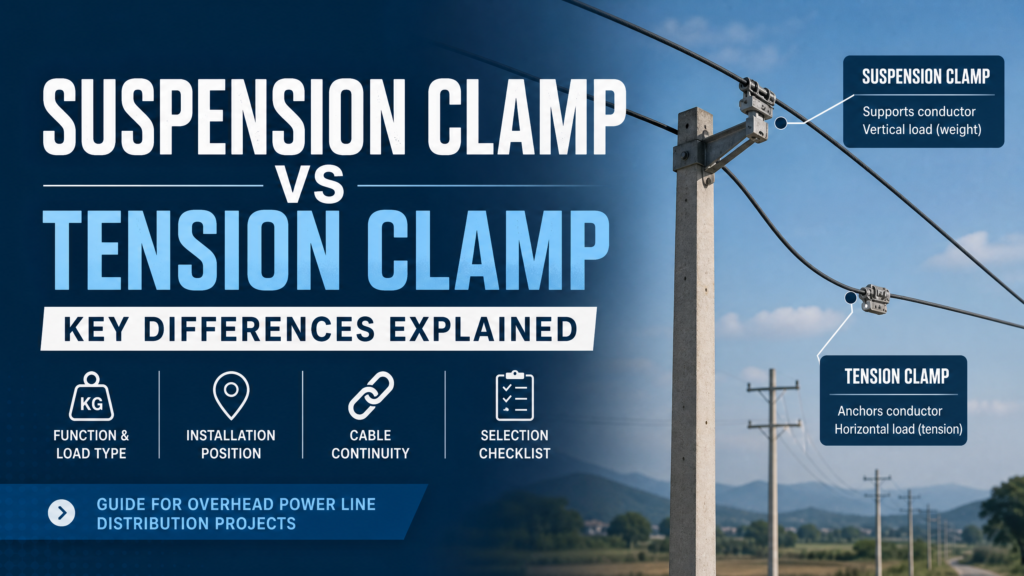
Suspension Clamp vs Tension Clamp: Key Differences Explained
Suspension clamps and tension clamps are two of the most common fittings on overhead power lines, yet they are easy to confuse because both attach a cable to a pole or tower. The short answer is this: a suspension clamp supports and suspends a cable at an intermediate pole, letting the conductor pass through and swing freely, while a tension clamp anchors and terminates a cable at a dead end, corner, or tension point, transferring the full longitudinal pulling force to the structure. Choosing the wrong one can lead to cable slippage, conductor damage, excessive sag, or premature fatigue at the support point.
This guide compares suspension clamps and tension clamps in plain terms, covers where each one belongs on the line, and gives you a practical checklist for selecting the right fitting for your overhead line project.
The Quick Answer: Suspension Clamp vs Tension Clamp
Think about what happens to the cable at the installation point. That single question decides which clamp you need.
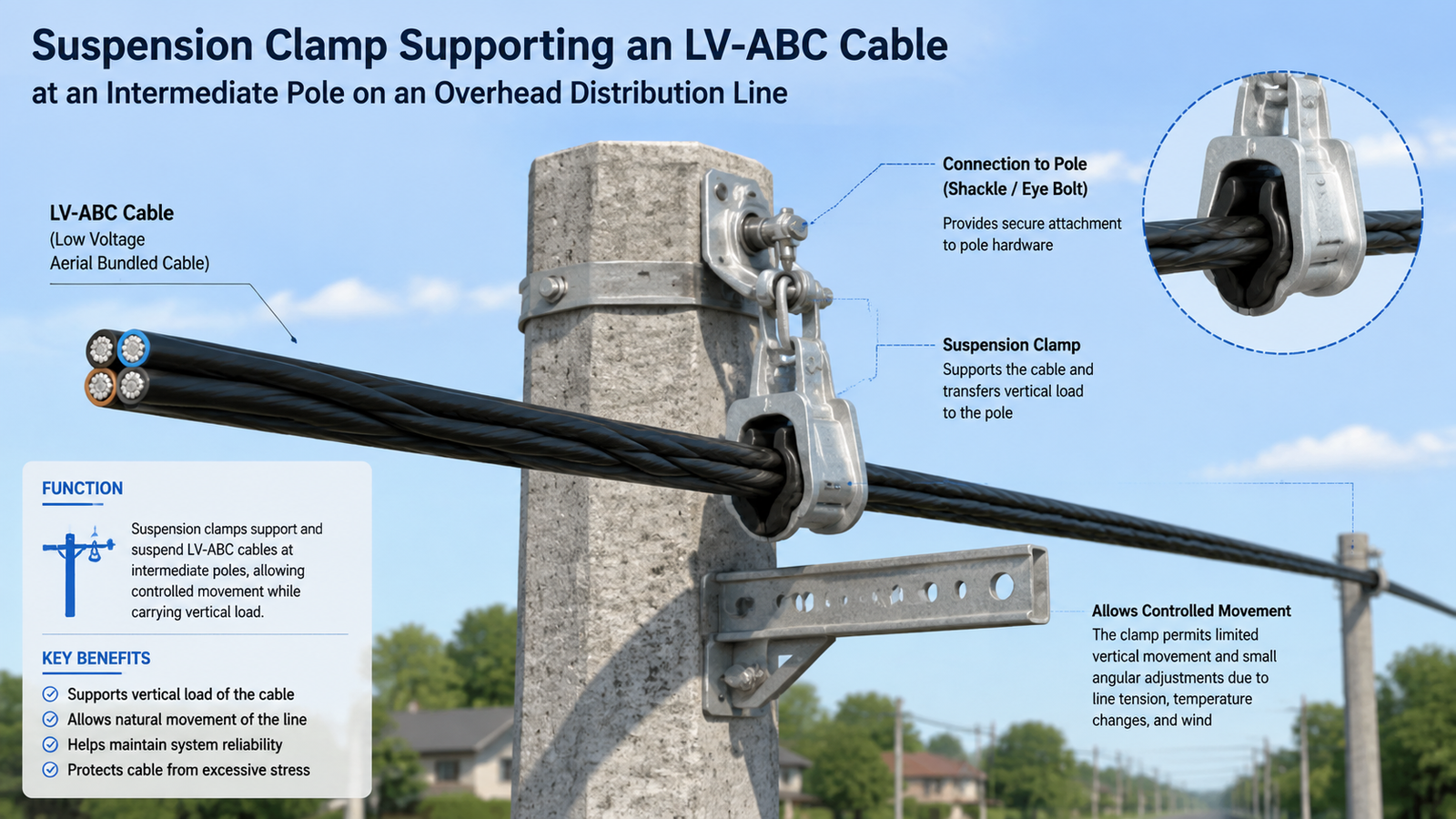
- Suspension clamp — the cable continues through the fitting. The clamp holds it at the correct height, carries the vertical load (cable weight, ice, wind pressure), and allows controlled movement and swing. It is used at intermediate or tangent poles along straight sections.
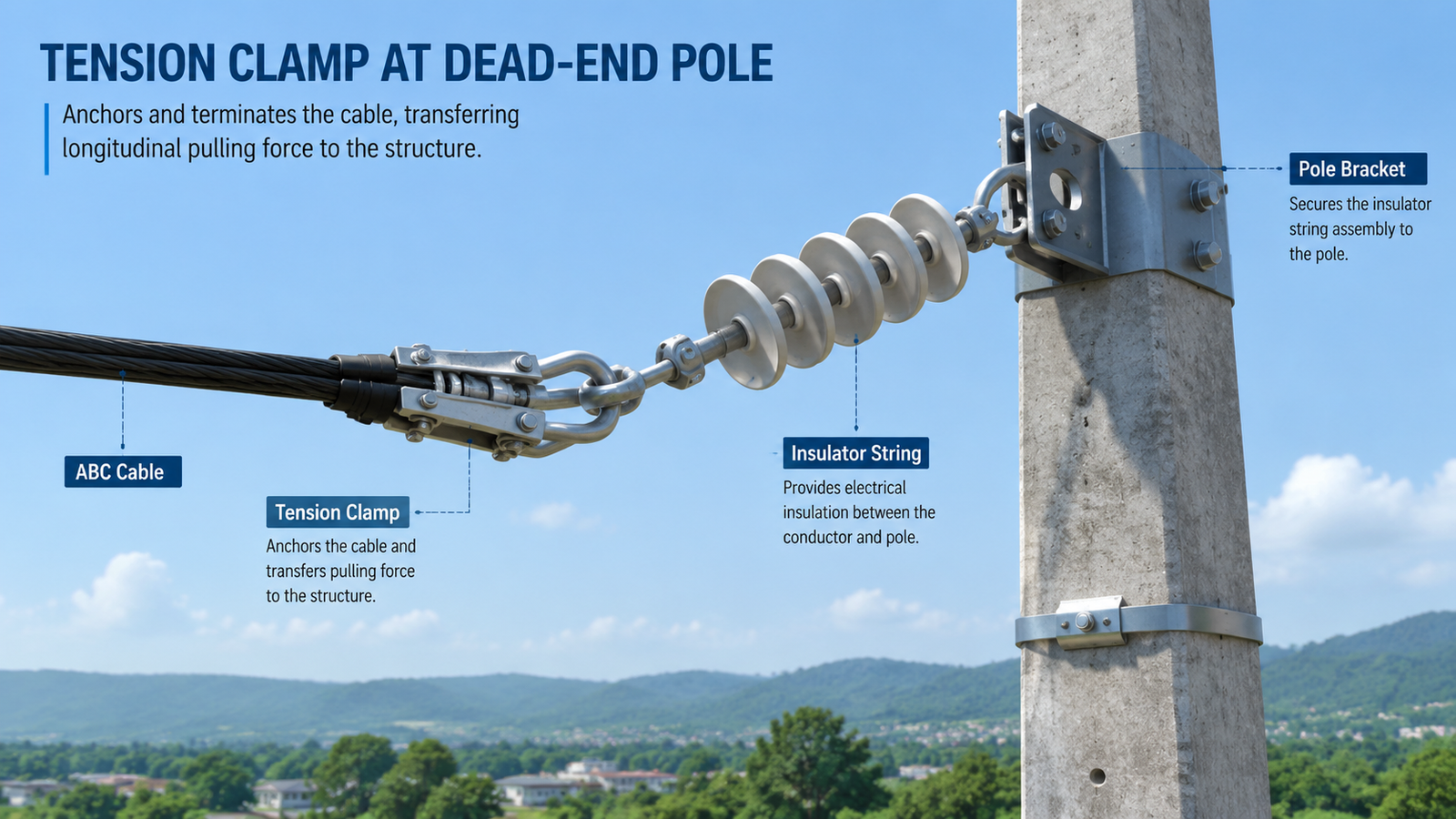
- Tension clamp — the cable stops at the fitting. The clamp grips the cable end firmly, resists longitudinal pull, and transfers that tension to the pole, tower, or insulator string. It is also called a strain clamp , dead-end clamp , or anchoring clamp .
| Comparison Point | Suspension Clamp | Tension Clamp |
|---|---|---|
| Main function | Supports and suspends the cable | Anchors and terminates the cable |
| Typical position | Intermediate or tangent pole/tower | Dead end, terminal, tension, section, or angle structure |
| Primary load | Vertical load with limited lateral movement | Longitudinal tensile load |
| Cable continuity | Cable passes through the support point | Cable is mechanically restrained or terminated |
| Movement allowed | Controlled swing and longitudinal movement | No slippage; movement is locked out |
| Common names | Hanging clamp, support clamp | Strain clamp, dead-end clamp, anchoring clamp |
What Is a Suspension Clamp?
A suspension clamp is an overhead line fitting that attaches a conductor, ground wire, ADSS cable, or OPGW cable to an intermediate supporting structure. Its job is to keep the cable at the designed elevation and position without turning the support point into a full-tension termination.
When you install a suspension clamp, the cable normally enters and exits the fitting and continues along the route. The clamp body, rubber insert, armor rods, or helical rods spread the contact pressure over a controlled area. This prevents concentrated force from damaging conductor strands, cable sheaths, or internal optical fibers.
For ADSS and OPGW applications, a suspension assembly usually includes preformed rods, rubber or elastomeric inserts, an aluminum alloy housing, and connecting hardware. The rubber insert cushions the cable, while the outer structure connects the assembly to the pole or tower. Where spans are long or dynamic loads are severe, engineers specify reinforced or double suspension assemblies.
Good suspension clamps also reduce vibration and abrasion at the support point. That is why they are the standard choice for long-span overhead lines where wind-induced galloping and vibration can shorten conductor life.
What Is a Tension Clamp?
A tension clamp is used where the cable must be held against longitudinal pulling force and that force must be transferred to the supporting structure. Instead of allowing the cable to pass freely through an intermediate support, the tension clamp grips or terminates it at a defined position.
You will find tension clamps at the beginning and end of a cable route, at section points, terminal towers, tension towers, and major direction changes. In these positions, the fitting must resist conductor or cable tension without excessive slippage, strand damage, or sheath deformation.
Preformed tension clamps use helically formed rods that wrap around the cable. The grip comes from the rod geometry, the contact length, and in some designs an abrasive coating. Armor rods or reinforcing rods are often added to distribute pressure and protect the cable where it leaves the fitting.
For optical cables, holding force alone is not enough. The tension assembly must also control lateral compression and bending stress so that the required mechanical grip is achieved without damaging the fibers inside.
Where Each Clamp Is Used
Once you understand the difference in function, placement becomes intuitive.
Where suspension clamps are used
- Intermediate poles and tangent towers along straight line sections
- Support points for LV-ABC, MV bare conductors, ADSS, and OPGW cables, such as the PS1500 suspension clamp for LV-ABC networks
- Positions where the conductor must remain at a set height but still move with wind and temperature changes
Where tension clamps are used
- Dead-end poles where a line terminates
- Terminal towers at substations or customer connection points
- Tension and section towers that break a line into manageable tension sections
- Angle structures and corner points where the line changes direction
- Long-span crossings where sag must be tightly controlled
Key Differences at a Glance
Beyond function and position, several technical details separate the two fittings:
| Aspect | Suspension Clamp | Tension Clamp |
|---|---|---|
| Load type | Bears vertical load only; resists bending and vibration | Bears tensile (mechanical) load along the line axis |
| Materials | Aluminum alloy body with rubber/neoprene inserts | Aluminum alloy, hot-dip galvanized steel, or forged steel |
| Suitable cables | LV-ABC, ACSR, ADSS, OPGW, ground wire | AAC, AAAC, ACSR, OPGW, LV-ABC, optical cable ends |
| Design goal | Reduce vibration, bending stress, and abrasion | Secure a firm, non-slip grip under full line tension |
| Installation | Clamped over the cable with cushioned support pads | Mechanically tightened; wedge or preformed rods create the grip |
| Failure mode if misused | Conductor slip or sheath wear under excessive tension | Conductor strand damage or fiber crush from over-tightening |
How to Choose: Which Clamp Do You Need?
Work through this checklist in order. It covers the decisions that line designers and buyers actually face.
- Identify the installation position. Is the structure an intermediate support, or is it a dead end, terminal, angle, or tension point? Intermediate support usually means suspension; a termination or direction change usually means tension.
- Check the cable type and diameter. The clamp groove or rod set must match the conductor diameter exactly. A mismatch concentrates pressure and damages strands.
- Calculate the loads. For suspension clamps, check vertical load, span length, and support angle. For tension clamps, check line tension, rated tensile strength (RTS) of the conductor, and termination load.
- Consider environmental conditions. Coastal and high-pollution sites need corrosion-resistant materials. High wind areas need vibration damping, which favors a well-designed suspension assembly.
- Match hardware connections. Confirm the clevis, shackle, or eye connection matches the insulator string or bracket on your structure.
- Verify standards and ratings. Use clamps that meet the relevant national or utility specifications, and never exceed the rated breaking load.
Common Mistakes to Avoid
- Using a suspension clamp at a dead end. The clamp cannot resist longitudinal pull; the cable slips or the fitting fails under load.
- Using a tension clamp on a straight run. It converts the support into a rigid anchor, raising mechanical stress and making the line harder to maintain.
- Matching the clamp by visual size instead of cable diameter. Two cables can look similar and have completely different diameters.
- Ignoring sag control. On long spans, a tension clamp at both ends is needed to keep sag within limits, not just a suspension clamp at mid-span.
- Skipping vibration protection. On long, wind-exposed spans, a bare suspension clamp without damping lets galloping damage the conductor over time.
- Buying on price alone. A failed fitting on an energized line costs far more in downtime and labor than the price difference of the clamp.
FAQ
Is a tension clamp the same as a dead-end clamp?
Yes. Tension clamp, strain clamp, dead-end clamp, and anchoring clamp are different names for the same family of fittings that terminate a cable and transfer tension to the structure.
Can a suspension clamp hold tension?
No. A suspension clamp is designed to support vertical load and allow controlled movement. It is not rated to resist longitudinal tension, so it must not be used where the cable is under significant pull.
Where is a suspension clamp installed on a power line?
Suspension clamps are installed at intermediate or tangent poles and towers along straight sections, where the cable needs support but must continue along the route.
What cables are suspension clamps used with?
Suspension clamps work with LV-ABC cables, bare ACSR conductors, ground wires, ADSS fiber optic cables, and OPGW cables on intermediate supports.
How do I know if I need a tension clamp or a suspension clamp?
If the cable continues past the structure and only needs support, choose a suspension clamp. If the cable ends, changes direction, or must be held against pull, choose a tension clamp.
Why does the cable sometimes slip out of a suspension clamp?
Slip usually happens when the clamp groove is too large for the cable diameter, the fitting is installed at a position with unexpected longitudinal load, or the bolts are not tightened to the specified torque.
Conclusion
The rule is simple: suspension clamps support cables that keep going; tension clamps anchor cables that stop or turn. Match the fitting to the installation position, cable diameter, and real loads, and your overhead line will hold up through wind, ice, and temperature swings.
If you are sourcing fittings for an overhead distribution project, compare suspension clamp options and the tension clamp range, or contact our engineers directly with your cable size and span details for a recommendation.