



Electrical Power Lines Explained: Types, Voltage Levels, Components & Real-World Applications
Electrical power lines form the circulatory system of the modern world. From the moment electricity is generated at a power plant to the instant it powers a factory floor or lights up a residential street, it travels through a vast network of conductors, cables, insulators, and power line fittings that hold, connect, and protect every junction along the route. Understanding how these systems work — and where components like clamps, connectors, and fittings fit in — is essential for engineers, procurement teams, and utility contractors who build and maintain power infrastructure.
In this guide, we break down the major categories of electrical lines, the voltage classes that define them, the components that keep them running, and the industries that depend on them most. We also examine how modern challenges — renewable energy integration, smart grid adoption, and grid hardening — are reshaping the way power lines are designed, connected, and maintained.
1. What Are Electrical Power Lines?
An electrical power line is a system of conductors, supporting structures, insulation components, and connection hardware engineered to transport electrical energy from generation facilities to end users. The network spans everything from massive transmission corridors stretching across continents to the final low-voltage cables entering a residential breaker panel.
Power lines connect:
- Power generation plants (thermal, hydro, nuclear, wind, solar)
- Step-up and step-down substations
- Industrial manufacturing complexes
- Commercial buildings and data centers
- Residential communities
- Renewable energy installations (solar farms, wind turbines)
At its core, the system works on a straightforward principle: a voltage differential applied across a conductive material drives current flow. The engineering challenge lies in moving that current over long distances while minimizing losses, maintaining voltage stability, and ensuring that every conductor is securely fastened, properly insulated, and reliably connected at every tap, branch, and termination point.
Why Power Lines Matter More Than Ever
Global electricity demand continues to climb, driven by urbanization, the electrification of transportation, the rapid expansion of data centers, and the shift toward renewable energy. According to the International Energy Agency, electricity consumption is projected to grow faster than any other final energy source through 2030. This places enormous pressure on transmission and distribution infrastructure to deliver more power, more reliably, across greater distances than ever before — and every connection point along the way must be engineered to withstand decades of mechanical stress, thermal cycling, and environmental exposure.
2. Major Types of Electrical Power Lines
Power lines are classified by their installation method, voltage level, and function within the grid. Each type serves a specific purpose and comes with distinct engineering trade-offs.
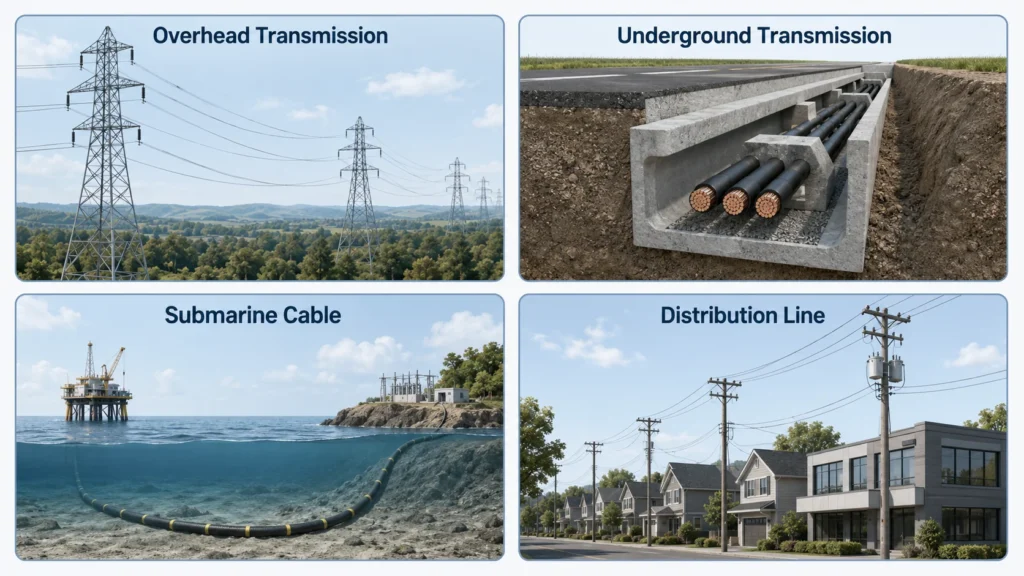
2.1 Overhead Transmission Lines
Overhead lines are the backbone of long-distance power transmission. Suspended from steel towers or concrete poles, they use bare conductors exposed to open air. This design offers several practical advantages:
- Lower initial installation cost compared to underground alternatives
- Easier access for inspection, maintenance, and fault repair
- Higher current-carrying capacity due to natural air cooling
- Proven reliability over decades of operation
However, overhead lines are vulnerable to weather events — high winds, ice accumulation, and especially lightning strikes. Every conductor must be anchored at each tower with tension clamps that withstand the full mechanical load of the span, and suspended at intermediate points with suspension clamps that allow controlled movement without damaging the conductor. At tap-off points where power branches to substations or communities, insulated piercing clamps provide reliable electrical connections without stripping the cable insulation.
2.2 Underground Transmission Lines
Underground cables use solid-dielectric insulation (typically XLPE — cross-linked polyethylene) to encase conductors buried below the surface. They are increasingly favored in urban environments where space constraints, aesthetics, and public safety concerns make overhead lines impractical.
Key benefits include:
- Elimination of visual impact on the landscape
- Immunity to wind, ice, and falling-tree damage
- Reduced electromagnetic field exposure
- Lower risk of public contact
The trade-offs are significant: underground installation costs can be 5–10 times higher than overhead, and locating and repairing faults is far more complex and time-consuming. Proper cable joint design, reliable cable connectors, and moisture protection are essential for long-term reliability.
2.3 Submarine Power Cables
Submarine cables transmit electricity across bodies of water, connecting offshore wind farms to onshore grids, linking islands to mainland power networks, and enabling cross-border power exchange. These specialized cables must withstand hydrostatic pressure, saltwater corrosion, and mechanical stress from ocean currents and shipping activity.
Notable applications include:
- Offshore wind farm export cables (typically 33 kV for array cables, 220 kV+ for export)
- Inter-island grid connections (e.g., in Southeast Asia and Northern Europe)
- International interconnectors enabling renewable energy sharing between nations
2.4 Distribution Lines
Distribution lines represent the final stage of power delivery, carrying electricity from substations to homes, businesses, and industrial facilities. Operating at medium voltage (typically 10 kV–35 kV) before being stepped down to low voltage (400 V or 480 V) at the customer end, these networks are where most utility customers interact with the electrical system.
Distribution infrastructure includes pole-mounted transformers, street-level junction boxes, service drop connections, and the metering equipment that tracks consumption. It is also where power quality issues — voltage sags, harmonics, and transient overvoltages — most frequently originate, making proper connection hardware and reliable branch connectors essential at this level.
Comparison of Electrical Line Types
| Line Type | Voltage Range | Installation | Cost Level | Maintenance | Typical Use Case |
|---|---|---|---|---|---|
| Overhead Transmission | 35 kV – 765 kV+ | Towers & poles | Low | Easy | Long-distance bulk power transfer |
| Underground Transmission | 35 kV – 500 kV | Buried cable systems | High | Difficult | Urban power infrastructure |
| Submarine Cable | 33 kV – 525 kV | Underwater | Very High | Complex | Offshore wind, island grids |
| Overhead Distribution | 0.4 kV – 35 kV | Utility poles | Low | Moderate | Local power delivery |
| Underground Distribution | 0.4 kV – 35 kV | Underground ducts | High | Moderate | Commercial & residential districts |
| Railway Electrification | 750 V – 25 kV | Catenary systems | Medium | Moderate | Metro, high-speed rail |
3. Voltage Classifications: From Low to Ultra-High
Voltage level is the single most important parameter in power line engineering. Higher voltages enable more efficient long-distance transmission by reducing current (and therefore resistive losses) for a given amount of power. The power grid is structured as a hierarchy of voltage levels, each serving a distinct purpose.
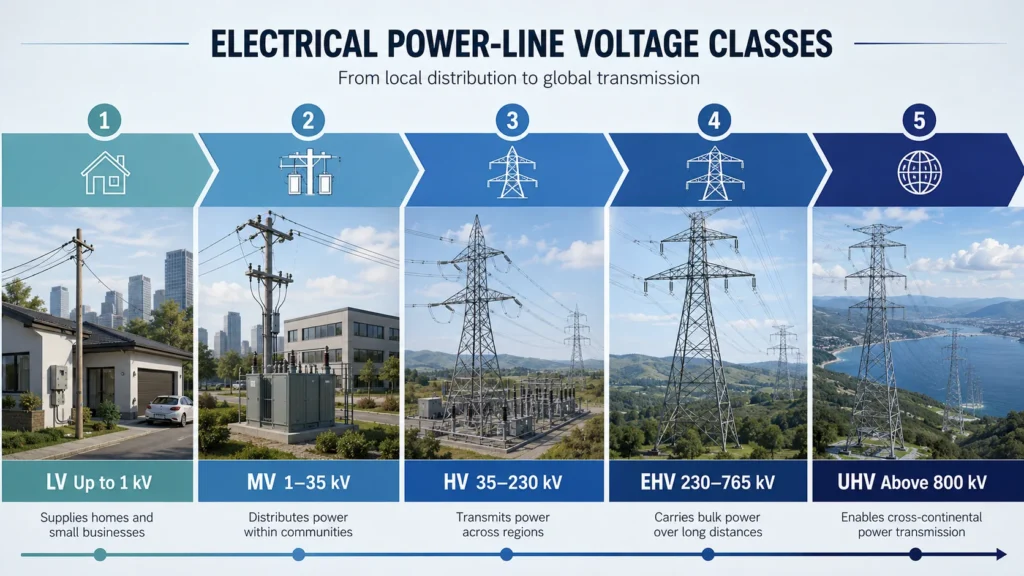
3.1 Low Voltage (LV) — Up to 1 kV
Low voltage lines deliver power to end-use equipment: residential outlets, commercial lighting, small motors, and electronic devices. This is where electricity meets the consumer, and where cable connectors, terminal lugs, and branch connectors handle the final stage of power distribution. At this level, safety requirements are especially stringent because these are the circuits people interact with daily.
3.2 Medium Voltage (MV) — 1 kV to 35 kV
Medium voltage lines serve as the primary distribution network, carrying power from substations to neighborhood transformers and large industrial customers. MV systems require robust switchgear, cable terminations, and reliable connector hardware to handle the higher fault currents and mechanical loads that occur at these levels.
3.3 High Voltage (HV) — 35 kV to 230 kV
High voltage lines handle regional power transmission, connecting major substations across cities and provinces. At these voltages, corona discharge, insulation coordination, and lightning protection become critical engineering concerns. Transmission towers must maintain large safety clearances, and insulator strings must be designed to withstand switching and lightning overvoltages. Every conductor attachment point uses heavy-duty tension and suspension hardware rated for the mechanical loads at these spans.
3.4 Extra High Voltage (EHV) — 230 kV to 765 kV
EHV systems form the backbone of national transmission networks, moving bulk power across hundreds of kilometers. These lines require sophisticated protection schemes, including high-speed relay systems, circuit breakers rated for hundreds of kiloamperes, and extensive grounding infrastructure with corrosion-resistant grounding hardware.
3.5 Ultra High Voltage (UHV) — Above 800 kV
UHV transmission enables cross-continental power transfer, connecting remote renewable energy resources (such as hydroelectric plants in mountainous regions or massive solar arrays in deserts) to distant population centers. China leads the world in UHV deployment, with several ±800 kV DC and 1000 kV AC lines already in commercial operation.
Voltage Classification Summary
| Voltage Class | Range | Primary Application | Example Infrastructure |
|---|---|---|---|
| Low Voltage (LV) | Up to 1 kV | Residential & commercial end-use | Cable connectors, terminal lugs, branch clamps |
| Medium Voltage (MV) | 1 kV – 35 kV | Industrial plants, local distribution | Switchgear, cable terminations, piercing connectors |
| High Voltage (HV) | 35 kV – 230 kV | Regional transmission | Transmission towers, tension & suspension clamps |
| Extra High Voltage (EHV) | 230 kV – 765 kV | Long-distance bulk transmission | National grid interconnections, grounding hardware |
| Ultra High Voltage (UHV) | Above 800 kV | Cross-continental power transfer | Large-scale renewable energy delivery |
4. Key Components of Electrical Power Lines
A power line is only as reliable as its individual components. Each part must be engineered to withstand electrical stress, mechanical loading, and environmental exposure over decades of service.
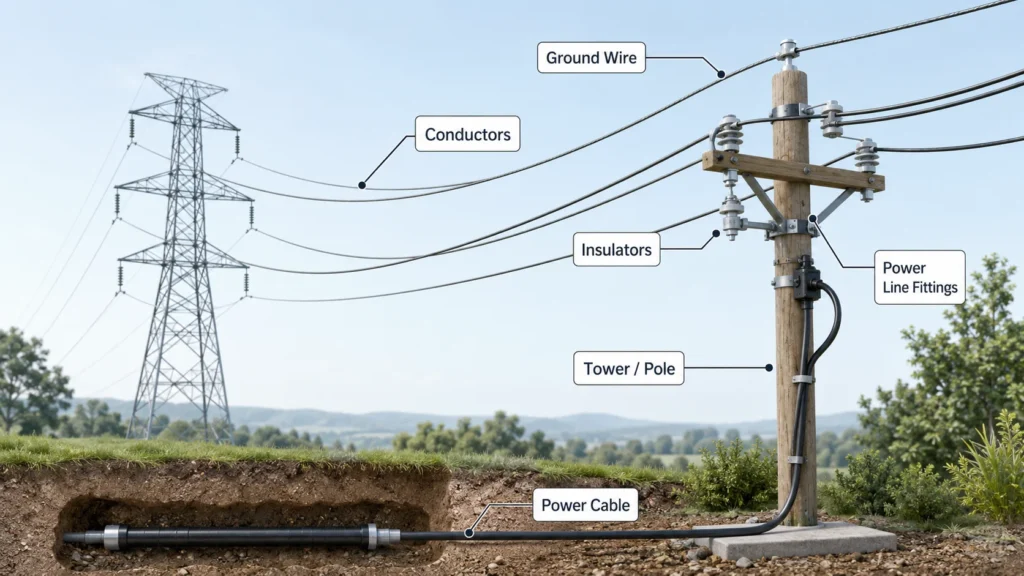
4.1 Conductors
Conductors carry the electrical current and are the primary functional element of any power line. Material selection depends on the balance between conductivity, mechanical strength, and cost:
- AAAC (All-Aluminum Alloy Conductor): High corrosion resistance, used in coastal and polluted areas
- ACSR (Aluminum Conductor Steel-Reinforced): The workhorse of high-voltage transmission — aluminum strands for conductivity, steel core for tensile strength
- AAC (All-Aluminum Conductor): Excellent conductivity, used for short-span urban distribution
- HTLS (High-Temperature Low-Sag): Advanced alloys that allow higher operating temperatures, enabling capacity upgrades on existing corridors
4.2 Insulators
Insulators prevent current from leaking from energized conductors to grounded structures. Modern options include:
- Porcelain — traditional, durable, but heavy
- Toughened glass — self-inspecting (shatters visibly when damaged)
- Composite polymer — lightweight, contamination-resistant, increasingly preferred for new installations
Insulator performance is critical in areas with high lightning activity or industrial pollution, where flashover risk is elevated. The hardware that attaches insulators to towers and conductors — ball-and-socket couplings, clevises, and corona rings — must be equally robust.
4.3 Transmission Towers and Poles
Supporting structures must maintain safe conductor-to-ground clearances under all loading conditions — including wind, ice, and conductor tension. Lattice steel towers dominate high-voltage transmission, while concrete and composite poles are common at distribution levels. The points where conductors meet these structures are among the most mechanically demanding locations on any power line, requiring purpose-built clamps and fittings that can endure decades of vibration, thermal cycling, and wind loading.
4.4 Ground Wires and Lightning Protection
Ground wires (shield wires) run along the top of transmission towers to intercept lightning strikes before they hit phase conductors. But shielding alone is not enough — the resulting surge current must be safely diverted to ground through a well-designed grounding system:
- At towers: Grounding down-leads connect the shield wire to the tower grounding system, which may include copper-bonded ground rods driven deep into the soil
- At substations: Ground grids with copper connectors and exothermic welded joints ensure low-impedance fault current paths
- At distribution level: Pole-mounted grounding hardware and lightning protection fittings safeguard downstream transformers and service drops
A well-designed lightning protection strategy combines proper shielding geometry, low-resistance grounding, and corrosion-resistant connection hardware that maintains electrical continuity over the full service life of the installation.
4.5 Power Cables
Modern power cables for underground and submarine applications are complex engineered products. A typical XLPE cable includes:
- Conductor (copper or aluminum)
- Conductor screening layer
- XLPE insulation
- Insulation screening layer
- Metallic sheath (for grounding and fault current path)
- Anti-corrosion outer jacket
Cable terminations and joints are critical weak points in any underground system. The connectors used at these junctions must maintain water-tight seals, provide adequate electrical contact area, and resist thermal expansion stress over thousands of load cycles.
4.6 Distribution and Protection Equipment
At the point where transmission meets end-use, a range of equipment manages power flow and protects circuits:
- Circuit breakers and fuses — interrupt fault currents to protect conductors and equipment
- Switchgear and ring main units — control power routing and provide isolation points for maintenance
- Transformers — step voltage down from medium to low voltage for customer delivery
- Reclosers and sectionalizers — automatically isolate faulted line sections and restore power to unaffected areas
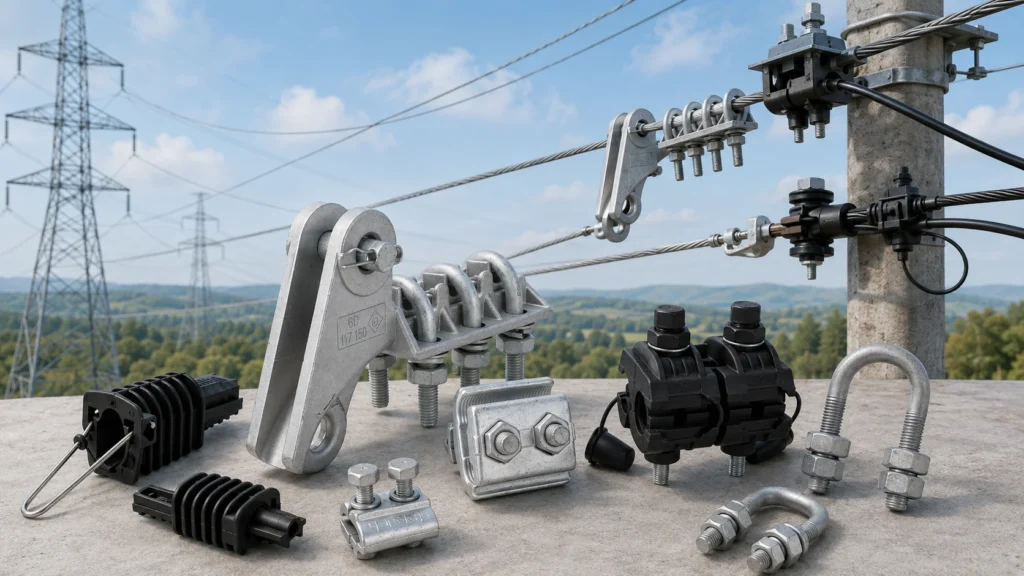
4.7 Power Line Fittings: The Connective Tissue of Every Line
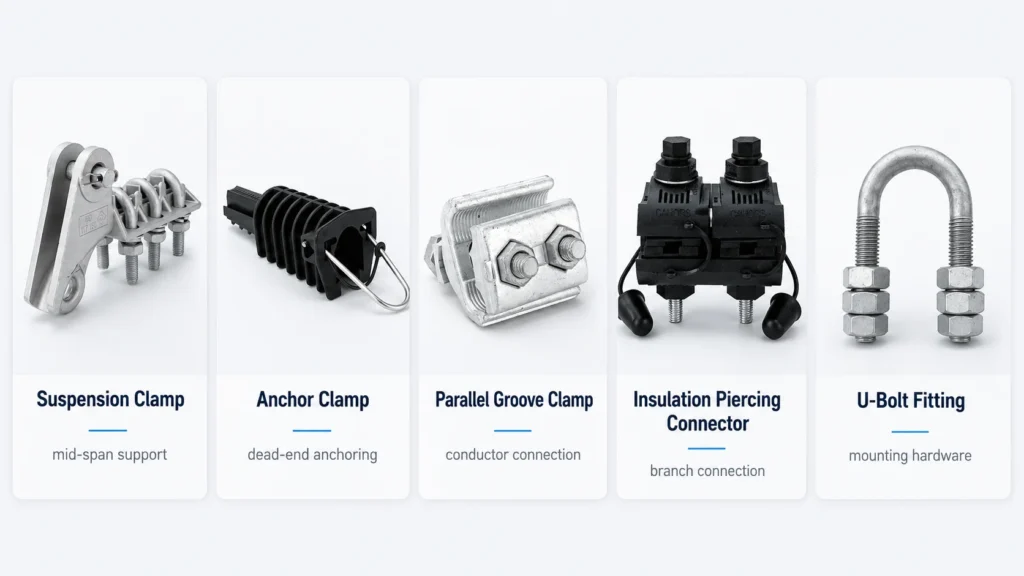
Conductors, insulators, and towers get most of the attention, but none of them function without the fittings that connect, secure, and protect them. Power line fittings are the mechanical and electrical interface between every major component on a power line — and their reliability directly determines the reliability of the entire system.
The main categories include:
- Insulated piercing clamps — create branch connections on insulated conductors without stripping the insulation. A specially designed contact blade pierces the cable insulation to establish electrical contact, while the clamp body provides insulation and mechanical retention. Widely used in low-voltage aerial bundled cable (ABC) networks and service drop connections.
- Tension clamps (also called strain clamps or dead-end clamps) — anchor conductors at the ends of each span, bearing the full mechanical tension of the line. They grip the conductor without damaging it and transfer the load to the tower or pole through insulator strings. Proper selection depends on conductor type, span length, and mechanical load rating.
- Suspension clamps — support conductors at intermediate towers along the line. Unlike tension clamps, they allow limited longitudinal movement to accommodate thermal expansion and uneven loading, while maintaining the conductor’s position relative to the tower. Designs must balance grip strength against the risk of conductor damage from clamp pressure or vibration.
- Cable connectors and lugs — join conductor segments, connect cables to equipment terminals, and transition between different conductor materials (e.g., copper-to-aluminum transitions). Compression connectors, bolted connectors, and exothermic welds each serve specific applications depending on voltage level, conductor size, and environmental conditions.
- Protection fittings — include armor rods, vibration dampers, and spacer dampers that protect conductors from Aeolian vibration, galloping, and short-circuit forces. These components extend conductor life by reducing fatigue stress at support points.
Selecting the right fitting for each application requires matching the fitting’s mechanical rating, conductor compatibility, insulation class, and environmental rating to the specific line conditions. A fitting that is undersized, incompatible with the conductor material, or not rated for the local pollution level can become the weakest link in an otherwise robust power line.
Component Summary Table
| Component | Function | Common Materials | Key Design Factor |
|---|---|---|---|
| Conductor | Carry electrical current | Aluminum, copper, ACSR | Ampacity, resistance, sag |
| Insulator | Isolate energized conductors | Polymer, glass, porcelain | Flashover voltage, pollution |
| Tower / Pole | Mechanical support | Galvanized steel, concrete | Wind load, ice load, clearance |
| Ground Wire | Lightning shielding | Steel, OPGW | Shielding angle, grounding |
| Tension Clamp | Anchor conductor at span ends | Aluminum alloy, galvanized steel | Grip strength, tension rating |
| Suspension Clamp | Support conductor at mid-span | Aluminum alloy, malleable iron | Conductor protection, load capacity |
| Piercing Clamp | Branch connection without stripping | Aluminum alloy + polymer housing | Contact resistance, insulation rating |
| Power Cable | Underground / underwater transmission | XLPE, EPR, PVC | Thermal rating, moisture resistance |
| Cable Connector | Join cable segments & terminals | Copper, aluminum, bimetallic | Contact area, corrosion resistance |
5. Transmission vs. Distribution: Understanding the Distinction
The power grid is divided into two fundamental stages: transmission and distribution. Understanding the difference is crucial for specifying the right equipment.
Transmission Systems
Transmission lines move bulk power from generating plants to substations over long distances. They operate at high voltages (typically 110 kV and above) to minimize losses. These networks are the interstate highways of the electrical system — high capacity, long distance, few connection points.
Distribution Systems
Distribution lines deliver power from substations to end users at medium and low voltages. This is the local road network — many branches, many connection points, direct customer access. Distribution equipment includes transformers, switchgear, service drop hardware, piercing connectors for branch lines, and the protection devices that safeguard customer premises.
The separation exists for practical reasons: different voltage levels require different insulation, different fitting specifications, and different operational procedures. Maintaining clear boundaries between transmission and distribution improves system reliability and simplifies maintenance.
6. Real-World Applications Across Industries
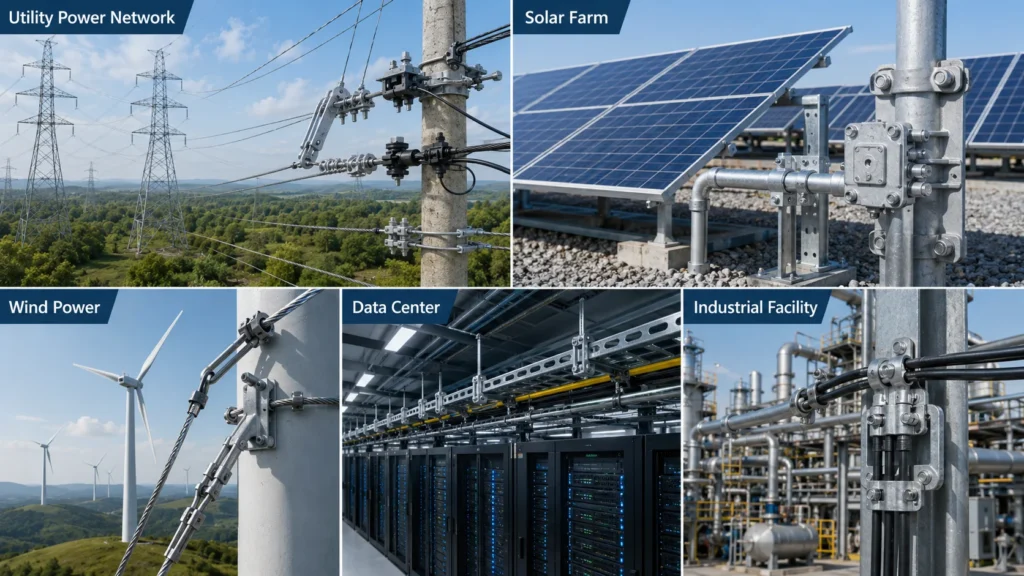
6.1 Utility Power Networks
National and regional utilities operate the most extensive power line networks, connecting diverse generation sources — coal, gas, nuclear, hydro, wind, and solar — to millions of consumers. Grid reliability depends on properly specified connection hardware at every tower, tap, and termination point. Tension clamps at dead-end structures, suspension clamps at tangent towers, and piercing connectors at service drops all play critical roles in maintaining network integrity.
6.2 Renewable Energy Projects
Solar farms and wind installations require specialized electrical infrastructure with reliable connection hardware throughout. Solar generation involves DC-side cable runs that connect panel strings to inverters, with cable connectors and branch connectors managing multiple parallel circuits. Wind farms need collection systems that combine power from multiple turbines before delivering it to a substation for grid connection. The exposed, open-area nature of these installations means all connection hardware must be corrosion-resistant and rated for the environmental conditions.
6.3 Data Centers
Modern data centers consume enormous amounts of power and demand exceptional reliability. Their electrical infrastructure typically includes dedicated substations, UPS systems, and power distribution networks that deliver power to server racks with branch-level monitoring. Every cable termination, busbar connection, and grounding point must be engineered for continuous high-load operation. Reliable compression connectors and bolted joints are essential to prevent hot spots and thermal runaway at high-current connection points.
6.4 Industrial Facilities
Factories and manufacturing plants operate high-power equipment — motors, drives, furnaces, and process controllers — that require robust electrical infrastructure. Medium-voltage switchgear feeds low-voltage distribution panels that power individual production lines. Industrial environments involve heavy switching loads, vibration, and thermal cycling, making high-quality cable connectors, terminal lugs, and grounding hardware essential for preventing connection failures that could cause production downtime.
6.5 Transportation Electrification
Railway electrification, metro systems, and EV charging networks all depend on specialized power line infrastructure. Railway catenary systems deliver power to moving trains through contact hardware that must maintain reliable electrical contact at high speed. EV charging stations require local distribution infrastructure capable of handling high-power DC fast charging, with cable connectors and protection equipment rated for the demanding duty cycles of public charging.
Common Conductor Types at a Glance
| Conductor Type | Conductivity | Mechanical Strength | Best Suited For |
|---|---|---|---|
| AAC (All-Aluminum) | Excellent | Low | Urban distribution, short spans |
| AAAC (Aluminum Alloy) | High | Medium | Coastal & polluted areas |
| ACSR (Steel-Reinforced) | Good | High | Long-span HV transmission |
| ACAR (Aluminum Alloy Reinforced) | Very High | High | Extra-long spans |
| HTLS (High-Temp Low-Sag) | Excellent | Very High | Capacity upgrades on existing lines |
7. International Standards and Compliance
Electrical infrastructure must comply with rigorous international standards to ensure safety, interoperability, and long-term performance.
IEC (International Electrotechnical Commission)
IEC standards govern conductor specifications, insulation coordination, testing procedures, and safety requirements for electrical equipment worldwide. Key standards for power line fittings include IEC 61284 (string insulator sets), IEC 61897 (overhead lines — requirements and tests for fittings), and IEC 62568 (overhead lines — requirements for fittings for overhead transmission and distribution lines).
IEEE (Institute of Electrical and Electronics Engineers)
IEEE standards guide power system design, protection engineering, and reliability analysis. IEEE C135 series covers hardware for overhead transmission and distribution lines, while IEEE 1283 addresses the mechanical loading of overhead line components.
National and Regional Standards
Countries often maintain additional requirements for clearance distances, environmental compliance, and reliability criteria. Products sold across multiple markets must be tested and certified to each region’s standards — CE marking for Europe, UL listing for North America, CCC for China, and equivalent certifications elsewhere. Fitting manufacturers must also comply with material standards such as ASTM for galvanized steel and aluminum alloy specifications.
8. Future Trends Shaping Electrical Power Lines
Smart Grid Integration
Digital sensors, communication networks, and advanced analytics are transforming power line management. Real-time monitoring of conductor temperature, sag, and load enables dynamic line rating — safely increasing transmission capacity without building new corridors. Predictive maintenance powered by AI helps utilities identify failing components — including degrading connections and loose fittings — before they cause outages.
Advanced Conductor Materials
Next-generation conductors — including carbon-core composite (ACCC) and high-temperature superconducting cables — offer significantly higher capacity than traditional ACSR. These technologies allow utilities to upgrade existing lines without acquiring new right-of-way, a major advantage in densely populated areas. However, new conductor materials often require purpose-designed fittings compatible with their specific mechanical and dimensional characteristics.
Underground Grid Expansion
As cities grow and climate resilience becomes a priority, underground distribution networks are expanding rapidly. Modern cable technologies and improved fault location systems are making underground installation more cost-effective and easier to maintain than in the past. The demand for high-quality cable connectors, joints, and termination kits continues to grow in parallel.
Renewable Energy Integration
The shift toward distributed generation — rooftop solar, community wind, battery storage — requires power lines capable of handling bidirectional power flow. Traditional radial distribution networks are being reconfigured as meshed networks with intelligent protection schemes that can adapt to changing generation patterns. This also means more connection points, more branch taps, and greater demand for reliable piercing connectors and branch hardware.
Advanced Fitting Materials and Designs
As power lines are pushed to carry more current and operate in harsher environments, fitting technology is evolving. Corrosion-resistant alloys, composite materials, and improved coating technologies are extending fitting service life. Insulated piercing connectors with enhanced sealing designs are enabling faster, more reliable installations on aerial bundled cables. Smart fittings with embedded sensors are beginning to provide real-time data on mechanical load, temperature, and connection integrity — giving utilities unprecedented visibility into the health of their network’s physical infrastructure.
Frequently Asked Questions
What are the main types of electrical power lines?
The four primary types are overhead transmission lines (most cost-effective for long distances), underground cables (preferred in urban areas), submarine cables (for offshore and island connections), and distribution lines (delivering power to end users). Each type serves a specific role in the power delivery chain.
Why are high voltages used for long-distance transmission?
Higher voltage means lower current for the same amount of power, which reduces resistive losses (I²R losses) in the conductor. This is why transmission networks operate at 110 kV to 765 kV and above — it allows efficient power transfer over hundreds of kilometers.
What are power line fittings and why are they important?
Power line fittings are the hardware components that connect, secure, and protect conductors on overhead and underground power lines. They include tension clamps (anchor conductors at span ends), suspension clamps (support conductors at intermediate towers), insulated piercing clamps (create branch connections without stripping insulation), cable connectors (join conductor segments), and protection fittings (reduce vibration and fatigue). Fittings are critical because a failed fitting can cause a conductor to drop, a branch connection to overheat, or a ground path to be lost — any of which can lead to outages, equipment damage, or safety hazards.
What is the difference between tension clamps and suspension clamps?
Tension clamps (also called strain clamps or dead-end clamps) are installed at the ends of each conductor span and bear the full mechanical tension of the line. They grip the conductor firmly and transfer the load to the tower through insulator hardware. Suspension clamps are installed at intermediate towers along the span — they support the conductor’s weight but allow limited longitudinal movement to accommodate thermal expansion and uneven loading. Both types must grip the conductor without causing damage that could lead to fatigue failure.
How do insulated piercing clamps work?
Insulated piercing clamps create electrical connections on insulated conductors without requiring the cable insulation to be stripped. The clamp contains sharp contact blades that pierce through the insulation layer when the clamp is tightened, establishing electrical contact with the conductor underneath. The clamp body provides insulation around the connection and mechanical retention. This design enables fast, tool-efficient branch connections on aerial bundled cables (ABC) and service drops, while maintaining the weatherproof integrity of the conductor insulation.
What is the difference between transmission and distribution lines?
Transmission lines carry bulk power at high voltages (35 kV and above) over long distances, connecting power plants to substations. Distribution lines operate at medium and low voltages (up to 35 kV), delivering power from substations to homes and businesses. The two systems use different equipment, fitting specifications, and operational procedures.
Are underground power lines better than overhead lines?
Underground lines offer better aesthetics, weather resistance, and public safety, but they cost significantly more to install (often 5–10× more) and are harder to repair when faults occur. Overhead lines remain the standard for long-distance transmission due to their lower cost and easier maintenance. The choice depends on location, budget, and reliability requirements.
What standards apply to power line fittings?
Key standards include IEC 61284 and IEC 61897 (international), IEEE C135 series (North American practice), and national certifications like CE, UL, and CCC. Fittings must be tested and certified to the standards of each market where they are installed. Material specifications — such as ASTM standards for galvanized steel and aluminum alloys — also apply to ensure long-term mechanical and corrosion performance.
How is the growth of renewable energy affecting power line hardware?
Renewable energy installations require extensive connection hardware — from DC-side cable connectors on solar arrays to collection system fittings on wind farms. The open-area, exposed nature of these installations demands corrosion-resistant materials and robust sealing designs. As distributed generation grows, distribution networks need more branch connection points, driving demand for reliable piercing connectors and tap-off hardware that can handle bidirectional power flow safely.
Conclusion
Electrical power lines are the foundation of modern energy infrastructure — and they are evolving rapidly. From traditional overhead transmission to smart-grid-enabled distribution networks, from basic conductors to advanced composite materials, the technology behind power delivery continues to advance. But beneath every innovation, the physical integrity of the network still depends on the fittings that connect, secure, and protect each conductor — tension clamps, suspension clamps, piercing connectors, cable lugs, and protection hardware that must perform flawlessly for decades.
Whether you are building a new transmission corridor, expanding a distribution network, or connecting a renewable energy installation, understanding how electrical lines work — and where the right fittings make the difference between a reliable system and a failure waiting to happen — is the first step toward building infrastructure that is safe, efficient, and built to last.
Looking for reliable power line fittings — piercing clamps, tension clamps, suspension clamps, or cable connectors — for your next project? Contact our team to discuss your requirements.