



Parallel Groove Clamp Types: A Complete Guide
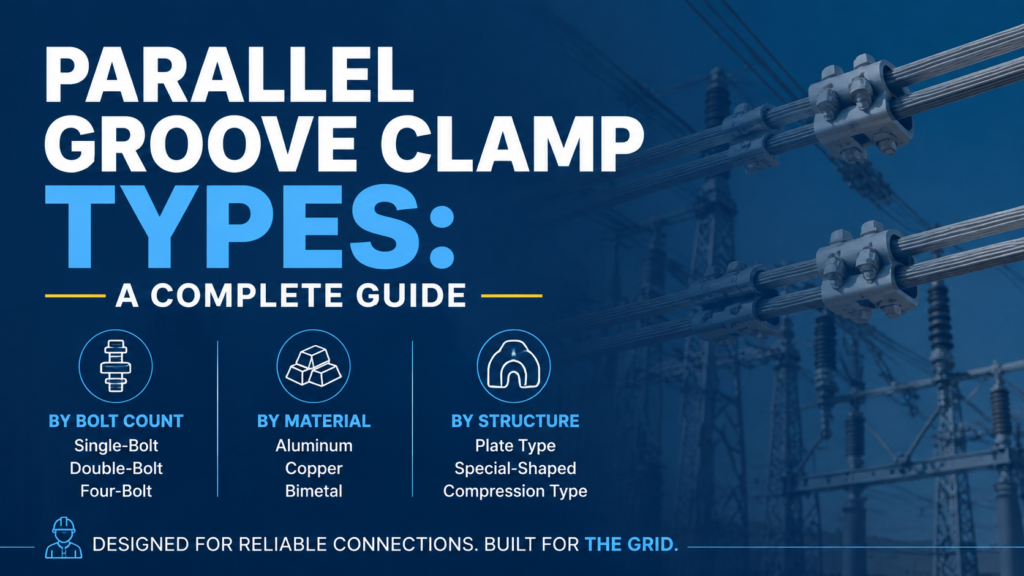
Parallel groove clamps come in several types, and picking the wrong one is a common cause of hot joints and premature failures on overhead lines. The short answer: parallel groove clamps are classified by bolt count (single, double, or four-bolt), material (aluminum, copper, or bimetal), and structure (standard plate, special-shaped, or compression). Match all three to your conductor sizes, material pairing, and joint location, and the connection will stay cool and reliable.
This guide explains each parallel groove clamp type, what it is for, and how to choose between them on real distribution and transmission projects. If you need the basics first, read our introduction to the parallel groove clamp.
Parallel Groove Clamp Types by Bolt Count
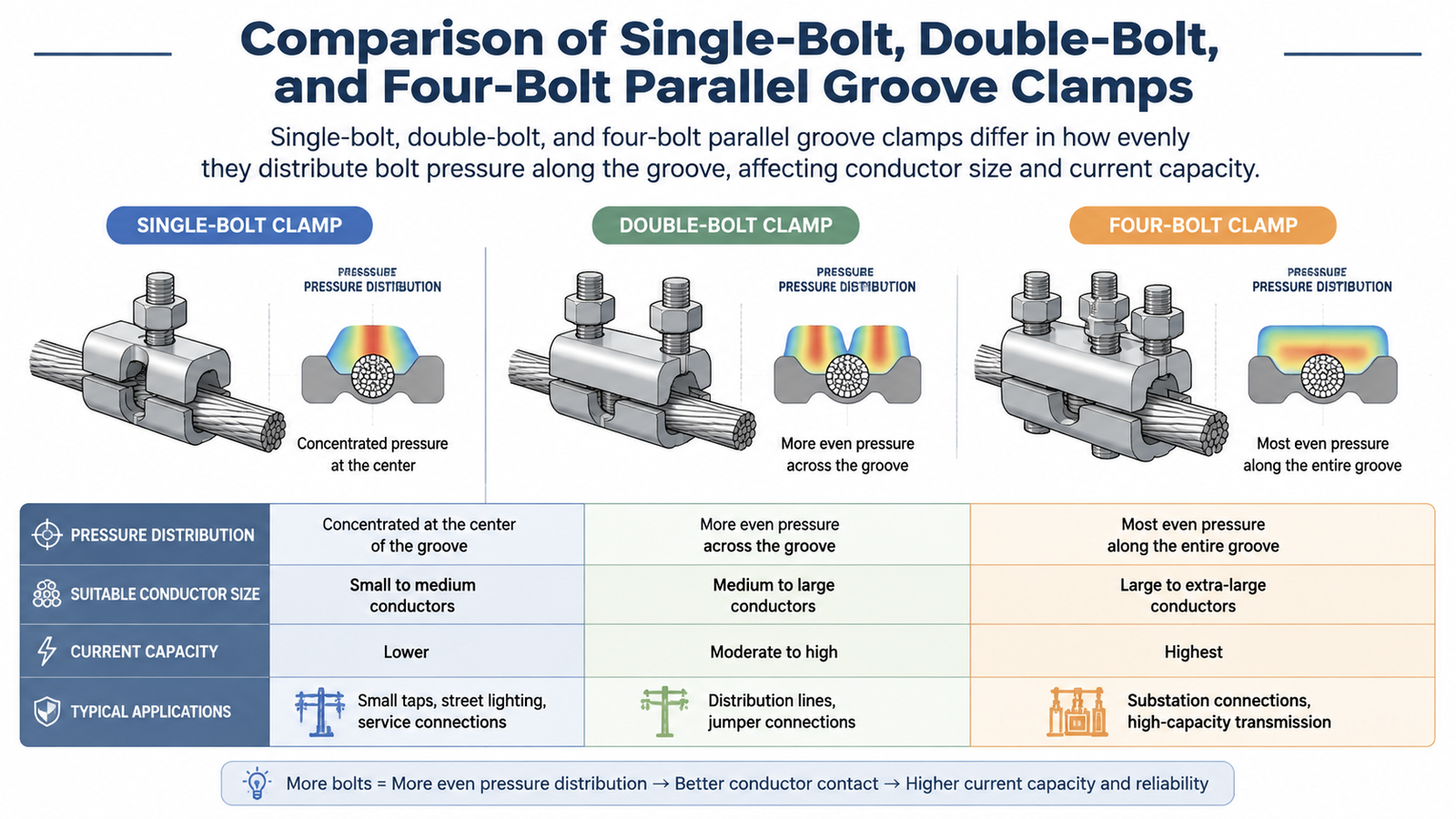
Bolt count determines how much pressure the clamp can apply and how evenly it distributes that pressure along the groove. This directly affects the maximum conductor size and current the joint can handle.
Single-bolt PG clamps
Single-bolt clamps have one bolt in the center of the plates. They are compact, inexpensive, and fine for small taps and light branch connections. Because the pressure concentrates at one point, they are not recommended for large conductors or high-load joints.
Double-bolt PG clamps
Double-bolt clamps spread pressure over two points along the groove, which improves electrical contact and grip. They are the most common choice for standard distribution taps and jumper connections across a wide conductor range.
Four-bolt PG clamps
Four-bolt clamps apply the most uniform pressure and are used for large conductors, high-current joints, and demanding applications such as main feeders and substation connections. The extra bolts also give the strongest mechanical grip under vibration and thermal cycling.
Parallel Groove Clamp Types by Material
The clamp body material must match the conductor material, with one exception handled by transition designs.
Aluminum PG clamps
Aluminum alloy clamps are the standard for overhead aluminum conductors such as AAC, AAAC, and ACSR. They offer good conductivity, light weight, and natural corrosion resistance when surface-treated.
Copper PG clamps
Copper clamps are used with copper conductors, mainly in substations, grounding systems, and copper distribution networks. They provide the lowest resistance of the standard types.
Bimetal and transformed PG clamps
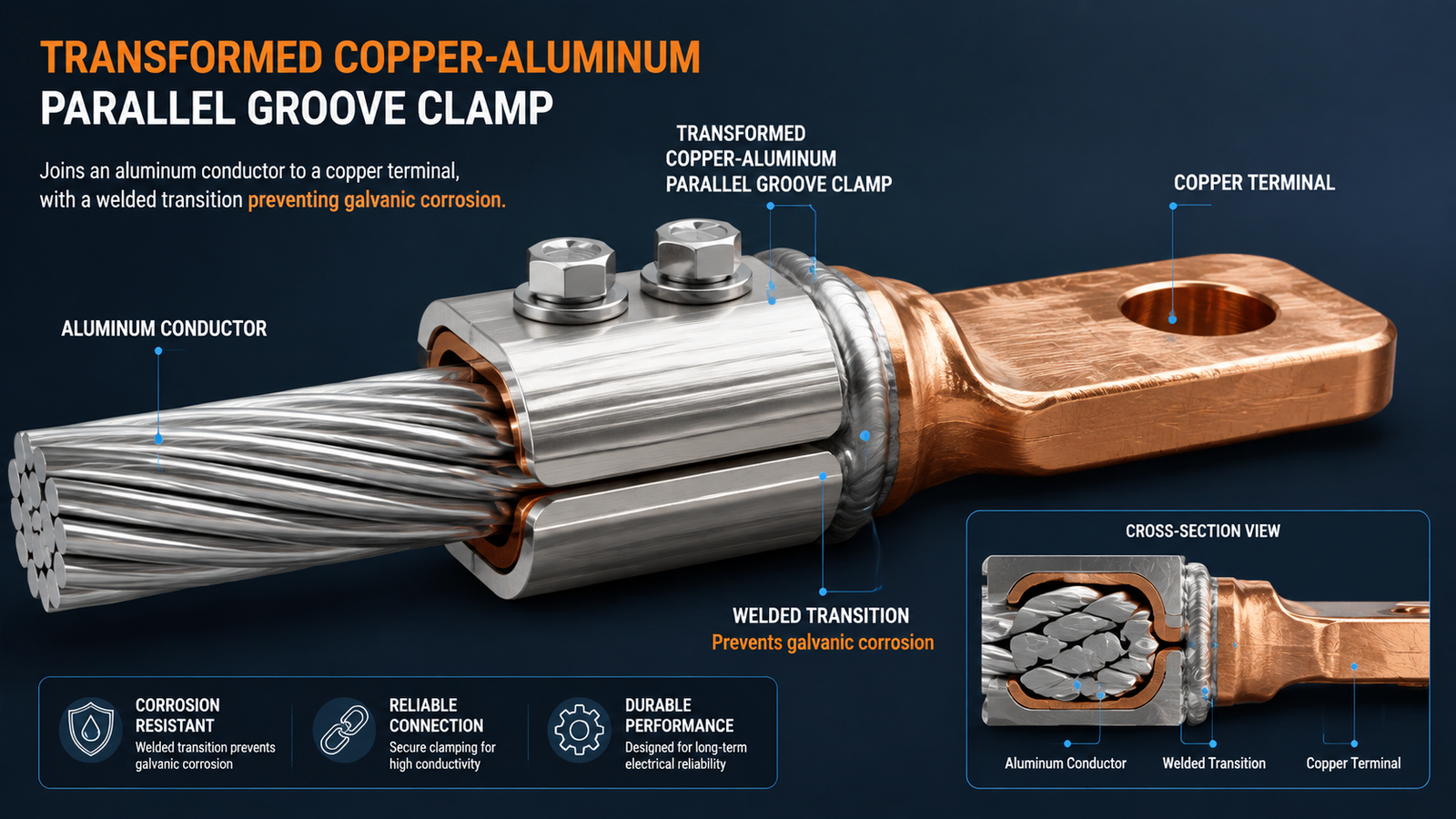
Bimetal or transformed clamps join aluminum conductors to copper conductors or terminals without direct metal-to-metal contact. The transition between the copper and aluminum sections is friction- or explosion-welded, preventing the galvanic corrosion that destroys mixed-metal joints. GGLDF’s CAPG transformed copper-aluminum clamps are made for exactly this job.
Parallel Groove Clamp Types by Structure
Standard plate clamps
Standard plate clamps use two grooved plates and bolts to press the conductors together. This is the classic PG clamp design used for the majority of taps, jumpers, and grounding connections.
Special-shaped clamps
Special-shaped clamps have a contoured body designed for specific joints, such as conductor-to-insulator connections, transformer terminals, or parallel conductors of very different diameters. Some support insulation covers for live-line work, and transformed versions handle copper-aluminum transitions.
Compression PG clamps
Compression-style parallel clamps are crimped onto the conductors with a die instead of relying on bolt pressure. They are less common than bolted PG clamps but provide a permanent joint for high-reliability installations where tooling is available.
Parallel Groove Clamp Types at a Glance
| Type | Best Used For | Key Characteristic |
|---|---|---|
| Single-bolt | Small taps, light branches | Compact and economical |
| Double-bolt | Standard taps and jumpers | Balanced pressure and grip |
| Four-bolt | Large conductors, high current | Most uniform pressure |
| Aluminum body | AAC, AAAC, ACSR conductors | Lightweight, corrosion-resistant |
| Copper body | Copper conductors | Lowest resistance |
| Bimetal / transformed | Aluminum-to-copper joints | Prevents galvanic corrosion |
| Special-shaped | Mixed diameters, insulator connections | Contoured for specific joints |
| Compression | Permanent high-reliability joints | Crimped, not bolted |
How to Choose the Right Parallel Groove Clamp Type
- Identify the conductor materials. Aluminum-to-aluminum uses an aluminum clamp; copper-to-copper uses copper; aluminum-to-copper requires a bimetal or transformed clamp.
- Measure both conductor sizes. The clamp’s groove range must cover both diameters, for example 16-240 mm² or 50-400 mm².
- Estimate the current. Larger loads and main feeders favor four-bolt clamps with larger contact areas.
- Consider the joint location. Taps on small branches can use single-bolt clamps; jumper and substation joints benefit from double- or four-bolt designs.
- Check tooling and access. Bolted PG clamps need only a wrench; compression types need matched dies and a crimping tool.
- Confirm standards and environment. Look for IEC 61284 and IEEE/ANSI C119.4 compliance, and choose galvanized or surface-treated hardware for coastal and industrial sites.
Common Mistakes to Avoid
- Using a single-bolt clamp on a large conductor. Pressure concentrates at one point and the joint overheats.
- Joining aluminum and copper with a plain aluminum clamp. Galvanic corrosion destroys the joint over time; use a transformed clamp.
- Guessing the conductor range. A clamp sized by eye often has a groove that is too large or too small for the conductors.
- Ignoring torque specifications. Under-torqued bolts cause high resistance; over-torqued bolts crush the conductor.
- Choosing a compression clamp without the right dies. The wrong die gives an uneven crimp that fails under load.
- Buying on price alone. A failed clamp on an energized line costs far more than the price difference of the right type.
FAQ
How many types of parallel groove clamps are there?
Parallel groove clamps are typically grouped by bolt count (single, double, four-bolt), material (aluminum, copper, bimetal), and structure (standard plate, special-shaped, compression).
What is the difference between a single-bolt and a four-bolt PG clamp?
A four-bolt clamp distributes bolt pressure over a larger area, giving better electrical contact and a stronger grip. It is used for larger conductors and higher-current joints, while single-bolt clamps suit small taps.
When do I need a bimetal parallel groove clamp?
Whenever an aluminum conductor must connect to a copper conductor or terminal. The bimetal or transformed design prevents galvanic corrosion between the dissimilar metals.
What is a special-shaped parallel groove clamp?
A special-shaped clamp has a contoured body for specific joints, such as conductors of different diameters, insulator connections, or applications that need insulation covers. Transformed versions handle copper-aluminum transitions.
Can I use a compression PG clamp without a crimping tool?
No. Compression clamps must be crimped with the correct die and tool. If no crimping tool is available on site, choose a bolted PG clamp instead.
Which PG clamp type is best for substation connections?
Four-bolt clamps are preferred for substation busbar and equipment connections because they handle high current and provide the most uniform pressure.
Conclusion
Choosing the right parallel groove clamp type comes down to three checks: match the material to the conductor pairing, match the bolt count to the current and conductor size, and match the structure to the joint location. Get those right and your connections will carry load safely for decades.
If you are sourcing clamps for an overhead or substation project, browse the parallel groove clamp range, or contact our engineers with your conductor sizes and materials for a recommendation.