



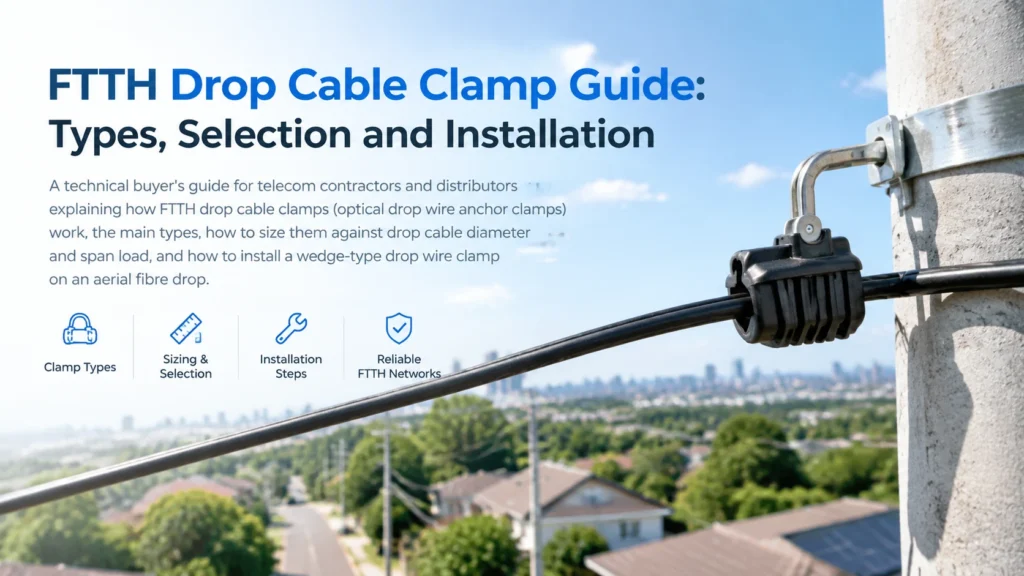
FTTH Drop Cable Clamp Guide: Types, Selection and Installation
An FTTH drop cable clamp is the small piece of hardware that decides whether the last few dozen metres of a fibre network survive a decade of wind, ice, and thermal cycling. Its job is narrow but non-negotiable: grip the drop cable or its messenger so that span tension goes into the pole, bracket, or wall anchor — never into the optical fibres. When the size or style is wrong, the first symptoms are usually a clamp that has crept along the cable, a jacket pinched at the trough exit, or slowly rising attenuation that no splicing recipe will fix.
This guide covers how these clamps work, the styles you will meet on aerial FTTH builds, how to size one against a real cable and span, how to install it without hurting the fibre, and which checks catch problems before a subscriber complains.
What an FTTH Drop Cable Clamp Actually Does
A drop cable clamp is a dead-end device. It terminates the drop cable at a fixed point and holds the mechanical load of the span, so the cable does not carry its own weight between the pole and the building. Three interfaces have to be right at the same time:
- The cable interface. The grip must hold the load-bearing element — the messenger wire, the figure-8 strength member, or the FRP rod inside an all-dielectric drop cable — without deforming the part of the jacket that protects the fibre.
- The mounting interface. The bail, hook, or body must seat correctly on a pole bracket, hook bolt, or building anchor, and stay seated when the span swings in wind.
- The insulation interface. On telecom drop clamps the body is normally a non-metallic polymer, so the clamp does not create a conductive path toward premises equipment.
What the clamp must not do is just as important. It must not compress the fibre-bearing element, and it must not force the cable into a bend tighter than the cable manufacturer’s minimum bend radius at either end of the grip zone. A clamp that grips well but exits the cable over a sharp edge will pass a pull test on the day of installation and still cause macro-bending loss months later.
This is also what separates a drop cable clamp from a suspension clamp. A suspension clamp carries vertical load at an intermediate support point and deliberately allows the cable to move longitudinally; a dead-end or anchor clamp stops that movement entirely. If your route needs intermediate supports between poles, use a suspension clamp rather than a tension clamp at those points.
Types of FTTH Drop Cable Clamps
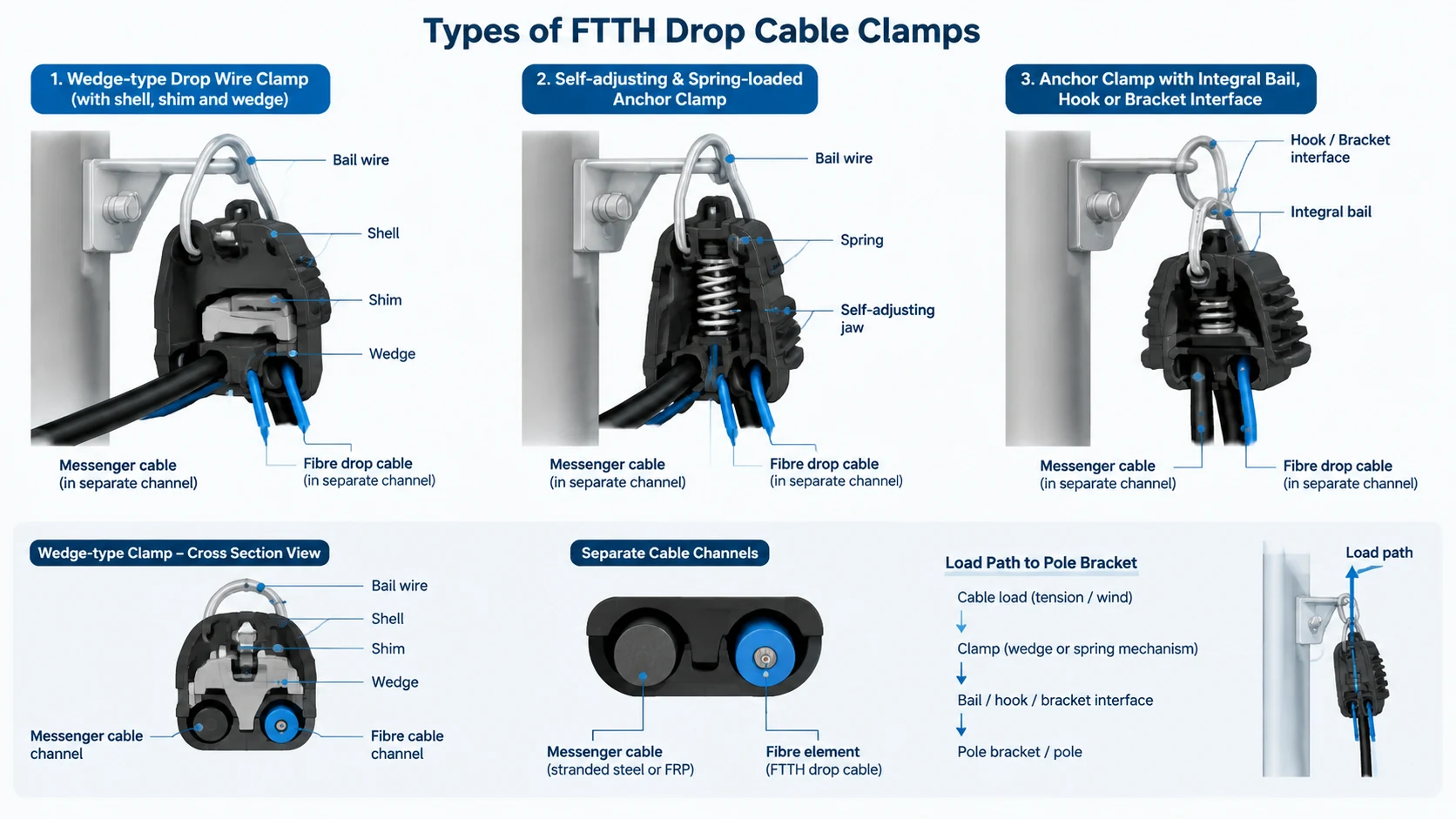
Most aerial drop hardware falls into three families. They differ in how the grip is generated, which decides how forgiving they are on site.
Wedge-type drop wire clamps
The wedge type is the workhorse of FTTH rollouts, and it is also the design most often installed incorrectly. It has three parts: a shell that holds the cable, a shim that sits between the cable and the wedge, and a wedge that is driven into the shell. Friction between the shim and the cable converts span tension into grip, so the clamp tightens itself as load increases.
Two details matter more than any other. First, the wedge is inserted narrow end first — reverse it and the clamp cannot self-tighten, so it slips under load almost immediately. Second, the raised embossing on the shim faces the cable. The embossing raises the friction coefficient without concentrating stress at a single point, which is what lets a wedge clamp hold a jacketed drop cable firmly without crushing it.
Wedge clamps are available for flat drop cables and for round drop cables. The shell trough is profiled for the cable cross-section, so a shell made for a flat 2 × 5 mm cable will not grip a round cable of similar diameter correctly — the cable tilts in the grip zone and load concentrates on one edge.
Self-adjusting and spring-loaded anchor clamps
These use a polymeric wedge or a spring that follows the cable diameter instead of a fixed shell profile. The practical benefit is inventory: one model covers a diameter range, which reduces the number of variants a crew has to carry and lowers the chance of installing the wrong size. The trade-off is that grip depends on the mechanism rather than on a matched shell, so pull-out performance should be confirmed from the supplier’s test data for your specific cable, not assumed from the diameter range alone.
Anchor and drop clamps with an integral bail, hook, or bracket interface
The bail wire or hook is the mechanical link between the clamp and the structure, and it is frequently the weakest point of a cheap assembly. Look at three things: the material and grade of the bail (marine or industrial environments push you toward 304 or 316 stainless rather than a basic grade), whether the loop is closed or has a self-locking open hook, and whether the geometry lets you install the clamp on a span that is already strung.
An open-hook, “one-pass” design lets the installer hang the clamp on the bracket and seat the cable without threading the cable end through the clamp body. On a live span that saves time and avoids cutting and re-splicing cable just to fit hardware.
Where suspension clamps and ADSS clamps belong
Not every drop needs a dead-end clamp. Long aerial drops with intermediate support points use suspension clamps at those points, and fibre routes carried on ADSS cable use dielectric suspension and tension assemblies designed specifically for all-dielectric cable. Those are separate product families with their own selection rules — mixing a drop cable clamp into an ADSS span, or the reverse, is a common and avoidable mistake.
How to Select an FTTH Drop Cable Clamp
1. Match the clamp to the actual cable, measured not guessed
Start with the cable datasheet, then confirm the installed outer diameter with a caliper. The relevant dimensions are the overall cross-section, the position and size of the strength member or messenger, and the jacket material. A mismatch of even a millimetre can be enough for a wedge to seat incorrectly, which produces either insufficient grip or excessive compression on the jacket. Do not size from the cable’s nominal description alone; two “4 × 8 mm” drop cables from different suppliers can differ in both dimensions and jacket hardness.
2. Check the load rating against span, wind, and ice
Drop clamps are rated by breaking load, quoted in kilonewtons. Design the installation around a working load that is a fraction of that figure, and make sure the clamp rating exceeds the tension the cable will actually see at the design wind and ice condition for your route. The allowable span itself comes from the cable manufacturer’s tension and sag data, not from the clamp — the clamp only has to hold what the cable puts on it. Treating the breaking load as an operating load is one of the most common specification errors on aerial drop work.
3. Choose materials for the environment, not just for the price
Two material decisions drive service life. The body is a UV-stabilised engineering polymer, and the quality of the UV package decides how the clamp performs after several summers of direct exposure. The metal parts — bail, hook, and any fasteners — decide corrosion behaviour. Galvanised steel is adequate inland; coastal, industrial, and high-humidity sites justify stainless steel, and where different metals meet, dissimilar-metal corrosion has to be considered. For projects with material restrictions, ask for a RoHS declaration rather than assuming it.
4. Confirm how the clamp mounts to the structure
A clamp is only as strong as what it is bolted to. Check the bracket, hook bolt, banding, or wall anchor rating as a system, verify the bracket hole or groove geometry accepts the clamp’s bail without the loop sitting across a ridge, and confirm the assembly cannot rotate or spin once loaded. GGLDF, for example, publishes a 15 kN rating for the CA1500 pole bracket used with its drop-cable and ABC clamps — always confirm the current figure against the datasheet for your project rather than relying on a catalogue page.
5. Ask for the test evidence behind the rating
Mechanical ratings are only useful if they are supported. For optical drop hardware, buyers commonly request the slip and load test data for the clamp with the intended cable, evidence of climatic ageing or UV exposure, the operating temperature range of the polymer body, and batch traceability. Test method references vary by market; optical cable hardware is often assessed against the mechanical test methods in the IEC 60794-1-21 series, but what matters is that a report for your product actually exists and names the cable it was tested with.
Selecting from the GGLDF ODWAC Drop Cable Range
GGLDF’s optical drop wire anchor clamps are grouped in the tension clamp range for ABC and optical drop cables. The table below lists the current published figures so you can shortlist before requesting full datasheets.
| Model | Cable size | Breaking load |
|---|---|---|
| ODWAC-15 | 2 × 6 mm | 1 kN |
| ODWAC-20 | 2 × 6 mm | 1 kN |
| ODWAC-21T | 2 × 6 mm | 1 kN |
| ODWAC-22/26 | 2 × 6 mm | 1 kN |
| ODWAC-22G | 2 × 6 mm | 1 kN |
| ODWAC-24 | 2 × 5 mm | 1 kN |
| ODWAC-24S | 2 × 5 mm | 0.5 kN |
| ODWAC-24SL | 2 × 5 mm | 0.5 kN |
The ODWAC-22H and ODWAC-22S models are also published at a 1 kN breaking load; confirm their cable range on the current datasheet before ordering. Within the range, the practical split is between the 1 kN bodies intended for the heavier flat drop profiles and the 0.5 kN models such as the ODWAC-24S, which suits lighter 2 × 5 mm drops. For the LV distribution line itself, the same catalogue carries heavier anchor-type hardware — the PA1500 plastic tension clamp for 50–70 mm² ABC, for instance — but those are sized for bundled distribution cable, not for a customer drop.
How to Install an FTTH Drop Cable Clamp
Before you climb
Confirm five things: the measured cable outer diameter against the clamp size; the cable’s minimum bend radius from its datasheet; the rating of the bracket or wall anchor; the required ground clearance and drip-loop geometry for the route; and the tools you will actually use. A caliper, a wrench, and clean hands do more for reliability than any torque specification applied to the wrong clamp size.
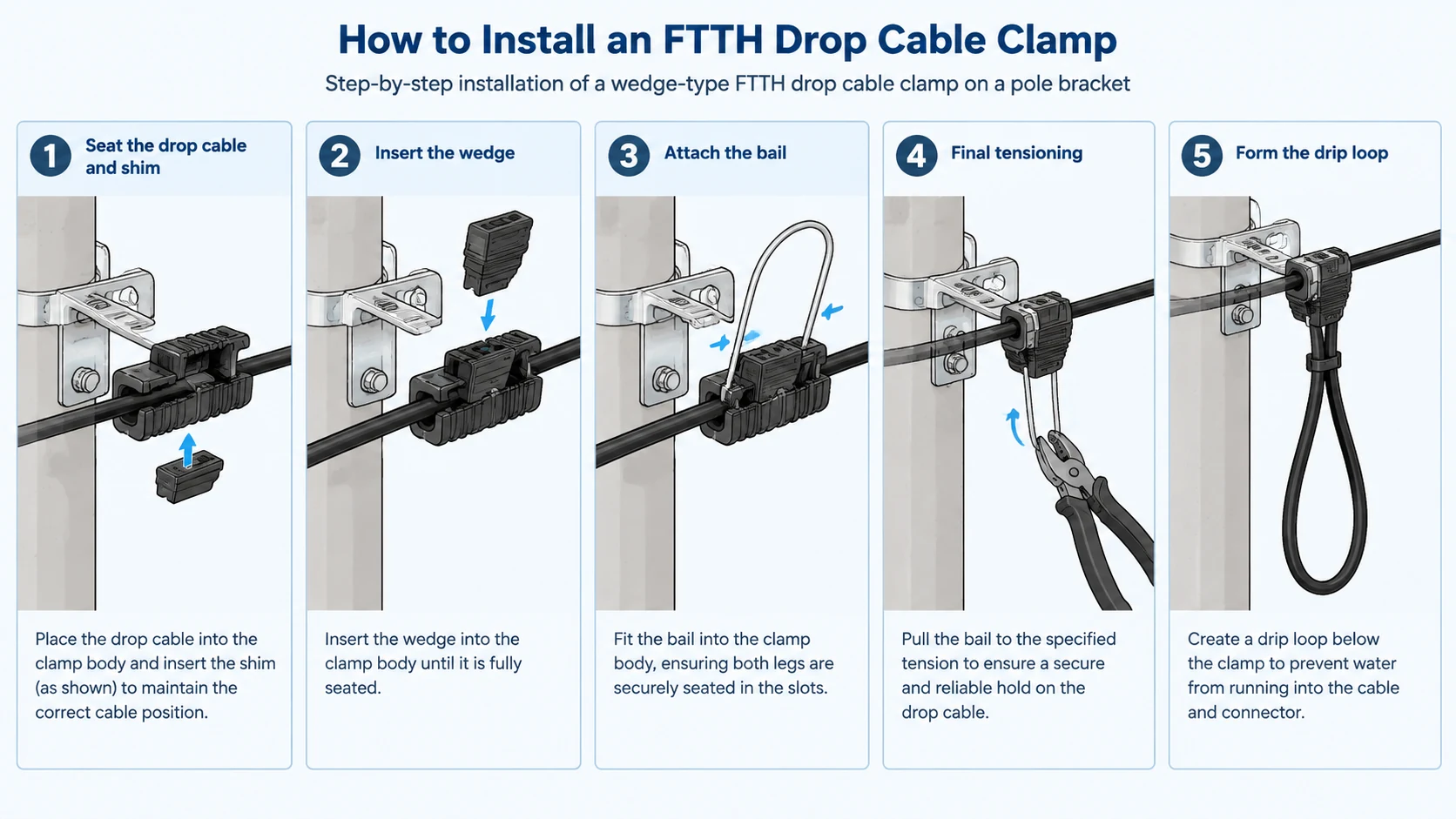
Step-by-step for a wedge-type drop wire clamp
- Inspect and measure. Check the clamp for cracks or a distorted shell, and confirm the cable diameter with a caliper. Reject any clamp with damaged teeth or a bent bail.
- Mount the anchor hardware. Fit the bracket, hook bolt, or wall anchor at the designated point and check it is rated for the combined cable weight and wind load. Seal wall penetrations against moisture ingress.
- Seat the cable in the shell. Lay the cable into the open trough. On figure-8 or self-supporting drop cable, the messenger or strength member must sit in the load-bearing channel and the fibre-bearing element in the unloaded channel. Keep the cable straight through the grip zone — no twist, no lateral offset.
- Place the shim. Set the shim on the cable with the raised embossing facing downward onto the cable surface, making firm contact. Never omit the shim; without it the wedge contacts the jacket directly and concentrates force on a single edge.
- Insert the wedge. Enter the wedge narrow end first into the large end of the shell track and push it in by hand until it engages. Do not use a hammer — if the wedge will not seat by hand pressure, the shell size is wrong for the cable.
- Attach the bail to the anchor. Loop the bail wire through the bracket or hook before applying final tension, so the clamp can still be positioned precisely.
- Set the clearance. Pull the drop cable through the clamp until the span reaches the required ground clearance, then hold that position.
- Tension the clamp. With one hand holding the cable in position, pull the clamp body sharply toward the anchor point. This drives the wedge to its final seated position and locks the cable. Then apply hand tension to the cable and confirm there is no slippage.
- Form a drip loop. Create a small downward loop in the cable below the clamp so water running down the cable cannot travel into the building, and so the loop absorbs thermal movement instead of loading the clamp.
Installation mistakes that show up months later
- Oversized shell. The cable tilts in the grip zone and the load concentrates on one edge of the jacket.
- Wedge installed backwards. No self-tightening action; the clamp slips as soon as the span loads up.
- Shim skipped. Direct wedge contact deforms the jacket and can induce micro-bending in the fibre.
- Wedges hammered home. Over-compression permanently deforms the jacket and can damage the fibre core, even when the pull test passes.
- Tight bend at the trough exit. A sharp edge where the cable leaves the clamp creates a permanent bend at the point of maximum mechanical stress. Check both the clamp geometry and the routing on either side.
- Mixed hardware grades. A galvanised bracket with a stainless bail, or a plain-steel hook in a coastal area, moves the failure point from the clamp to the mounting.
- No drip loop. Water tracks along the cable into the premises, and the terminator becomes the weakest point of the link.
Inspection and Maintenance
Drop clamps are low-maintenance items, but they are not maintenance-free. Inspect the run in the first few months after installation, when most settling and creep occur, and then on the normal network inspection cycle. Look for cable movement through the grip zone, corrosion or rust staining around the bail and bracket, cracks in the polymer body, and any change in the cable’s path at the clamp — a cable that has started to bend more sharply is usually a sign the clamp has slipped.
After storms or ice loading, re-check the spans that carried the highest load. Replace, do not re-tension, any clamp with a cracked body, a deformed bail, or a shell that no longer seats the cable squarely, and support the cable while swapping hardware so the load is never transferred to a splice. Where local practice allows re-tensioning of a sound clamp, follow the manufacturer’s instruction for that specific model rather than applying a generic procedure.
Frequently Asked Questions
What is the difference between a drop wire clamp and an anchor clamp?
In practice the terms overlap. Both are dead-end devices that hold the tension of a span at a pole, bracket, or building entry. “Anchor clamp” tends to be used for the wider family, including heavier clamps on LV ABC distribution lines, while “drop wire clamp” usually refers to the lighter hardware used to terminate a customer drop. What matters is the load rating and cable range, not the label.
How long a span can one FTTH drop cable clamp support?
There is no universal answer, because the limiting factor is normally the drop cable’s own tension and sag performance rather than the clamp. The published breaking load of a 1 kN clamp is not an operating limit — design to a working load well below it and confirm the allowable span from the cable manufacturer’s data for your wind and ice condition.
Will an FTTH drop cable clamp damage the fibre?
Not when the size matches the cable and it is installed as designed. Damage comes from three avoidable causes: a shell too large for the cable, a missing shim, or a sharp bend where the cable exits the grip zone. A correctly sized wedge clamp with its shim fitted spreads the load across the grip length rather than concentrating it.
Can one clamp size fit several drop cable sizes?
Only if it is designed to. Self-adjusting models cover a published diameter range and reduce the number of parts a crew carries. Fixed wedge clamps are matched to a specific cable profile, so a 2 × 5 mm shell should not be used on a 2 × 6 mm cable even though the difference looks small.
What is the shim for in a wedge-type drop wire clamp?
The shim sits between the cable jacket and the wedge. Its raised embossing increases friction at the cable interface while spreading the clamping force, so the clamp can hold the load without the wedge cutting into or crushing the jacket.
Does a drop cable clamp need to be electrically insulated?
For telecom drops, a non-metallic body is the norm because it avoids creating a conductive path between the support structure and premises equipment. That is a design characteristic, not a substitute for correct earthing practice — where a route shares structures with power circuits, follow the clearance and bonding rules that apply in your market.
What to Specify on Your Next Order
An aerial drop is only as reliable as the clamp that terminates it. Size the clamp to a measured cable diameter, keep the working load well inside the breaking load, match materials to the environment, and install the wedge, shim, and bend radius exactly as the design intends. Those four decisions cover most of the failure modes seen in the field.
GGLDF manufactures optical drop wire anchor clamps and the related tension, suspension, and bracket hardware used on aerial FTTH and LV distribution lines. If you send us your drop cable cross-section, required span, and site environment, our team can confirm the matching model from the ODWAC range and supply datasheets for review — get in touch with our technical sales team.