




How to Specify Overhead Line Fittings in an RFQ
Most requests for quotation for overhead line fittings do not fail on price. They fail on data. A buyer sends a list that reads “tension clamps 200 sets, suspension clamps 300 sets, delivery 60 days” and receives back not a quotation but a page of questions: which conductor, what outer diameter, what span, what string, what environment. Each round of answers takes days, each answer changes the configuration, and by the third exchange the supplier is quoting from assumptions instead of from the specification. The order that eventually arrives is then a different order from the one anyone priced.
The reason is structural. A line fitting has no independent existence: a tension clamp is defined by the conductor it grips and the load it holds, a suspension assembly by the conductor it carries and the structure it hangs from. Asking for the fitting without the conductor data is like asking for a key without the lock. This article sets out what a request for quotation must contain so a fittings supplier can quote firm on the first pass — item by item, why each item is needed, and what happens downstream when it is missing. It does not cover how to choose between clamp types; that selection logic is covered separately for tension clamp types and in how to choose a suspension clamp. Here the subject is the specification itself — the document that decides whether the quotation you receive describes your line or the supplier’s guess.
Why the Conductor Data Comes First
Every dimensional and mechanical property of a line fitting traces back to one item: the conductor it is fitted to. The groove diameter of a suspension clamp, the wedge angle of a tension clamp, the grip length, the rated load of the assembly, even the packing quantity per carton — all are functions of conductor diameter and construction. This is why the first block of an RFQ, before any fitting list, is the conductor schedule.
Four items define a bare conductor for fitting purposes, and buyers routinely supply one of the four and omit the rest.
Conductor type. ACSR, AAC, AAAC, and ABC are different products with different fitting families. An aluminium conductor steel reinforced carries its strength in the steel core, so tension hardware grips a composite section; an all-aluminium conductor concentrates the same nominal area in softer aluminium strands, so the clamp must distribute pressure more gently. Aerial bundled cable is a system, not a bare conductor, and it takes its own hardware family — clamps, connectors and insulation accessories designed around the bundled configuration described in aerial bundled cable fittings. Insulated covered conductors sit in yet another category, because the fitting must compress insulation, not just aluminium. Writing “aluminium conductor” without the type is the single most common reason a first quotation comes back wrong.
Nominal cross-section. Useful as an identifier, useless on its own as a fitting dimension. A 120 mm² conductor under one national standard and a 120 mm² conductor under another can differ in actual diameter by a noticeable margin, because the nominal area is a rating, not a measurement.
Actual outer diameter. This is the number the clamp groove is machined to. Suppliers do not need it to three decimal places, but “approximately” is not enough either: a suspension clamp range is a band, and a conductor sitting at the wrong end of the band either slips under load or is gripped so hard the strands are damaged. Give the measured diameter from the conductor datasheet, and state which standard the datasheet follows.
Stranding construction. The lay-up — for example, a steel core with a stated number of aluminium layers — determines how the conductor behaves under a clamp. A conductor with a heavy steel core and few aluminium layers tolerates point pressure differently from a soft all-aluminium section of the same diameter. Two conductors with identical outer diameter but different stranding do not automatically take the same clamp, and a quotation issued on diameter alone can miss this.
Give these four per conductor, if the project has several. A distribution line mixing three conductor sizes needs the fitting schedule split per size, not one blended quantity, because every clamp order line will be configured per diameter anyway.
The Required-Items Checklist, and What Each Gap Costs
The table below is the core of this article. It lists what an RFQ for line fittings must contain, why the supplier needs it, and what typically happens when it is left out. The consequences column is not hypothetical — each row is a recurring pattern in fittings procurement.
| Required item | Why the supplier needs it | If it is missing |
|---|---|---|
| Conductor type (ACSR / AAC / AAAC / ABC / insulated) | Decides which fitting family applies at all | Quotation covers the wrong family; whole schedule re-quoted after the first reply |
| Nominal cross-section and conductor standard | Identifies the conductor unambiguously between national designations | Supplier assumes a standard; diameter and groove do not match the real conductor |
| Actual outer diameter | Machining dimension for grooves, wedges and grip ranges | Clamps quoted at the edge of their range; slip or strand damage risk found after installation |
| Stranding construction | Determines permissible clamping pressure and wedge behaviour | Substitution risk: two conductors of one diameter treated as interchangeable when they are not |
| Span and design tension | Sets the load class of tension and suspension assemblies | Fittings quoted at a generic load rating; either over-specification or a rating below the line’s actual working load |
| Structure type and string configuration | Defines attachment hardware, link plates, and whether a suspension or tension string applies | Assemblies arrive without the clevis, ball-eye or socket the towers actually take |
| System voltage | Governs insulation coordination, corona considerations, and clearances in the string | Hanging hardware quoted without the insulation class the string requires |
| Environment (coastal, industrial, icing, high wind) | Determines material and coating requirements for body and fasteners | Standard galvanising quoted for a salt-heavy site; service life falls far short of expectation |
| Fitting categories and quantities per conductor | The actual bill of quantities the quotation prices | Blended totals that cannot be split per size; prices issued per “set” with undefined contents |
| Third-party inspection requirement | Must be scheduled and costed before production, not added afterwards | Inspection requested after booking; production holds and the delivery date slips |
| Packing and marking requirements | Export packing, carton labels, and set composition are part of the price | Goods arrive in bulk packing; sets must be re-sorted on site before crews can work |
| Delivery port and time window | Production planning and booking depend on both | “ASAP” quoted as a best case that the factory never committed to |
| Documents required with the shipment | Material certificates and test records are produced per lot during production | Documents requested after shipment cannot reference the delivered lots |
Two general points about the table. First, the rows are not independent: outer diameter depends on conductor type and standard, load class depends on span and tension, and coating class depends on environment — which is why a partial RFQ produces a quotation that looks complete and is not. Second, every row that gets answered after the quotation has been issued is a change to a priced configuration, and priced changes are where procurement budgets leak.
Spans, Tension and the String the Fitting Joins
Conductor data defines the grip; line geometry defines the load. A fitting on a short urban span with modest tension and a fitting on a long rural span of the same conductor are not the same product, even though they clamp the same aluminium.

Span. Give the ruling span, or the range of spans if the line varies. Span drives vibration exposure and, with it, the fatigue environment the suspension assembly lives in.
Design tension. State the maximum working tension or the design tension of the line, and say which one the figure is. A tension assembly is selected against the load it must hold continuously; quoting against a guessed rating is how assemblies end up either over-priced or under-rated.
Structure type and string configuration. A wooden pole takes different attachment hardware from a steel tower; a suspension string and a tension string are different assemblies with different components. If the project already uses a string design, include the string drawing or at least the fitting points: what connects to the tower, what connects to the conductor, and any intermediate hardware the buyer intends to reuse. Suppliers price complete strings far more accurately than isolated clamps, and mixed hardware from a previous project is a common source of fit problems at erection.
System voltage. Voltage is not only an electrical rating. It affects the length and composition of the string, insulation coordination, and at higher voltages whether grading or arcing protection hardware belongs in the assembly. State nominal voltage and whether the line is overhead bare, covered, or bundled.
Environment: The Row That Decides Material and Coating
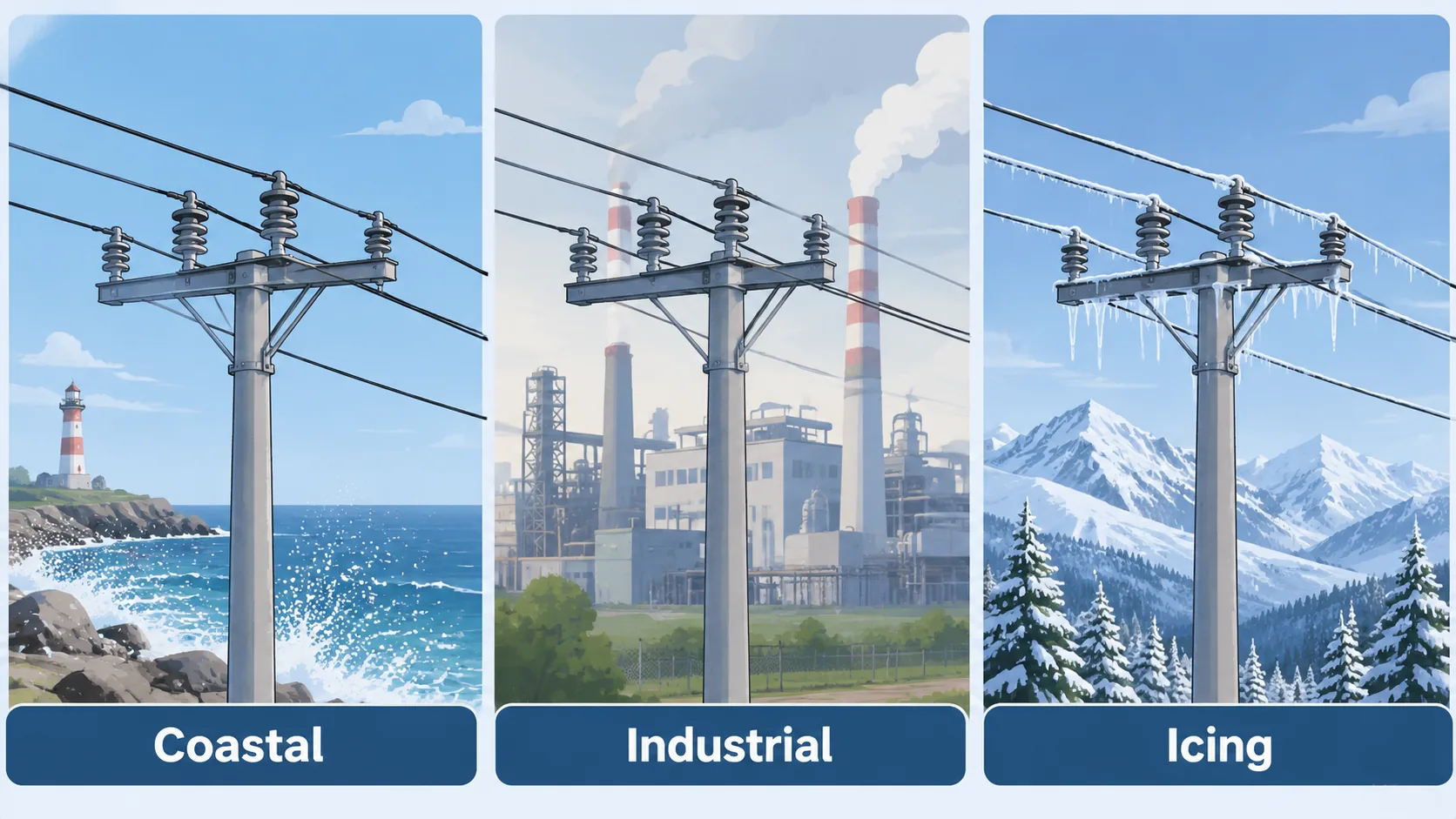
Two identical orders for the same conductor can correctly be quoted in different materials purely because of geography. A coastal line breathes salt; an industrial corridor breathes sulphur compounds; a mountain section adds ice loading and a wind-exposed plain adds fatigue cycles. The RFQ should say where the line is, in plain terms, and the buyer does not need to prescribe the solution — “coastal, 2 km from the shore, no de-icing” tells a competent supplier more than a guessed coating class does.
What matters is that the environment is stated once, clearly, and applied consistently to every line item. The recurring failure is partial specification: galvanised bodies specified for a coastal site while the fasteners, pins, and spring washers — the parts that corrode first — are left unmentioned and quoted at the cheapest default. Say explicitly that coating requirements apply to fasteners and small parts too, and that dissimilar-metal contact in the assembly must be accounted for in the design offered.
Say What You Need, Not What You Have Seen
Much of the ambiguity in fittings RFQs comes from describing scope the way a colleague once described it, rather than as a specification. The table below lists phrasings that appear regularly in incoming RFQs, and how the same line should read so it can be quoted without a round of questions.
| Commonly written | Why it cannot be quoted | Write instead |
|---|---|---|
| “Tension clamps, 100 sets” | “Set” is undefined and the clamp is undefined without a conductor | “Bolt-type tension clamp for ACSR, actual outer diameter as per datasheet, tension string complete with shackle and link hardware; 100 sets per conductor size” |
| “Suspension clamps to suit our conductor” | The supplier does not have “our conductor” unless it is named and dimensioned | “Suspension clamp with keeper for ACSR [type], measured outer diameter [value] mm, allocation per span schedule attached” |
| “Connectors for jointing, assorted” | Jointing method and conductor pair are missing | “Mid-span joints for ACSR-to-ACSR of the stated diameters; parallel groove connectors for AAC jumpers; quantities per size in the schedule” |
| “Accessories as required” | Nothing is priced, so nothing is certain to arrive | “Cotter pins, washers and spring washers per string drawing, quantity per string, total strings stated” |
| “Standard export packing” | Means different things on different docks | “Cartons marked with part number, conductor range and quantity; sets bagged together per string; palletised and shrink-wrapped for open-yard transit” |
| “Inspection as per usual practice” | Neither party can plan or cost it | “Third-party inspection at final production stage; scope: visual, dimensional sampling and documentation review; witness points listed in the annex” |
The pattern in the right-hand column is consistent: name the conductor, name the diameter, define the word “set”, and attach quantities per configuration. A supplier who receives that can produce a firm quotation; a supplier who receives the left-hand column can only produce a questionnaire.
Quality Evidence: Decide in the RFQ, Not at the Dock
Everything about verification is cheaper to arrange before the order than after it. The RFQ should state three things explicitly.
Whether third-party inspection is required at all. If it is, name the stage — final, pre-shipment, or during production — and the scope. Inspection that appears in the order acknowledgement was priced and scheduled; inspection that appears in an email after production started costs the delivery date.
Which documents must travel with the shipment. Material certificates traceable to the production lots, and routine test records for the items that are tested per lot, are generated during production. A buyer who states in the RFQ that certificates must reference heat or lot numbers receives paperwork that reconciles with the goods; a buyer who asks afterwards receives whatever the archive still holds. What to do with those documents on arrival — how to check them against cartons and part numbers — is the subject of incoming inspection of line hardware, and the two processes only work if they are designed to match.
What the acceptance basis will be. The RFQ does not need to contain a full inspection plan, but it should commit to the principle: characteristics will be checked against the manufacturer’s drawings and the figures stated in the specification, with sampling agreed before production. Buyers sometimes hesitate to put inspection language into a first RFQ for fear of complicating the quotation; in practice it does the opposite, because it fixes the same basis for every bidder and makes the quotations comparable.
Packing, Marking and Delivery: Boring Rows That Decide the Schedule
Packing is not a courtesy item. Fittings ship as heavy small-parts cargo; loose in bulk cartons, suspension clamp keepers and cotter pins migrate, and a string that cannot be assembled complete at the tower is a delayed string regardless of how good the clamps are. State how the goods will be issued to crews: if the site issues complete strings, say that sets are to be bagged or boxed together per string, and make the carton label carry part number, conductor range, and quantity. If the buyer intends to re-sort at the site store, fine — but say so deliberately, because the quotation will otherwise assume the cheaper bulk packing.

For delivery, two data points: the port or crossing point, and a time window rather than a date. “Delivery by mid-quarter” gives production a real plan; “urgent” gives it nothing. If the project has a stringing season or an energisation deadline, say what it is and what happens if it is missed — a supplier planning around a fixed deadline prices and schedules differently from one filling a gap between orders. And if part of the quantity is needed earlier than the rest, split the delivery schedule in the RFQ rather than asking for partial shipments later; split shipments are easy to agree when they are priced and hard to extract once the order is running.
Frequently Asked Questions
Is it enough to give the conductor type without the outer diameter?
Occasionally, if the conductor type and standard uniquely fix the dimensions and the buyer names both. But this relies on the supplier’s assumption that the standard was applied exactly, and conductors of the same nominal designation vary between standards and between vintages. The measured outer diameter is the dimension clamps are actually made to, and supplying it removes the last assumption from the quotation. It is one line in the RFQ and the single highest-value line in it.
Are fittings for the same conductor interchangeable between manufacturers?
Not automatically. The conductor range may be the same, but interface details — attachment hardware, link dimensions, cotter arrangements — differ between designs. Mixing fittings from different sources on one string is workable only where the interface hardware matches what the towers and the existing string take, which is precisely why the RFQ should include the string drawing or attachment data. Quote the line, not a catalogue page.
Should a target price be included in the RFQ?
A target price is legitimate commercial information, but it must not be the only quantity anchor. If a target is given, give it alongside the full technical specification, and expect bidders to respond to the specification rather than to the number. A target price without a specification invites suppliers to remove the features that pushed the price over the target — usually coating class, packing, and documentation, the three items hardest to inspect on arrival.
Does the RFQ need to name inspection standards?
It needs to name the requirement for inspection and the acceptance basis; it does not need to legislate every test method. Name which characteristics matter — dimensional conformity to drawing, coating class, documentation — and let the supplier’s offer state how each is demonstrated. What must be fixed in writing is that acceptance is against the specification and the drawings at a stated revision, not against “normal practice”.
Can one RFQ cover several fitting categories at once?
Yes, and it usually should, because fittings are priced as a system: a tension string and its suspension hardware share conductor data, environment, packing and shipping. The structure that works is a schedule with one block per conductor size, listing categories, quantities and any special requirements per line, with the common items — environment, inspection, packing, delivery — stated once for the whole request. Splitting one line’s fittings across several unconnected RFQs is how packing, coating and marking requirements end up inconsistent between deliveries to the same site.
A specification that survives contact with a supplier’s quotation desk comes down to a short list of disciplines: name every conductor with its type, standard, measured diameter and stranding; state the span, tension, structure and voltage that set the load class; describe the environment once and apply it to every line item including fasteners; define the word “set”; and fix inspection, documents, packing and delivery in the RFQ rather than in correspondence. None of this is technical difficulty — it is completeness, and it is entirely within the buyer’s control before the first quotation arrives. When the specification is ready, the hardware side of it — tension clamps, suspension clamps, and insulation piercing connectors — can be quoted against it directly, and the quotation that comes back will describe the line that is actually going to be built.