



Tension Clamp Types Compared: Compression, Bolted, Wedge and Preformed
When buyers ask about tension clamp types, they are usually not asking which one is strongest. All four structural families can hold a properly matched conductor. The real question is which one fits your conductor, the tools your crew actually carries, how permanent the termination has to be, and what happens when something needs to come apart again.
This article compares the four families — compression, bolted, wedge and preformed — by conductor, tooling, whether they are crimped, where they are used, where each reaches its limit, and how each fails when specified or installed wrong. It also clears up the naming, because tension clamp, strain clamp and dead-end clamp are used inconsistently in catalogues and tenders.
Tension Clamp or Dead-End Clamp: Clearing Up the Name First
In overhead line hardware, a tension clamp, a strain clamp and a dead-end clamp describe the same job: terminating a conductor and transferring its full longitudinal tension into a pole, tower, insulator string or structure. Dead-end clamp is common in North American utility practice; strain and tension clamp are more common in European, Asian and IEC-influenced specifications. The difference carries no technical meaning.
The name misleads in two places. A tender may use “tension clamp” for a link fitting inside an insulator string rather than for the conductor clamp — the drawing settles that faster than the name will. Outside the power industry the phrase means something else: in fluid work it refers to constant-tension hose clamps for fluid systems, which share nothing but the words with overhead fittings.
If you are still deciding whether the position needs terminating hardware at all rather than a supporting fitting, settle that first — the load case is different. Our suspension clamp vs tension clamp comparison covers it.
What Every Tension Clamp Has to Do at the Same Time
A dead end has two jobs that must be satisfied together, and most selection mistakes come from optimising one and forgetting the other.
- Mechanical: transfer full conductor tension into the structure without slip, and without damaging strands or jacket where the cable leaves the fitting.
- Electrical: where the clamp sits in the current path, carry load current without becoming a hot spot. A clamp that holds mechanically but contacts poorly becomes a heater, and thermal cycling loosens it further.
For optical cables (ADSS, OPGW) the second job changes shape: the fitting must reach its grip without crushing the cable or straining the fibres, so lateral pressure matters as much as axial grip. That is why preformed hardware dominates there.
The figure that governs the mechanical job is slip strength — the load at which the conductor starts moving inside the clamp. It is normally specified as a percentage of the conductor’s rated breaking strength, and transmission dead-end specs often call for something in the region of 90–95%. Treat that as a project requirement, not a product property. The number that governs your order is the one on the type-test report for the exact clamp-and-conductor pair, and it varies with conductor type, installation torque, and for compression types the die set used. Ask for it.
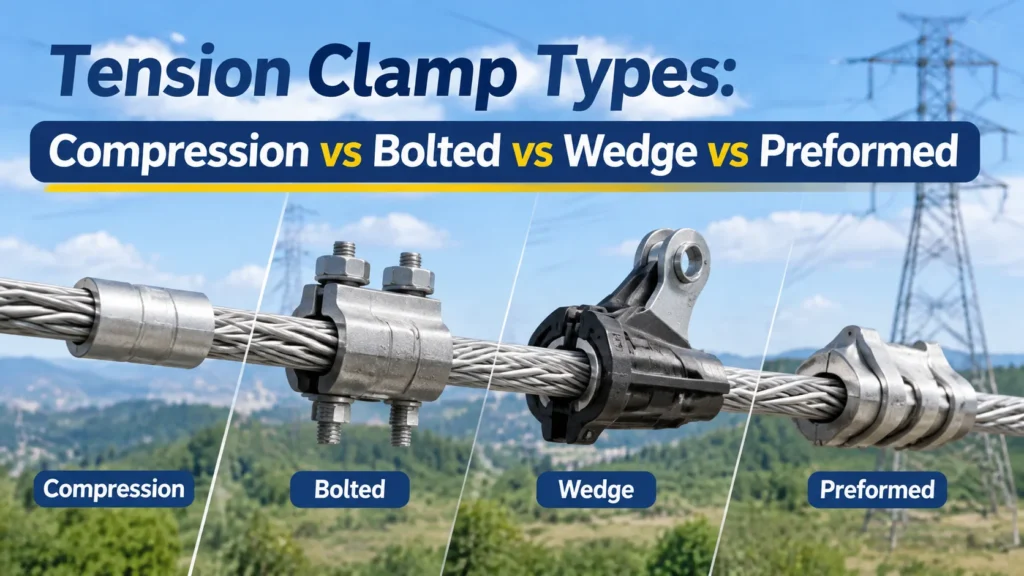
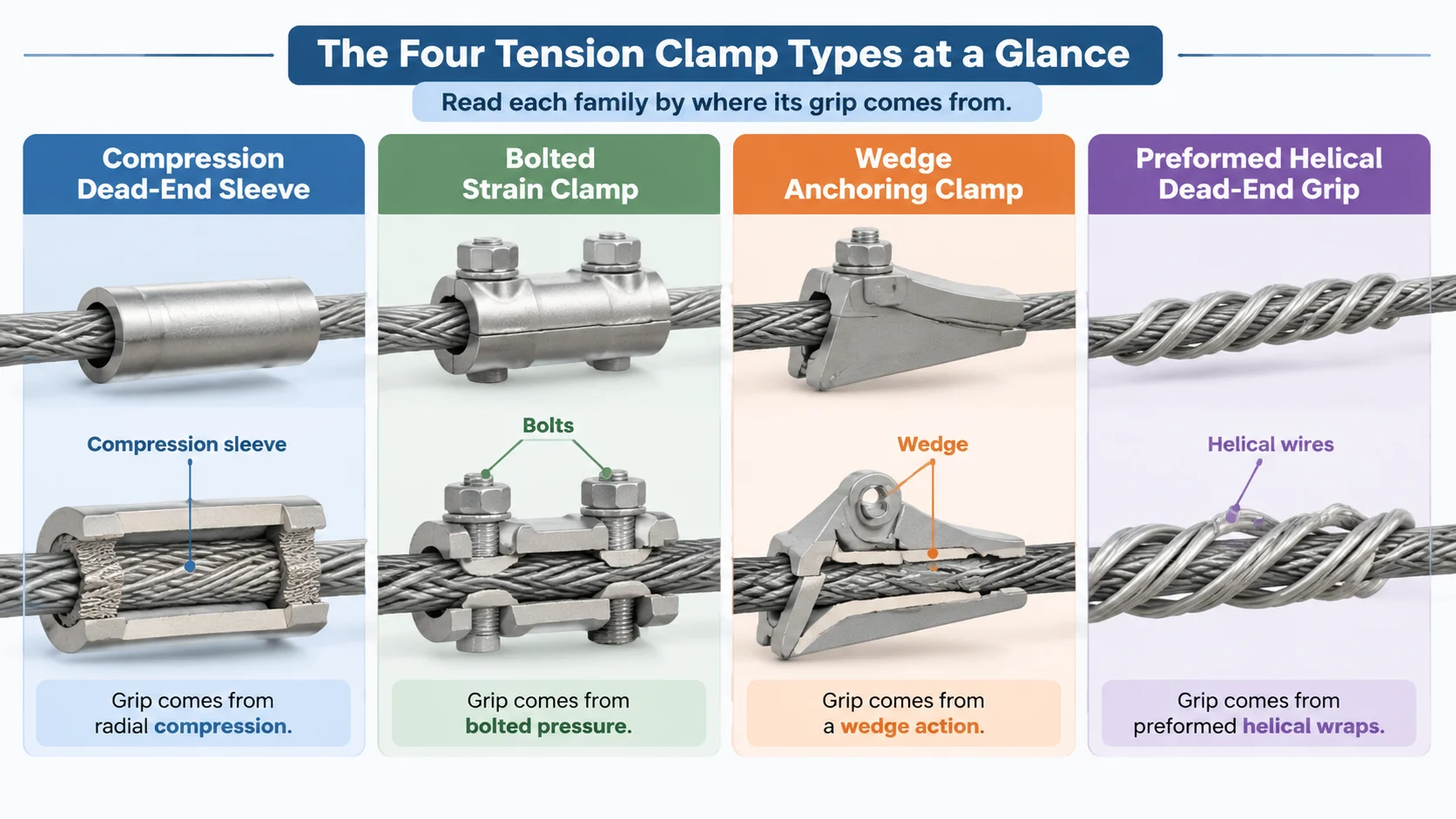
The Four Tension Clamp Types at a Glance
Read each family by where its grip comes from:
- Bolted — bolt pressure squeezes a keeper onto the conductor in a groove.
- Wedge — a taper: tension pulls the wedge deeper, so harder pull means tighter bite.
- Compression — a sleeve plastically deformed onto the strands by a hydraulic press.
- Preformed — helical rods wrap the conductor and spread load over a long length.
Some products blend two ideas, such as a wedge element inside a bolted body. It is still worth deciding which family dominates, because it sets the inspection method: bolted is checked by torque, wedge by visual seating, compression by the crimp record, preformed by the rod sequence and alignment marks.
Compression Type: When the Sleeve Becomes the Fitting
A compression dead end turns a length of the conductor itself into the anchor. An aluminium (or copper-aluminium) sleeve slides over the prepared end, and hydraulic dies compress it onto the strands in overlapping bites. Sleeve metal flows into the spaces between strands and becomes a collar held by interference fit alone. There is no bolt to loosen, no wedge to drift back.
That permanence is why it is the normal choice where spans stay put for decades: transmission dead ends, river and valley crossings, long tension sections, substation terminations. It is also the usual answer for large conductors whose required holding force exceeds what a bolted groove can reliably deliver in the field.
The trade-off is that the joint is only as good as its workmanship and cannot be inspected afterwards. The die set must be qualified for the exact conductor make and clamp model, the press must be within calibration, strands must be cleaned and wire-brushed, and inhibitor applied correctly before the sleeve goes on. Miss any of those and the joint looks correct while holding less than rated. Because the deformation cannot be undone, the fix is to cut it off and start with a new sleeve.
Compression also gives the lowest and most stable contact resistance of the four, which matters where the clamp is in the current path. The same die discipline governs both outcomes — see our cable lug crimping guide. The principle also sits behind full-tension aluminium cable joints, so a crew tooled for one is usually tooled for the other.
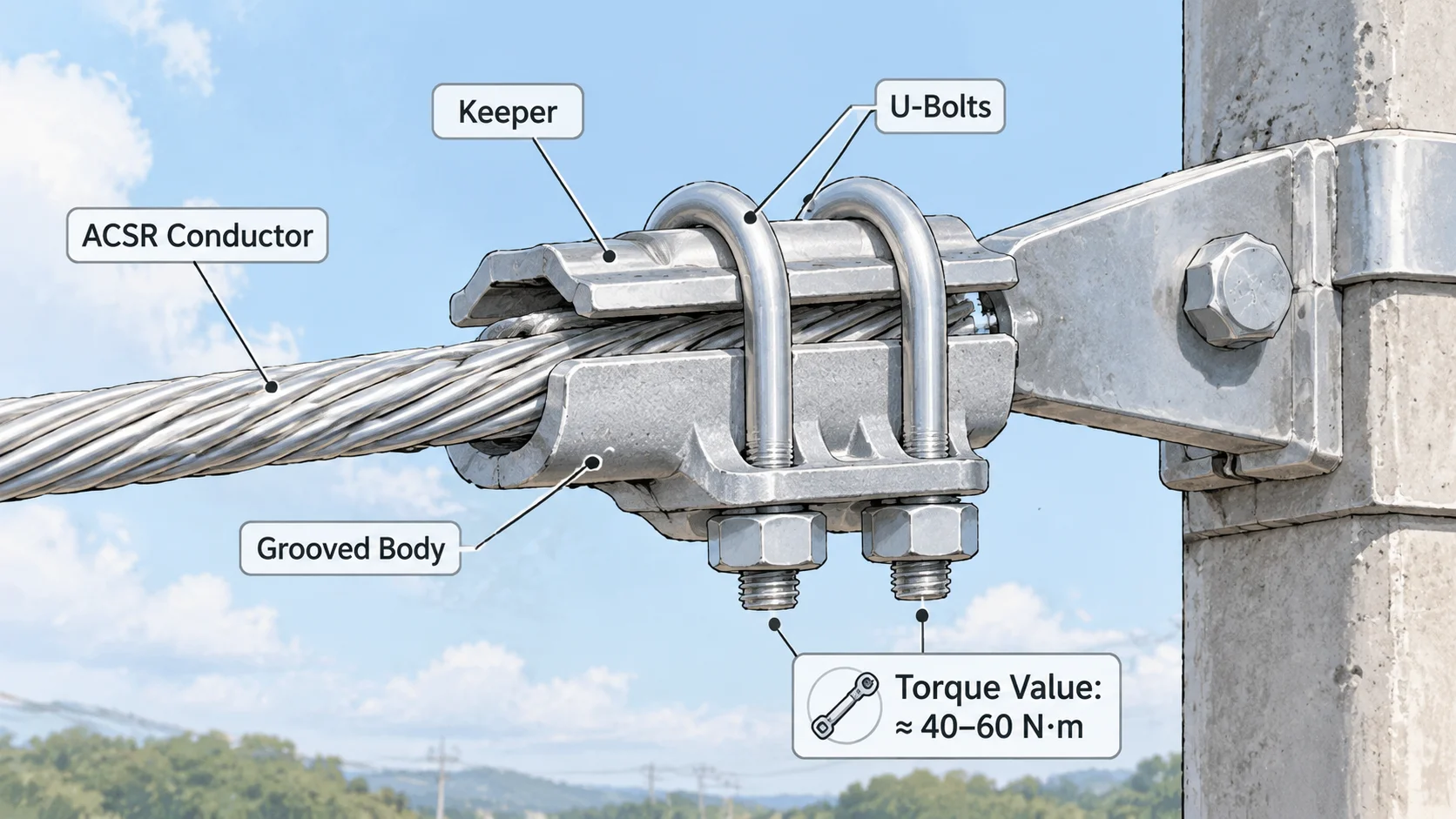
Bolted Type: U-Bolts, Keeper and a Torque Value
A bolted tension clamp grips the conductor between a grooved body and a keeper tightened by U-bolts or cap bolts. Bodies are typically high-strength aluminium alloy, with malleable or ductile iron series where the load case or specification calls for it; bolt hardware is normally hot-dip galvanized steel. Groove geometry matches a band of conductor diameters rather than one exact size, which is what makes the type easy to stock.
Bolted clamps are the distribution workhorse. They need no press, tolerate a range of diameters, install with hand tools and a torque wrench, and can be opened and moved along the conductor when sag needs correcting or a route gets rebuilt. That reversibility is unique among the four families.
The price is dependence on installation quality and periodic attention. Under-torqued bolts give partial grip and a high-resistance contact; over-torqued bolts deform the keeper or damage strands. Vibration and thermal cycling relax preload over time, so a bolted termination benefits from a torque check whenever crews are on the structure anyway. It is the easiest family to inspect, because the pressure joint is visible hardware rather than hidden deformation — but only if someone looks.
Its limit is bolt pressure. The largest conductors and highest tensions move past what a bolted groove holds reliably, and a specification should then switch to compression rather than to a bigger bolted clamp.
Wedge Type: Self-Tightening, Fast, Diameter-Sensitive
A wedge tension clamp converts axial tension into radial clamping force. The conductor or messenger is laid into a housing, a tapered wedge is seated over it, and load pulls the wedge deeper, raising the grip. Under rising tension the joint tightens rather than relaxes, which is genuinely useful under dynamic loading such as ice shedding or galloping.
Installation needs no press and no torque chart — the wedge is seated by hand or with a simple setting tool, then the assembly is strained onto the insulator or pole. That is why wedge hardware dominates low-voltage aerial bundled cable dead ends, service drops, FTTH and figure-8 drops, and rapid electrification work where crews install dozens of terminations a day from a pole top.
The weakness is a narrow outer-diameter window. Too large and the wedge cannot bite, so the cable creeps and slips; too small and it crushes the jacket or deforms strands. Polymer-bodied telecom variants add two checks: UV resistance and low-temperature behaviour, because a shell that has chalked in the sun will let go.
Two habits prevent most wedge failures. Confirm measured cable diameter against the printed range and keep a margin instead of sitting at its edge. And treat wedge hardware as installed-where-it-stays: the geometry that secures it makes deliberate release awkward, so it is not the family for a termination you expect to re-tension repeatedly.
Preformed Type: Spreading the Load Along the Conductor
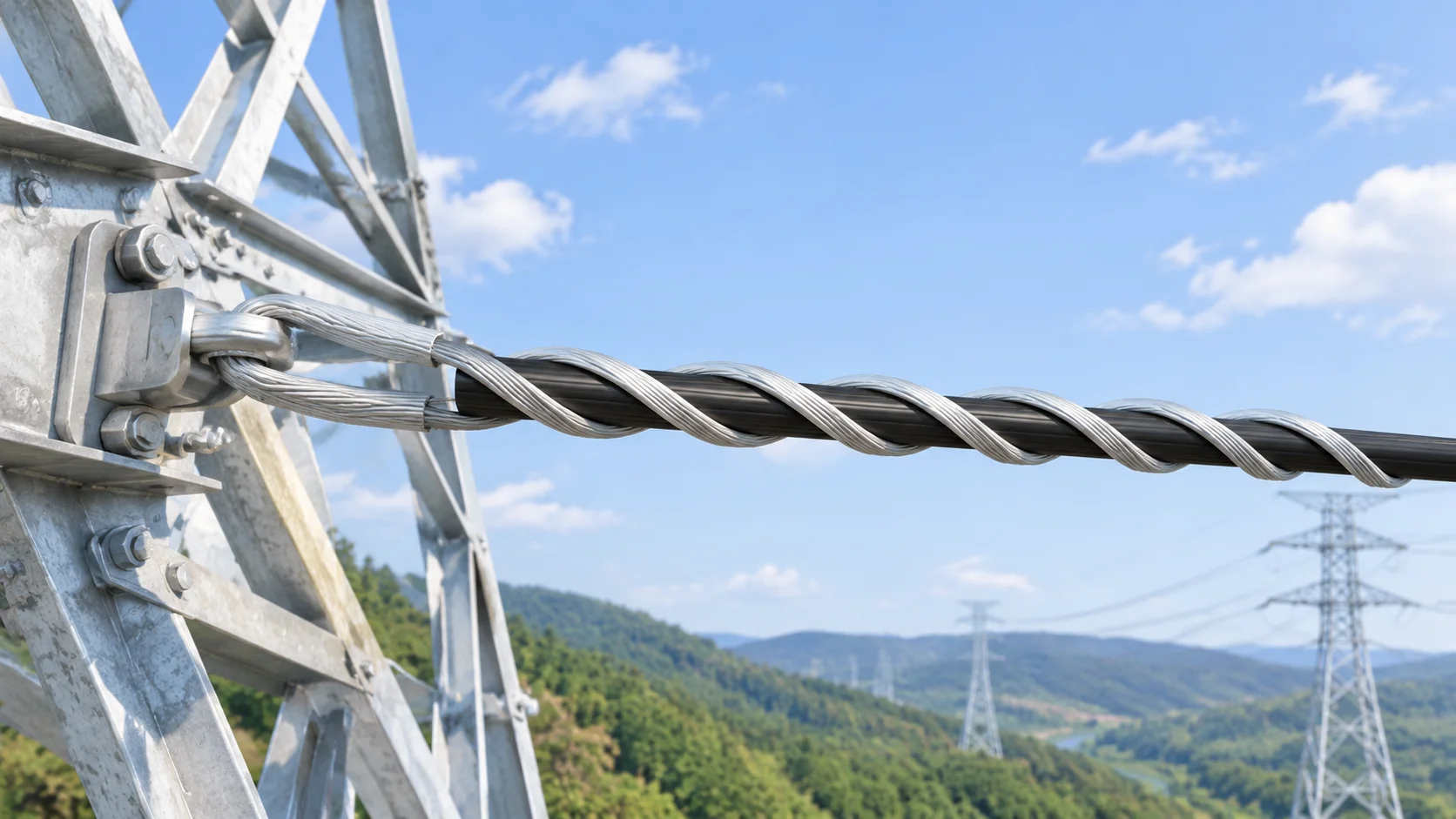
A preformed dead-end grip is a set of helically formed rods that wrap the cable and transfer load gradually along the grip length instead of at a single clamp mouth. Because the load is distributed, local strand stress is far lower than in a bolted clamp of comparable strength, and the long contact length damps vibration rather than concentrating it.
That combination is why preformed grips are the default for ADSS and OPGW terminations, optical cable at angles and branches, guy wires, and positions with sustained aeolian vibration. A full set is more than the rods: armour rods, thimble, shackle and connecting hardware normally belong to the assembly, sized as a system.
What this type demands is exact matching. Grip length is quoted as a multiple of cable diameter, so a grip catalogued for one cable cannot move to another of different diameter, and rod material — commonly aluminium-clad steel or galvanized steel — has to suit the cable and environment. Order against the cable designation, not the nominal size. Installation is then a discipline: rods applied in sequence, alignment marks respected, no re-use once loaded. The same helical principle appears in guy-wire hardware, covered in our guy grip guide.
Tension Clamp Types Compared Side by Side
Every value below is a structural or procedural property, not a rating. Conductor ranges, holding loads, torque values and die references are model-specific and must be read off the manufacturer’s datasheet, drawing or type-test report.
| Dimension | Compression | Bolted | Wedge | Preformed |
|---|---|---|---|---|
| Conductor or cable it suits | Bare conductor, mainly large ACSR / AAAC / AAC; sized to one conductor make | Bare ACSR / AAAC / AAC across a band of diameters | Insulated or jacketed: LV ABC, service drop, figure-8, FTTH drop | ADSS, OPGW, optical cable, guy wire; matched to exact designation |
| Tools needed on site | Hydraulic press and matched die set, calibration current; wire brush, inhibitor | Torque wrench and hand tools | Hand tools or setting tool; no press, no torque chart | Hand tools only; rod sequence and alignment marks |
| Requires crimping | Yes — the crimp is the joint | No | No | No |
| Typical application | Transmission dead ends, long spans, river crossings, substation terminations | Distribution dead ends, angle and section positions, re-tensioned feeders | LV ABC anchoring, service drops, figure-8 and FTTH drops | ADSS / OPGW dead ends and angles, high-vibration positions, guying |
| Advantages | Permanent; no fasteners to relax; low stable contact resistance; holds large conductors | Reusable and re-positionable; covers a diameter band; easy to inspect; no press | Fast; grip rises with load; compact and light; minimal tooling | Load spread over long length; low strand stress; damps vibration |
| Limitations | Irreversible; needs trained crew, press and die qualification; defects hidden after install | Depends on correct torque and re-checks; limited by bolt pressure on large conductors | Narrow OD window; awkward to release; polymer shells need UV and low-temp rating | Exact cable match required; not re-usable once loaded; bought as a complete set |
| Dominant failure mode | Bad crimp from wrong die, wrong sequence, dirty strands or uncalibrated press — looks fine, holds less | Bolt preload relaxes under vibration and thermal cycling; grip falls away | OD mismatch: creep and slip at the top of the range, jacket or strand damage at the bottom | Grip mismatched to cable diameter or RTS, or rods applied out of sequence |
How to Choose Between Tension Clamp Types on a Real Project
- Start from the cable. Insulated or jacketed cable points to wedge hardware. ADSS or OPGW points to preformed sets. Bare ACSR, AAAC or AAC leaves bolted and compression as the realistic options.
- Decide how permanent the termination is. If the span will be re-tensioned or re-sagged within its life, bolted is the only family that supports that reversibly. For a decision lasting decades, compression and preformed are both fine.
- Check what the crew can do at the structure. A compression termination assumes a press, a qualified die set, a calibration record and a trained operator at the work site. If that is not realistic, the specification should not call for it.
- Match grip to conductor, not to nominal size. Send the conductor or cable designation and its rated breaking strength with the enquiry. For wedge clamps send measured outer diameter and keep margin inside the stated range. For preformed grips send the full cable designation.
- Confirm slip strength for the exact pair — at the specified installation torque, or with the specified die set.
- Check the environment. Coastal or industrial corrosion, heavy ice, high wind, sustained vibration and high operating temperature each shift the material choice and sometimes the family.
Run in that order, the shortlist shrinks to one or two families. Then put your conductor designation, span and structure type in front of a supplier — the tension clamp range is organised by conductor and application.
Failure Modes: What Actually Goes Wrong
Dead-end failures rarely start with a broken clamp body. They start with loss of grip.
- Slip. The conductor moves inside the fitting. On bolted hardware this traces to relaxed preload; on wedge hardware to a diameter at the limit of its range; on a preformed grip to a mismatch between grip and cable; on a compression joint to an incorrect crimp. Slip at a dead end means lost clearance, and lost clearance is an outage and a safety problem.
- Heating at the joint. Where the clamp carries current, poor contact raises resistance, the joint heats, oxidation accelerates, and the cycle compounds until the fitting is visibly damaged.
- Strand or jacket damage. Over-tightening, an undersized wedge or a grip on the wrong diameter damages the conductor at exactly the point carrying the highest stress. A correctly rated clamp can still fail because the conductor beneath it was weakened during installation.
- Corrosion and galvanic attack. Dissimilar metals in contact in a wet or coastal environment, or a damaged galvanized layer, degrade a joint over years.
- Fatigue at the clamp mouth. Sustained aeolian vibration fatigues strands where the conductor leaves a rigid fitting. This is the case for preformed hardware, which spreads load instead of concentrating it.
The useful split: bolted and compression failures are usually torque or crimp failures, fixed with process control. Wedge and preformed failures are usually matching failures, fixable only before anything is ordered.
What to Confirm on the Datasheet Before You Order
Send this list with your enquiry. Every item is model-specific and must come from the manufacturer’s datasheet, drawing or type-test report.
- Conductor or cable designation, construction, and measured outer diameter
- The clamp’s stated diameter range, and where your cable sits inside it
- Slip strength for your exact pair, in kN and as a percentage of rated breaking strength
- Body, bolt hardware, material and finish
- Installation torque, if bolted; matched die set and press requirements, if compression
- Rod material, grip length and full set composition, if preformed
- Operating temperature range, and behaviour at sustained high conductor temperature
- Whether it carries current, and electrical performance data if so
- Type-test documentation for the exact combination quoted
Where any of these is missing from an offer, the gap tends to surface years later as a slip or a hot joint.
Frequently Asked Questions
Is a dead-end clamp the same thing as a tension clamp?
In overhead line work, yes. Strain clamp is the third common name for the same fitting, and regional usage is the only real difference. Ask for the drawing if a tender uses the term loosely: the phrase is also used for link fittings and, outside the power industry, hose clamps.
Which tension clamp type is used for ADSS and OPGW cable?
Preformed helical grips are the usual answer. The grip spreads load along the cable instead of concentrating it at a clamp mouth, which keeps lateral pressure and fibre strain under control while still reaching the required holding strength. The set normally includes armour rods, a thimble and connecting hardware, and the grip must be matched to the exact cable designation.
Can a bolted tension clamp be reused?
Yes, and that is its main advantage over the other three families. A bolted clamp can be opened, moved along the conductor and re-torqued, which is what you want on feeders that get re-sagged or re-routed — provided body, keeper and bolt hardware are undamaged and the galvanizing intact. Compression joints cannot be reused, preformed grips should not be reused after loading, and wedge clamps are awkward to release deliberately.
Why does compression installation need a qualified die set?
Because the crimp is the joint and there is no way to inspect it afterwards. The die set is matched to the conductor make and clamp model; the wrong die or press sequence produces a fitting that looks correct but holds less than rated and runs hotter. Press calibration, strand cleaning and inhibitor application are part of the same requirement. Where the conductor enters equipment rather than terminating on a structure, the same discipline applies to mechanical cable lugs.
How do I tell whether a slipped clamp is a product or an installation problem?
Work backwards through the family. Bolted: check torque against the manufacturer’s value. Wedge: check cable outer diameter against the stated range. Preformed: check the grip against the cable designation and rod sequence. Compression: check the die, press calibration and crimp record. Most slips trace to a mismatch or a missed step rather than a defective fitting.
The Short Version
Compression is the permanent, highest-integrity termination for transmission and long spans, and demands a press and a disciplined crew. Bolted is the flexible, inspectable choice for distribution, and depends on torque and periodic checks. Wedge is fast and self-tightening for insulated and drop cable, and lives or dies on diameter matching. Preformed spreads load along the cable and is the default for optical cable, guy wire and high-vibration positions. Pick by cable type first, permanence second, crew capability third — then confirm slip strength for your specific pair.