



Overhead Power Line and Components- The Ultimate Guide
Overhead power lines are networks of cables and conductors installed above the ground. They carry electricity between power stations, substations, distribution networks, and other locations.
These lines allow electrical energy to travel efficiently over short or long distances. The power can then be transformed, distributed, and delivered safely to residential, commercial, and industrial users.
What Is an Overhead Power Line?
An overhead power line is a system used to carry electricity from one location to another. It can transmit power at different voltage levels across short or long distances, including cities, rural areas, industrial zones, and difficult terrain.
The conductors are installed above the ground and supported by wooden poles, concrete poles, or steel transmission towers. These structures hold the lines at a safe height and provide enough clearance from roads, buildings, trees, and people.
Keeping the cables elevated also reduces the chance of accidental contact, physical damage, and electrical faults.
Overhead power lines are available in different designs, conductor sizes, and route lengths. Depending on the voltage and application, they can supply electricity to homes, commercial buildings, factories, substations, and large power networks.
How does an electrical power transmission system work?
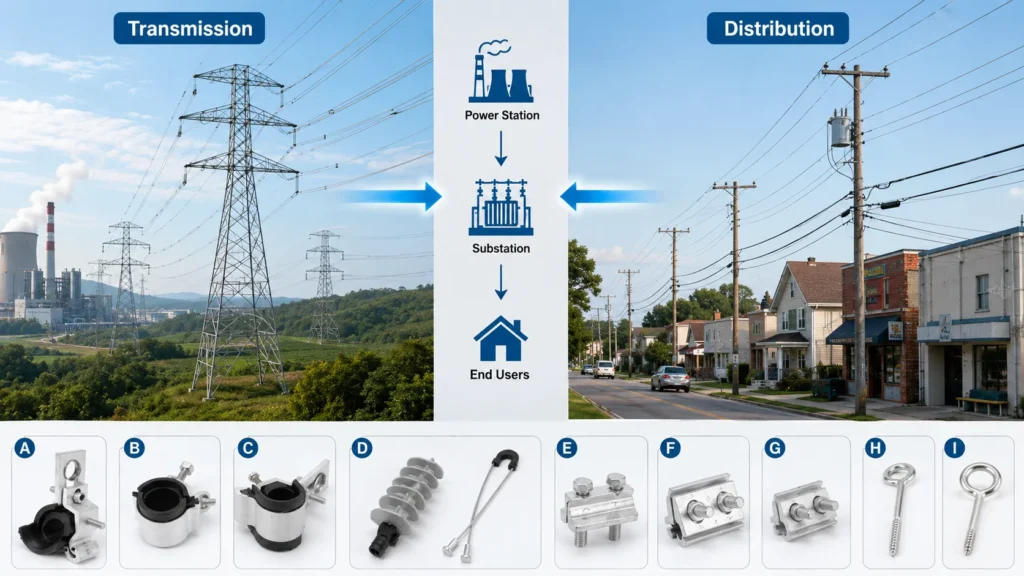
Overhead power networks move electricity across cities, towns, and rural areas. They help deliver a fast and consistent power supply to homes, offices, factories, and public facilities.
The system includes two main types of lines: transmission lines and distribution lines.
Transmission lines carry high-voltage electricity from power stations to substations. At the substation, transformers reduce the voltage to a safer and more practical level.
Distribution lines then deliver this lower-voltage electricity to residential, commercial, and industrial properties for everyday use.
Types of Power Lines
Power lines can transmit electricity using either alternating current (AC) or direct current (DC).
In a DC system, electricity moves continuously in one direction. In an AC system, the direction of current changes at regular intervals.
AC is used for most overhead power networks. It can handle high voltage efficiently, and transformers can easily increase or reduce the voltage for different transmission and distribution needs.
AC power lines are commonly grouped by voltage level and transmission distance.
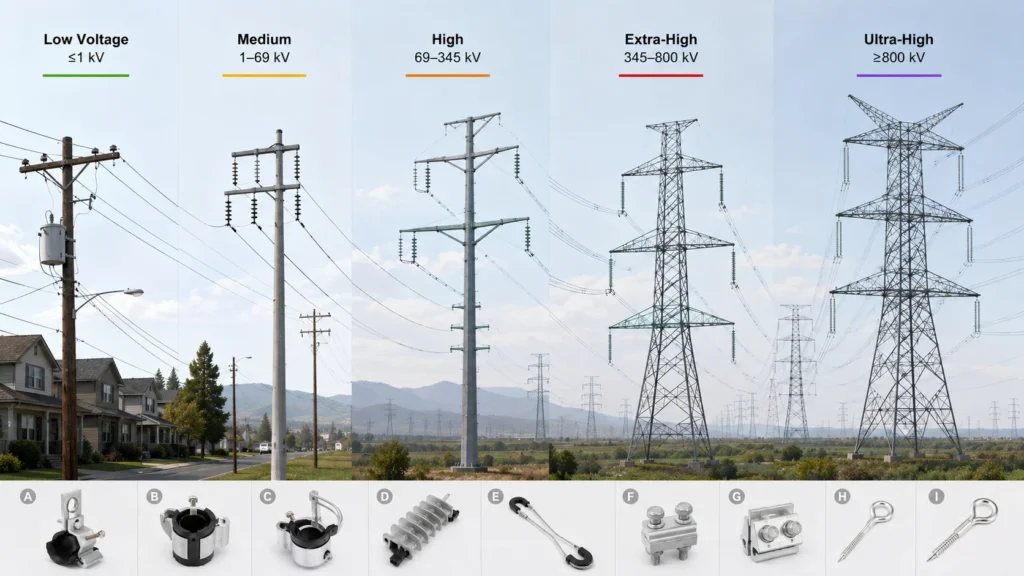
Classification by Voltage
Low Voltage: Up to 1 kV.
Medium Voltage: From 1 kV to 69 kV.
High Voltage: From 69 kV to 345 kV.
Extra-High Voltage: From about 345 kV to 800 kV.
Ultra-High Voltage: 800 kV and above.
Classification by Length
Short Transmission Lines
Short lines extend for up to 50 miles, or approximately 80 kilometres. They commonly operate between 11 kV and 33 kV.
These lines are often used for local power delivery, including residential areas and networks with relatively low electricity demand.
Medium Transmission Lines
Medium lines cover distances between 50 and 100 miles, or around 80 to 160 kilometres. Their typical operating voltage ranges from 66 kV to 132 kV.
They may be represented using either a nominal Pi model or a nominal T model.
In the Pi model, the line capacitance is divided equally between both ends. In the T model, the capacitance is placed at the centre of the line.
Long Transmission Lines
Long lines extend beyond 100 miles, or more than 160 kilometres. They normally operate at 132 kV or higher.
For performance calculations, resistance, inductance, capacitance, and leakage conductance are treated as evenly distributed along the full length of the line.
Components of Overhead Power Lines
An overhead power line is made up of several connected parts. Each component helps carry electricity safely, keep conductors stable, and protect the network from mechanical or environmental damage.
Line Supports
Line supports hold electrical conductors above the ground. This creates safe clearance and keeps the line in the correct position during operation.
The two main support structures are poles and towers. The best option depends on the operating voltage, route length, terrain, and required mechanical strength.
Poles
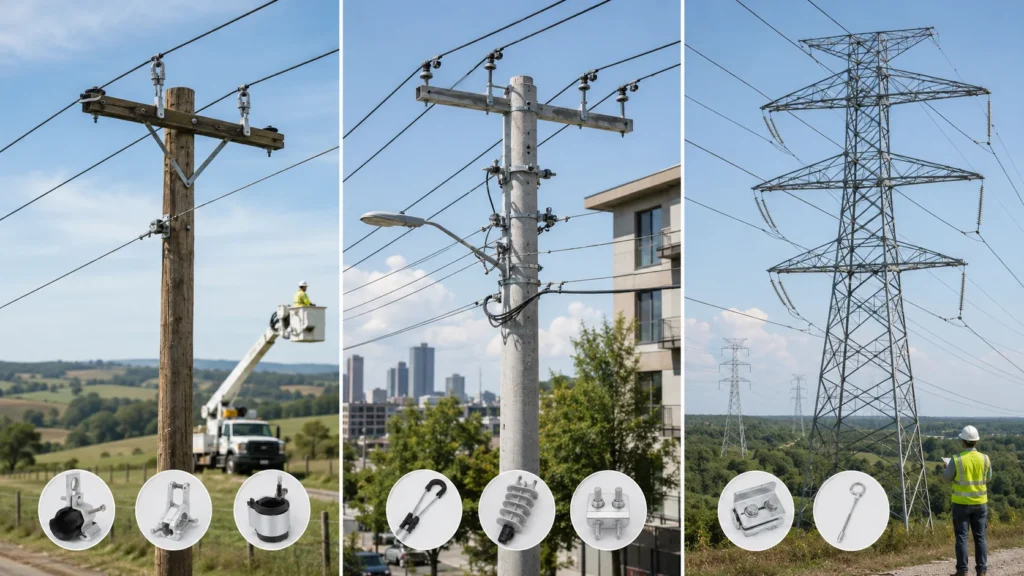
Utility poles are mainly used for distribution networks and shorter transmission distances. They can support low-, medium-, and in some cases high-voltage conductors.
Common pole materials include wood, concrete, and steel.
Wooden Poles
Wooden poles are an economical choice for short spans and low- to medium-voltage networks. They are relatively light, easy to install, and widely available.
However, wood has a shorter service life than manufactured materials. It can also be affected by moisture, insects, fire, and severe weather.
Concrete Poles
Reinforced concrete poles offer strong load-bearing performance and require little routine maintenance. They are suitable for locations exposed to heavy winds, high temperatures, storms, or other demanding conditions.
Their main disadvantage is weight. Concrete poles are harder and more expensive to transport, lift, and install.
Steel Poles
Steel poles are durable and can be manufactured in different heights, shapes, and load ratings. This flexibility makes them suitable for urban networks and projects with limited installation space.
Galvanized steel provides good corrosion protection, but rust may still develop if the surface coating is damaged. Steel poles also cost more than many wooden alternatives.
Towers
Steel lattice towers are normally used for high-voltage transmission across long distances. Their high mechanical strength allows them to support heavy conductors, wide spans, and multiple circuits.
They perform well in difficult environments and provide stable support for large transmission systems.
However, towers require significant investment, land, and installation work. Their height and metal structure also increase their exposure to lightning, so proper grounding and protection are essential.
Power Line Conductors
Conductors carry electrical current between power stations, substations, and end users. Their material and construction affect current capacity, mechanical strength, weight, and transmission efficiency.
Four widely used overhead conductor types are:
- AAC: All Aluminium Conductor
- AAAC: All Aluminium Alloy Conductor
- ACAR: Aluminium Conductor Alloy Reinforced
- ACSR: Aluminium Conductor Steel Reinforced
ACSR is one of the most common choices for modern overhead networks. Its steel core provides mechanical strength, while the surrounding aluminium strands carry most of the electrical current.
AAAC conductors are also widely used where corrosion resistance and a good strength-to-weight ratio are important.
AAC and ACSR conductors are lightweight and economical. They can also be installed in bundled arrangements on high-voltage lines to increase transmission capacity and improve electrical performance.
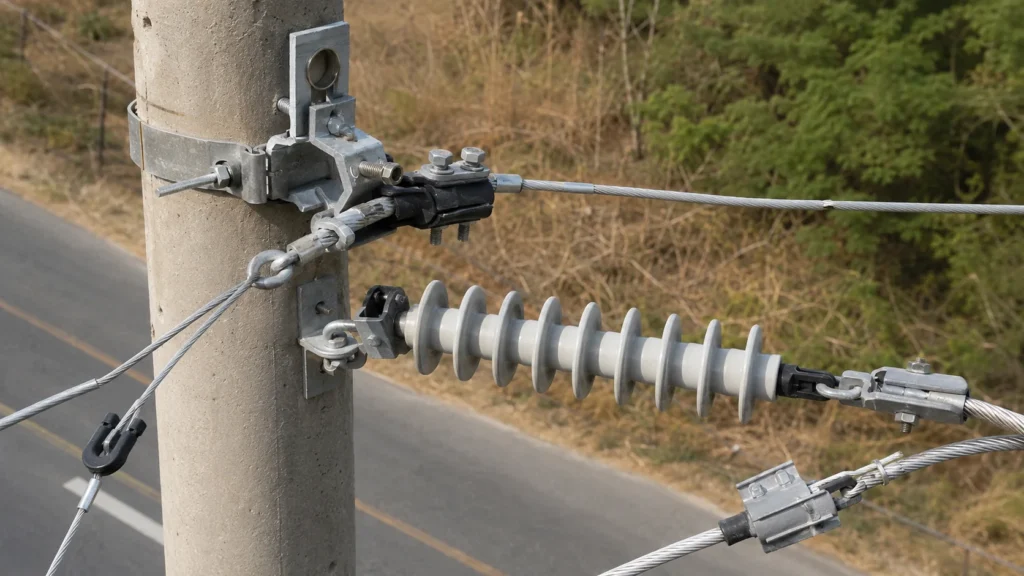
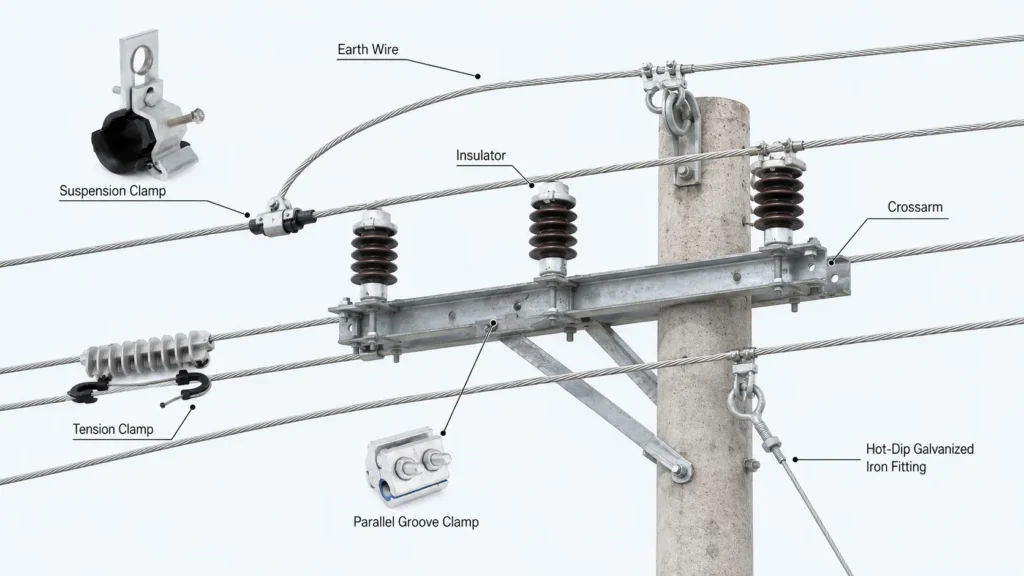
At branch points or conductor joints, a parallel groove clamp may be used to connect compatible overhead conductors while maintaining reliable electrical contact.
Power Line Insulators
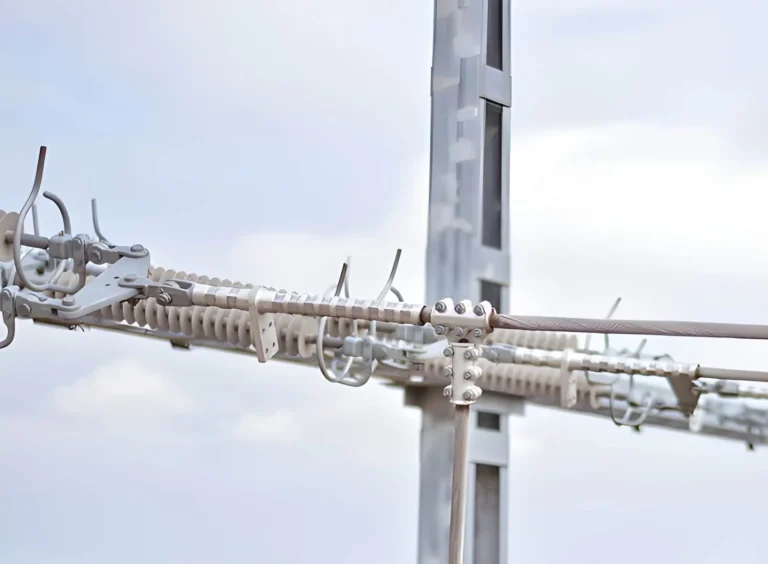
Insulators prevent current from flowing into poles, towers, and other grounded structures. They also hold conductors securely and maintain separation between energized parts.
Overhead line insulators are commonly divided into two groups:
- Pin insulators: Mounted above the supporting crossarm
- Suspension insulators: Hung below the support structure
Pin types are generally used on lower-voltage networks. Suspension insulators are more suitable for higher voltages and larger mechanical loads.
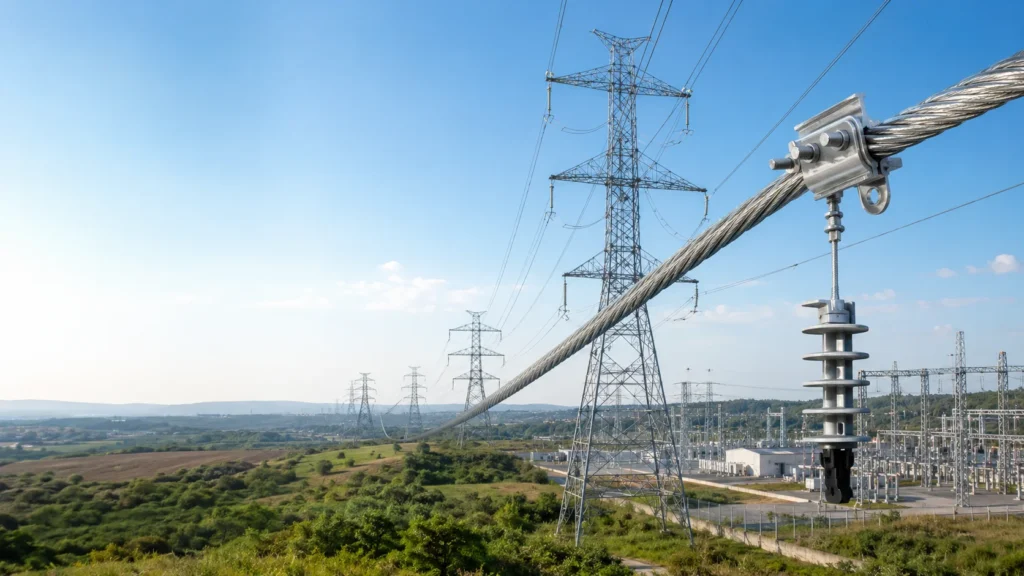
A suspension string consists of several connected insulator discs. The number of discs can be adjusted according to the voltage level and insulation requirement.
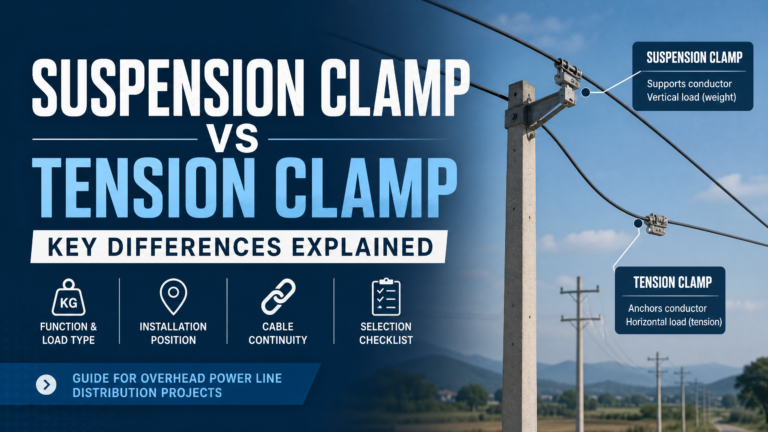
At intermediate support points, a suspension clamp holds the conductor or cable while distributing mechanical load across a controlled contact area.
For more details on clamp types and selection factors, read our guide on how to choose a suspension clamp.
Power Line Earth Anchors
Earth anchors, also called ground anchors, strengthen poles and towers by securing them to the surrounding soil.
They may be driven, screwed, or embedded into the ground. Once installed, they help resist pulling forces caused by conductor tension, strong winds, unstable soil, or changes in the surrounding landscape.
Earth anchors are especially important for terminal poles, angle poles, guyed structures, and installations exposed to severe weather.
Power Line Fittings
Overhead networks use many hardware fittings to connect, support, separate, and protect their components.
Common fittings include:
- Crossarms: Horizontal members mounted on poles to carry insulators, conductors, and related hardware.
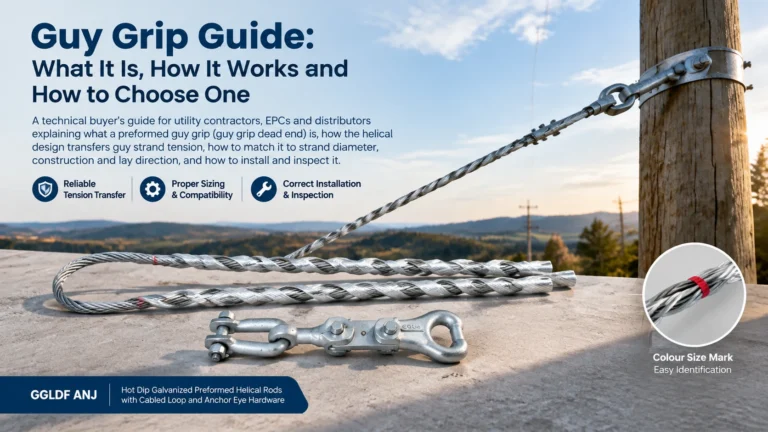
- Guy wires: Tensioned steel cables that provide extra support and prevent poles from leaning.
- Spacers: Devices that maintain a safe and consistent distance between bundled conductors.
- Dampers: Components that reduce wind-induced vibration and protect conductors from fatigue damage.
- Earth wires: Grounded wires installed above the phase conductors to shield the line from direct lightning strikes.
- Lightning arresters: Protective devices that divert surge current safely to the ground before it damages the electrical system.
Testing and performance requirements for many overhead-line fittings are addressed in IEC 61284 for overhead line fittings.
Conclusion
The development of alternating current transformed how electricity could be generated, transmitted, and used. Early pioneers such as Nikola Tesla helped establish AC as a practical solution for delivering power over long distances.
Today, AC remains the main standard for power transmission worldwide. Overhead power lines form a vital part of this system, carrying electricity across cities, rural communities, industrial areas, and remote regions.
Reliable long-distance transmission has supported modern homes, businesses, transport systems, communication networks, and public services. As power grids continue to expand and improve, overhead lines will remain essential to meeting future energy demand.
FAQ
What is an overhead power line?
An overhead power line is a group of electrical conductors installed above the ground. The conductors are supported by utility poles or transmission towers and carry electricity between power stations, substations, distribution networks, and consumers.
What is the difference between transmission and distribution lines?
Transmission lines carry large amounts of electricity at high voltage over long distances. They usually connect generating stations with substations.
Distribution lines operate at lower voltage levels. They deliver electricity from substations to homes, offices, shops, factories, and other local users.
What are the main components of an overhead power line?
The main components include conductors, poles or towers, insulators, crossarms, earth wires, spacers, dampers, guy wires, anchors, and lightning-protection devices.
Each part has a specific purpose. Some carry electricity, while others support the line, maintain safe clearances, or protect the system from mechanical and environmental damage.
What conductor types are used for overhead power lines?
ommon overhead conductors include AAC, AAAC, ACAR, and ACSR.
ACSR is widely used because its steel core provides mechanical strength, while its aluminium strands carry electrical current. AAAC is another common option where low weight and corrosion resistance are important.
Why are many overhead power line conductors not covered with insulation?
Many overhead conductors are bare because the surrounding air and the distance between conductors provide electrical insulation.
Adding a thick insulating layer to high-voltage conductors would increase their weight, cost, and installation difficulty. Poles, towers, insulators, and controlled clearances are therefore used to keep the energized conductors safely separated.