



Bimetallic Cable Lugs: When Do You Need One for an Aluminum-to-Copper Connection?
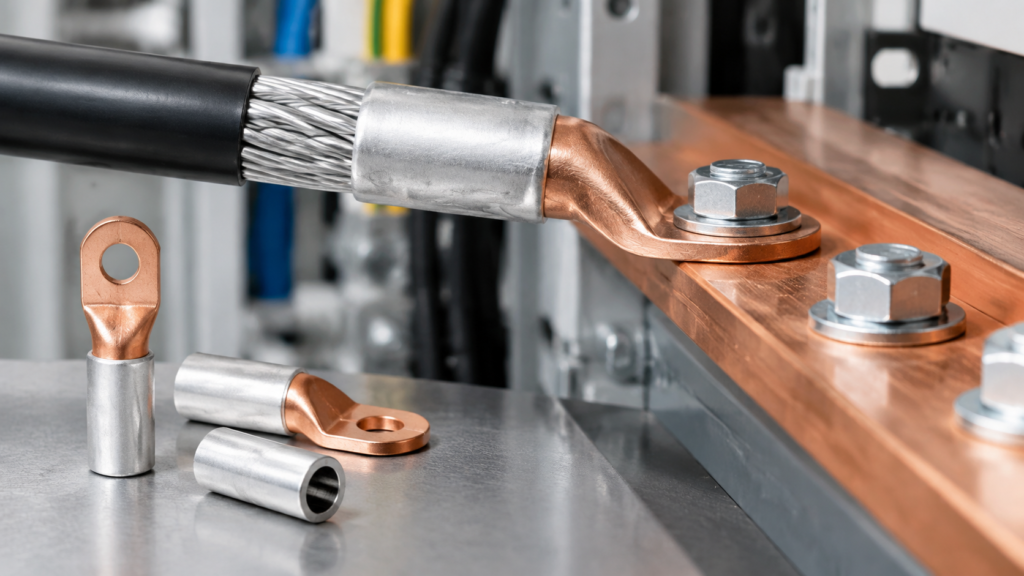
An aluminum feeder arrives at a distribution panel, but the terminal is a copper busbar. Which lug belongs at the cable end? This is the connection bimetallic cable lugs are designed to make: an aluminum conductor enters the aluminum barrel, while the copper palm bolts to the copper equipment terminal.
Getting the materials right is only the first step. The lug must also suit the conductor cross-section and construction, the terminal hole and available space, and the installation method. This guide focuses on those decisions so buyers and installers can specify the right part without guessing from a product photo.
What Is a Bimetallic Cable Lug?
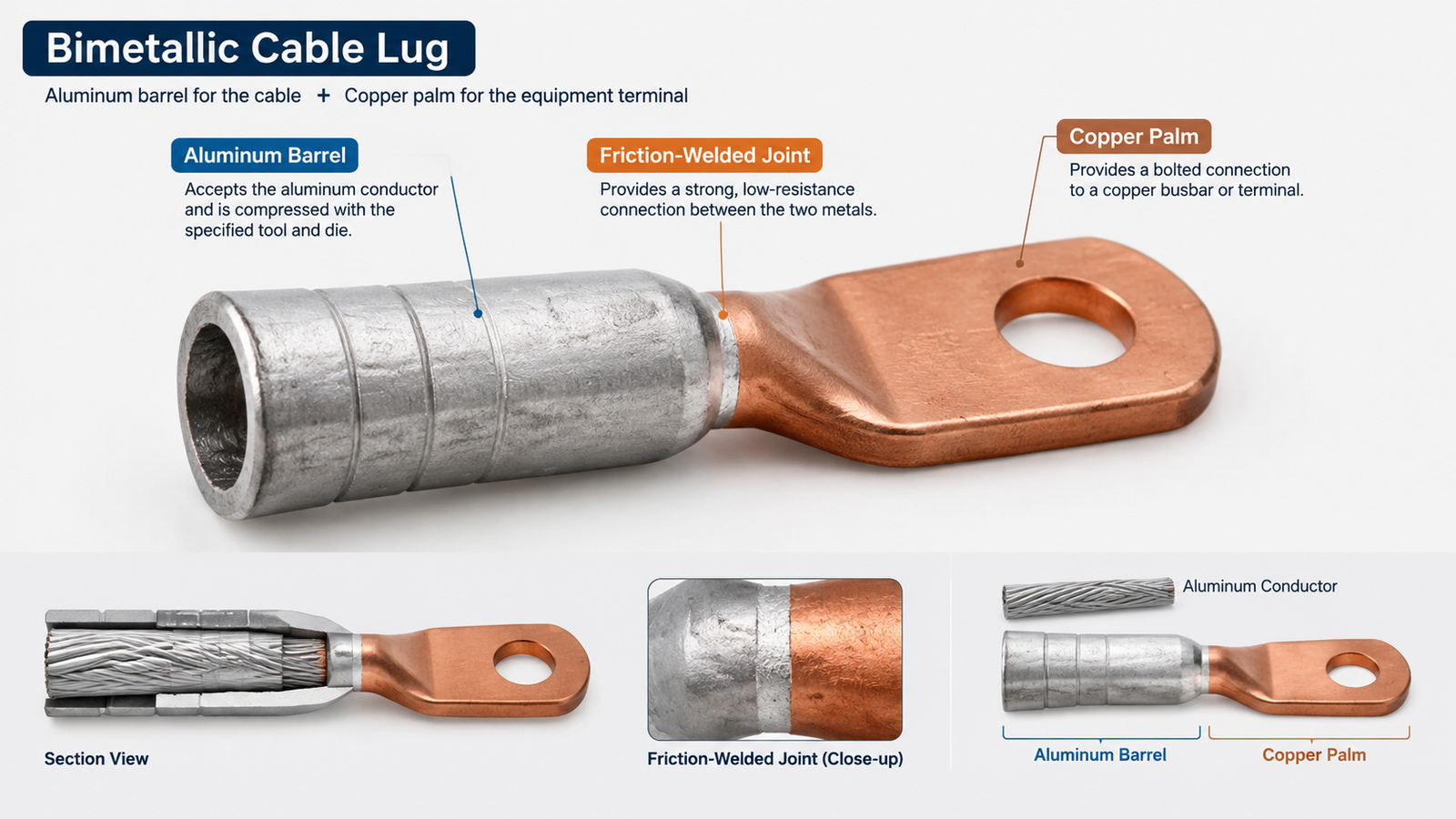
A typical aluminum-to-copper bimetallic lug has two working ends:
- Aluminum barrel: accepts the aluminum conductor and is compressed with the tool and die specified for that lug.
- Copper palm: provides a bolted connection to a copper busbar or terminal.
- Joined transition: connects the two metals within the manufactured part. Many bimetallic compression designs use a friction-welded transition.
This construction places a compatible metal at each connection surface. It is useful wherever an aluminum cable must terminate on copper equipment, including switchgear, transformers, distribution boards, and suitable renewable-energy equipment. A bimetallic lug is a cable termination; a straight-through splice or connecting tube serves a different job when two cable ends must be joined in line.
When Should You Choose Bimetallic Cable Lugs?
Start by identifying the conductor material and the equipment contact material. Do not decide from the cable insulation color or the appearance of a plated surface.
| Cable conductor | Terminal or busbar | Starting point for selection |
|---|---|---|
| Aluminum | Copper | Bimetallic lug intended for aluminum cable to copper terminal |
| Copper | Copper | Suitable copper lug |
| Aluminum | Aluminum | Suitable aluminum lug, subject to the equipment manufacturer’s instructions |
| Copper | Aluminum | Obtain an approved transition solution for the exact equipment connection; do not assume a standard aluminum-to-copper lug works in reverse |
The table is a material-screening tool, not a substitute for the equipment and lug manufacturers’ instructions. In particular, a bimetallic lug does not make an incompatible conductor size, terminal geometry, or crimp die acceptable.
A common case: aluminum feeder to copper busbar
Suppose a contractor is terminating a 95 mm² aluminum feeder at a copper busbar with an M10 connection. The request should specify at least 95 mm² aluminum conductor, copper busbar, M10 stud or bolt, conductor construction, voltage/application, and the available space. The supplier can then confirm a compatible lug and its exact drawing. A 95 mm² label alone does not establish the palm-hole diameter or the appropriate tooling.
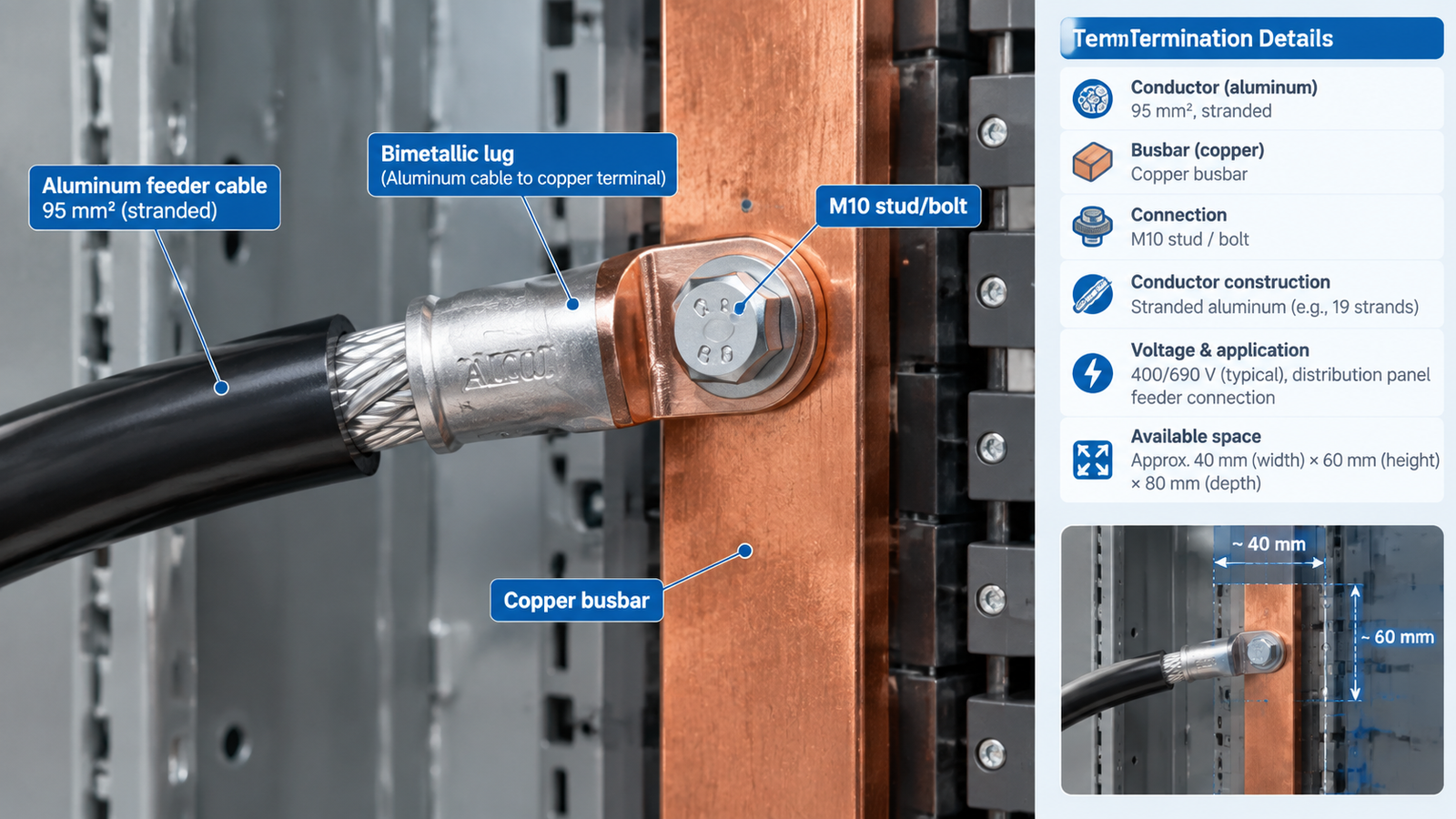
How to Choose the Right Bimetallic Cable Lug
1. Confirm the conductor, including its construction
Check aluminum conductor material, cross-section (mm² or AWG/kcmil), and whether it is stranded, compacted, solid, or flexible. Two conductors with the same nominal cross-section can require different barrel dimensions or approval. Ask for the compatible conductor range on the specific lug data sheet.
2. Match the palm hole to the equipment
Confirm the bolt or stud size, the number and spacing of holes, palm width, and clearance around neighboring phases or covers. A lug that fits the cable may still be impossible to mount in a tight cabinet. Never enlarge a palm hole on site unless the manufacturer approves that modification.
3. Verify the installation method
For a compression bimetallic lug, request the specified crimp tool, die or profile, crimp locations, and number of crimps for that model. Also confirm the instructions for preparing an aluminum conductor, including any supplied or required joint compound. For the bolted palm, follow the equipment manufacturer’s torque and surface-preparation instructions. Do not borrow a crimp or torque value from a different brand or series.
Our separate cable lug crimping guide covers the general installation and inspection sequence; this article addresses when and how to select a bimetallic termination.
4. Check the operating conditions and documentation
Tell the supplier whether the connection is indoors, outdoors, in a humid or coastal location, or inside equipment with demanding temperature and space limits. Ask for the specific model’s drawing, rated application, material and plating details, and any test documentation required by the project. Do not assume every product in a series has the same conductor range or approvals.
Three Mistakes That Cause Wrong Orders
Choosing by cable size alone. A nominal 95 mm² lug can still have the wrong palm hole or dimensions for the copper terminal. Send the equipment drawing or stud details with the cable specification.
Treating a lug as a cable-to-cable splice. The palm of a cable lug is intended to terminate at equipment. If the project needs an in-line aluminum-to-copper conductor joint, ask for a connector approved for that joint instead.
Assuming every bimetallic series is interchangeable. Product names tell you the material family, not the hole size, barrel geometry, tool system, or application approval. Confirm these against the exact part number before procurement or installation.
GGLDF Bimetallic Lug Options
GGLDF lists several bimetallic products in its cable lugs range, including DLT bimetal cable lugs, DTL-S bimetal cable lugs, and DTL-2-F bimetal cable lugs. These links let you review the available series. The current product pages do not provide enough model-by-model dimensions to recommend one series over another from the series name alone.
For a useful quotation, send:
- Conductor material, construction, and cross-section.
- Equipment terminal material, bolt size, hole layout, and any space restrictions.
- Installation environment and project voltage/application.
- Required drawings, test documents, order quantity, and delivery destination.
GGLDF can use these details to confirm a suitable part number, drawing, and installation requirements before you place an order.
Frequently Asked Questions
What are bimetallic cable lugs used for?
They are commonly used to terminate an aluminum conductor at a copper busbar or equipment terminal. The aluminum barrel connects to the cable and the copper palm connects to the equipment.
Can I use a copper lug directly on an aluminum cable?
Only if the specific connector is rated by its manufacturer for that aluminum conductor and application. A standard copper-only lug should not be assumed compatible. For an aluminum cable to copper terminal, a suitable bimetallic lug is a common solution.
Are bimetallic cable lugs the same as bimetallic connectors?
No. “Bimetallic connector” is a broad description. A cable lug terminates a conductor at equipment through its palm, while a splice joins conductors in line. Specify the connection geometry as well as the materials.
What details are needed to choose a bimetallic lug size?
Provide the conductor material, nominal cross-section and construction, plus the terminal bolt size and space available for the palm. The supplier should confirm the exact barrel and palm dimensions from the selected model drawing.
Does every bimetallic lug use the same crimping die?
No. Tool and die requirements depend on the exact lug and conductor. Use the chosen manufacturer’s instructions rather than selecting a die solely by the nominal cable size.