Line Fitting Materials: Galvanised Steel, Aluminium, Stainless
When buyers compare line fittings, the conversation usually stops at the model number: which tension clamp, which suspension clamp, which size range. The material the fitting is made from rarely gets a question of its own — and yet material decides how heavy the fitting is, how it corrodes, whether it plays nicely with the conductor it grips, and how long it survives on the pole. Two fittings with identical geometry but different materials can have completely different service lives on the same line.
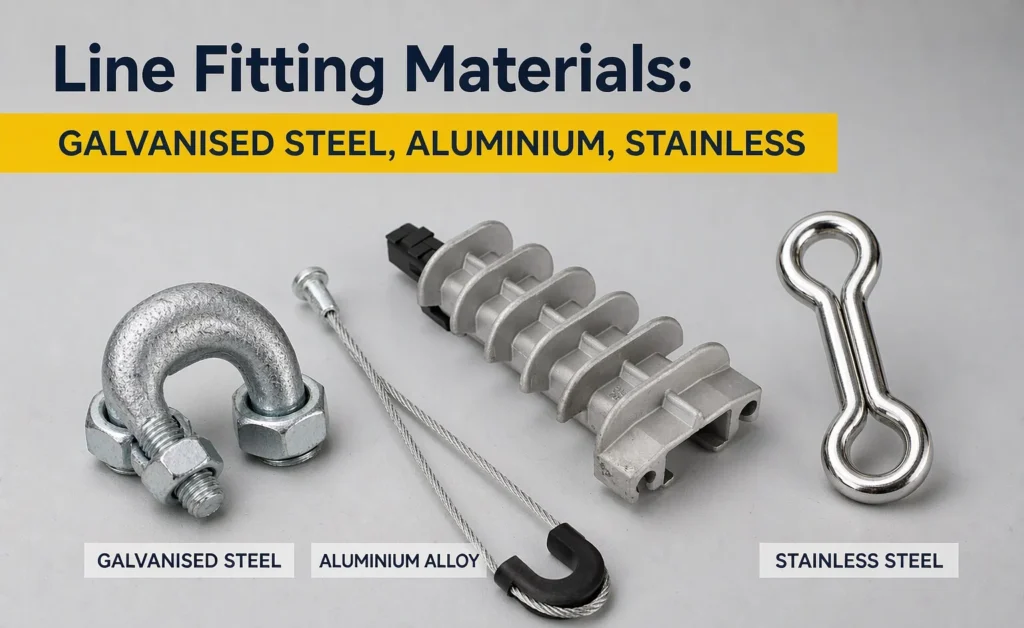
This guide walks through the four material families you will actually meet on overhead line fittings — hot-dip galvanised steel, aluminium alloy, malleable or ductile iron, and stainless steel — what each one is good at, where it belongs, and where it fails. It finishes with the galvanic-corrosion question that catches out most first-time buyers, and a checklist of what to confirm on drawings and data sheets before you place the order. If you are still deciding between fitting types, start with our comparison of tension clamp types — this article answers the next question down: once you know the type, which material should it be made from?
Why Material Choice Deserves Its Own Question
A fitting has three jobs at once: hold the conductor mechanically, carry current or bond safely, and survive weather for the design life of the line. No single material is best at all three, which is why manufacturers mix them — an aluminium alloy body with steel bolts, a cast iron clamp with a galvanised keeper, a stainless pin in a galvanised frame. The mix is deliberate, and it only works when each metal is placed where its properties fit the job.
Material choice also interacts with the conductor. Most overhead conductors are aluminium or aluminium alloy, so a fitting that clamps the conductor directly is usually aluminium too — steel in direct contact with aluminium conductor under tension and moisture starts a galvanic reaction that eats the conductor strand. That single fact drives more material decisions on a distribution line than any other. Conversely, fittings that never touch the conductor — pole brackets, U-bolts, stay rods — can be cheap galvanised steel, because they only need strength and weather resistance.
The cost angle matters as well. Stainless steel solves corrosion problems elegantly but prices itself out of most distribution work. Hot-dip galvanised steel is the workhorse precisely because it delivers decades of life at low cost when the coating is applied and inspected properly. Matching material to the actual exposure — not to the worst possible scenario — is where the savings are.
Hot-Dip Galvanised Steel: The Workhorse
Hot-dip galvanising means the fabricated steel part is immersed in molten zinc, so the coating is metallurgically bonded rather than painted on. The result is a grey, sometimes spangled surface that resists scratches far better than spray coatings, because the zinc around any scratch keeps protecting the exposed steel edge. On a distribution line this family covers the structural hardware: U-bolts and pole brackets, crossarm fittings, stay attachments, dead-end eyes, bolts, nuts, washers and pins on clamps of every type.
Its advantages are straightforward. Structural strength per unit cost is the best of any material here, threads and clamping faces hold torque reliably, and the zinc acts as a sacrificial layer — it corrodes preferentially and slowly, buying time for the steel underneath. Service life depends mainly on coating thickness and the corrosiveness of the site, so the practical question for a buyer is not “galvanised or not” but “how thick, and to which specification.” That number belongs on the drawing; if your enquiry does not state a coating requirement, see our guide on how to specify overhead line fittings in an RFQ for the exact fields to fill in.
The weaknesses show up in specific places. Cut edges and drilled holes made after galvanising have bare steel unless re-treated. Threads can accumulate zinc and need to be chased for a clean fit. And in heavy industrial or coastal atmospheres the zinc consumption rate rises sharply, which is exactly when a thicker coating — or a different material — becomes the better calculation.
Aluminium and Aluminium Alloy: The Conductor-Side Material
Wherever a fitting grips, terminates or splices aluminium conductor, the fitting body is almost always an aluminium alloy casting — wedge-type tension clamps for ABC, suspension clamp bodies, parallel groove clamps, splicing sleeves. The reasons are physical, not traditional. 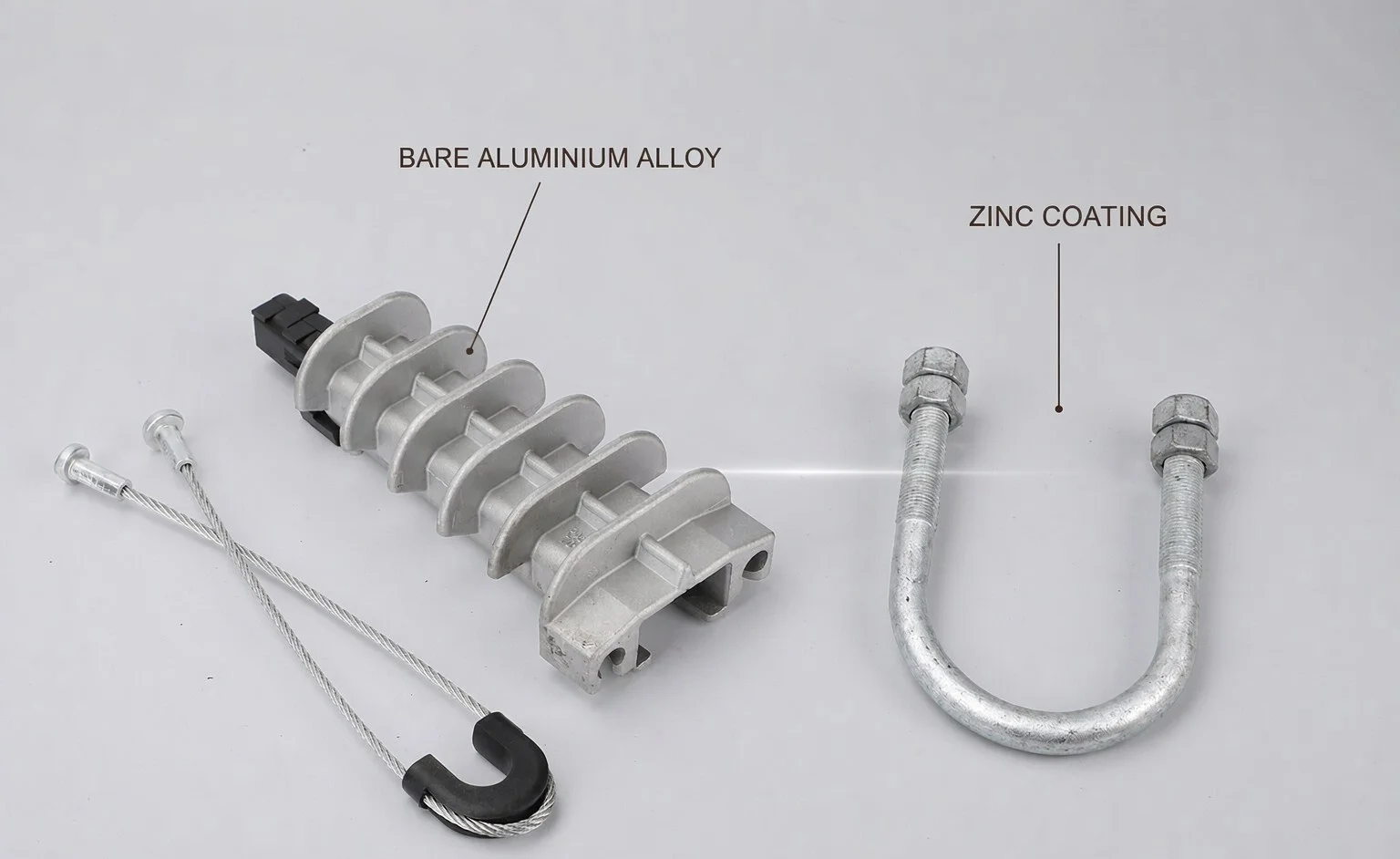 Aluminium against aluminium eliminates the galvanic couple at the most critical interface on the line. Aluminium is roughly one third the density of steel, which matters at the pole: a lighter fitting means less dead load on the crossarm and an easier climb for the installer. And extruded or cast aluminium takes the smooth, generous radii that prevent the fitting itself from abrading the conductor strand at the mouth of the clamp — the point where vibration damage concentrates.
Alloy selection and casting quality are the buyer’s silent variables. A casting with porosity or sharp internal edges will not show on a product photo, which is why sample approval and a documented inspection routine matter more for aluminium fittings than for plain steel hardware. Our walkthrough of incoming inspection of line hardware covers the casting and surface checks worth doing on receipt.
Two cautions. First, pure appearance is a poor material test: cast aluminium and galvanised cast iron both look grey-matte in photos, and mixing them up on a purchase order is a real and common mistake — more on telling them apart in the inspection section below. Second, aluminium fittings still contain steel parts — bolts, wedges, keeper pins. That mix is acceptable when designed for it (steel isolated or sized so corrosion does not affect grip), but it is why the bolt material and coating deserve their own line on the specification, not a footnote.
Malleable and Ductile Iron: The Casting Workhorses
Many suspension clamp bodies, pole brackets and heavy fittings are castings rather than fabrications, and the casting metals are malleable iron or ductile iron. Compared with grey cast iron — brittle and increasingly rare on line hardware — malleable and ductile grades bend before they break, which is what you want in a fitting that takes shock loads from stringing operations or falling branches. Castings are economical in complex shapes: the curved body of a suspension clamp with its bolt lugs would be expensive to fabricate from plate.
On drawings, the distinction is not academic. Cast iron, malleable iron and ductile iron have different strength and elongation behaviour, and a supplier substituting one grade for another changes the safety margin of the assembly without changing its outward shape. When the drawing says “malleable iron,” that word is a requirement, not a description. If your fitting drawings use material names you cannot verify, our overview of overhead line components explains where each casting family typically appears in the assembly.
Like fabricated steel, cast iron parts are almost always hot-dip galvanised for service, and they inherit the same coating questions: thickness, coverage inside tapped holes, and treatment after machining. A casting that was machined after galvanising may expose bare metal at critical faces, so the production sequence matters as much as the coating thickness itself.
Stainless Steel: Where It Earns Its Price
Stainless steel appears on line fittings in three patterns: as fasteners and pins on high-value assemblies, as complete fittings in severely corrosive sites, and as small parts — washers, split pins, springs — where a rusted small part would jam a mechanism. It resists corrosion by passivation rather than sacrifice, so it does not consume itself the way zinc does, and it keeps a clean appearance that also simplifies visual inspection over the years.
The economic case is narrow and real at the same time. For a short rural distribution line inland, stainless hardware is money spent on a problem that does not exist. For fittings near chemical plants, on coastal structures, or inside mechanisms that must remain free-moving for decades, stainless is often cheaper over the whole life than replacing galvanised parts on a schedule. The decision is site-driven, so it belongs in the environment assessment of your project, not as a default upgrade.
One specification trap: “stainless” is a family, not a material, and grades differ meaningfully in pitting resistance — the exact failure mode that matters in chloride-heavy coastal air. State the grade requirement on the drawing or accept the supplier’s grade with evidence, rather than writing only the word “stainless.”
The Four Materials Side by Side
| Material | Typical parts on the line | Strength / weight | Corrosion behaviour | Relative cost |
|---|---|---|---|---|
| Hot-dip galvanised steel | U-bolts, brackets, bolts and nuts, pins, stay hardware, dead-end eyes | High strength, heavy | Zinc sacrifices itself slowly; life follows coating thickness and site severity | Low |
| Aluminium alloy | Tension clamp bodies, suspension clamp bodies, groove clamps, splicing sleeves | Moderate strength, light | Passivates; must not sit in direct galvanic contact with steel or copper under moisture | Medium |
| Malleable / ductile iron | Cast suspension clamp bodies, complex brackets | Good strength, deforms before fracture | Always galvanised; same coating rules as steel | Low–medium |
| Stainless steel | Fasteners, pins, springs; complete fittings for severe sites | High strength, moderate weight | Passivates; grade choice decides pitting resistance in chloride air | High |
Use the table to narrow the field, then let the specific product data sheets decide — strength classes, alloy tempers and coating weights are all per-model figures that the manufacturer must state, and the values on the datasheet override any general rule in this article.
Galvanic Corrosion: The Question That Catches Buyers Out
When two dissimilar metals touch in the presence of an electrolyte — rain, condensation, salt fog — the less noble metal corrodes faster than it would alone. On overhead lines the classic pairs are aluminium against copper, and aluminium against bare steel. The first is why a copper lug must never be bolted directly to an aluminium conductor or fitting: the aluminium side becomes the anode and quietly disappears at the interface, raising contact resistance until the joint overheats. The industry’s standard answer is the bimetallic transition — a lug whose palm is aluminium and barrel is copper, friction-welded into one piece — and our guide to bimetallic cable lugs explains how those welds work and what to check on them. 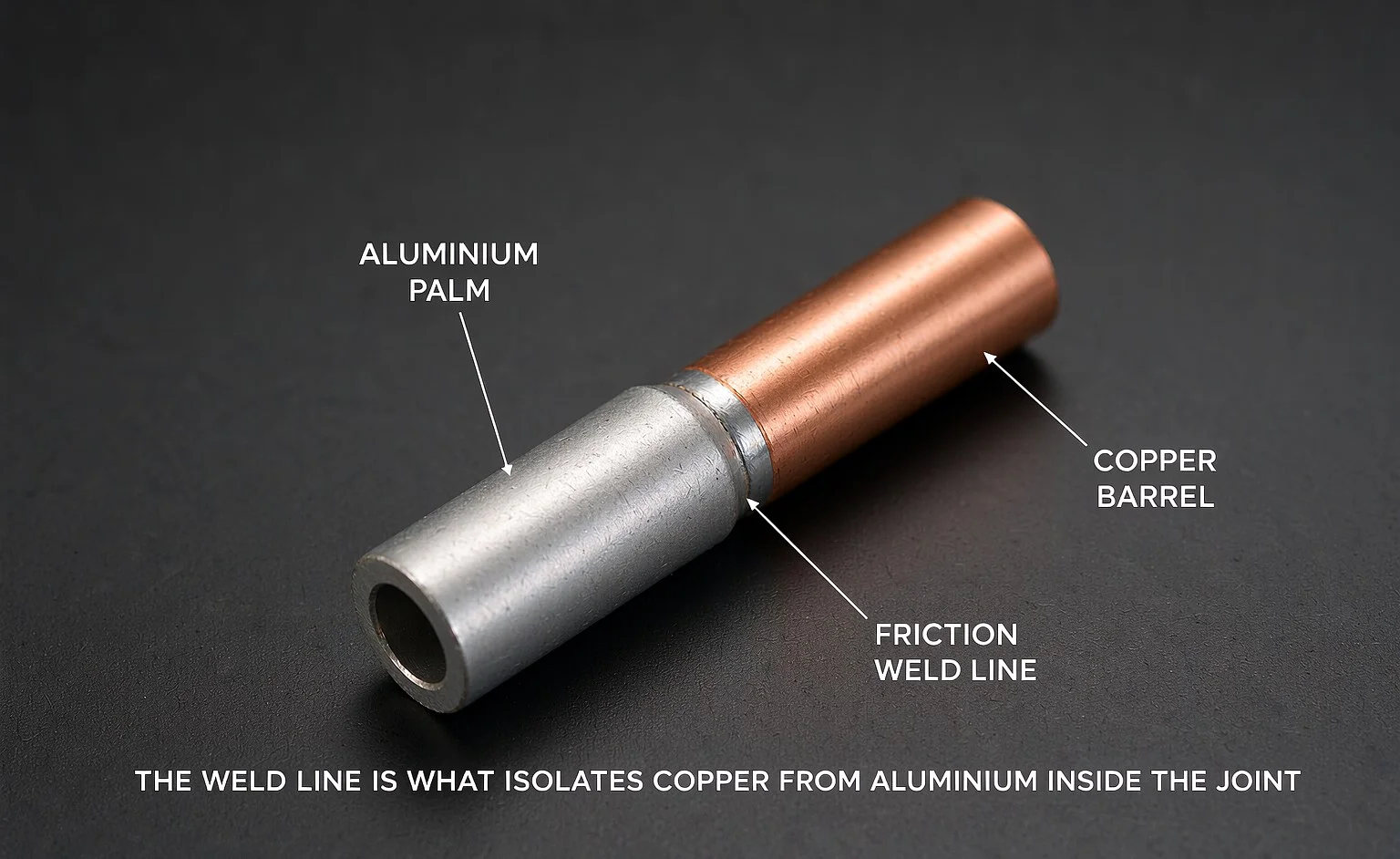 For the general aluminium-versus-copper problem, see the dedicated comparison of copper vs aluminium cable lugs.
Aluminium-to-steel contact appears inside fittings themselves. Designers manage it by geometry and isolation: keeping the steel part out of the current path, sizing it so surface corrosion does not affect clamping force, or interposing washers and sleeves. As a buyer you do not redesign the fitting, but you should ask how the mixed-metal interfaces are handled, and reject assemblies where a steel part sits in the current path between two aluminium conductors without a transition element.
The same logic reaches your installation practice. Stainless steel banding strapped directly around an aluminium conductor sheath, a copper earth conductor clamped to an aluminium pole bracket with a bare bolt — these are fitting-adjacent decisions that outlive the warranty. The rule of thumb for site crews is simple: at every mixed-metal joint, either use a transition part or isolate the pair, and record what was done so the next crew knows.
Coating and Surface: What to Verify, and How
Because coating quality, not material grade, is the most common early-failure cause on galvanised hardware, it deserves explicit checks on delivery. The verification below needs no laboratory — most of it is visual and tactile, done with the shipment on the pallet. 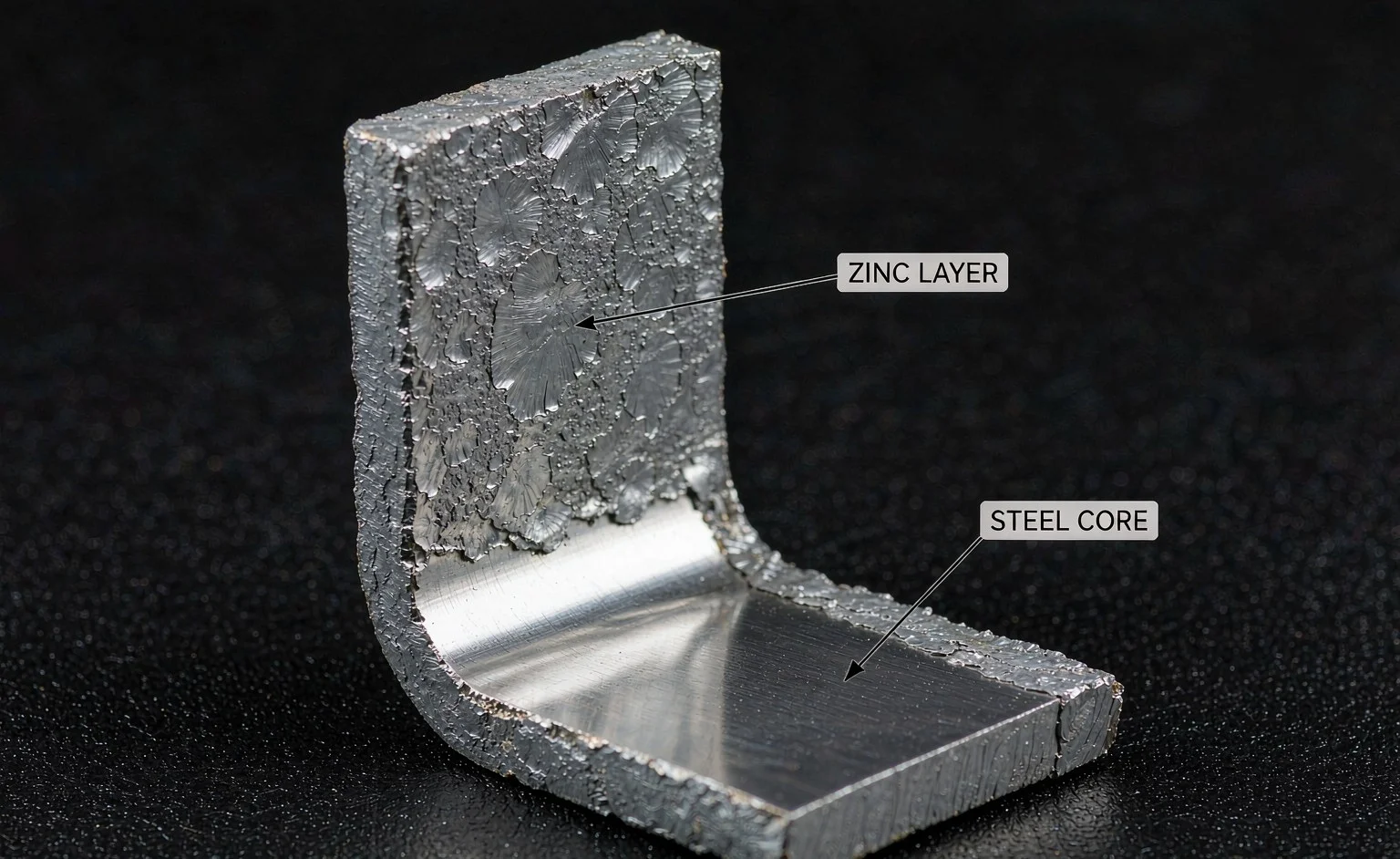
| Check | Method | What a pass looks like | What a fail predicts |
|---|---|---|---|
| Coating continuity | Visual over the whole surface, including inside slots and tapped holes | Even grey coating; no bare steel, blisters or flux residues | Pinholes and bare edges become the first rust sites |
| Coating on threads | Run the nut on by hand or with light tool effort | Smooth engagement; no flaking zinc in the thread | Over-thick or poorly controlled coating; torque values cannot be trusted |
| Post-machined faces | Compare machined faces against the drawing for re-treatment marks | Critical faces re-galvanised or protected after machining | Bare steel at the exact faces that carry load |
| Material identity | Compare weight and finish against the approved sample; check markings | Matches sample and part marking | Casting grade or material substitution; shape identical, properties different |
| Documentation | Match the material certificates and coating reports to the batch numbers received | Papers trace to the actual batch | Papers describe a different batch — the certificates prove nothing |
These checks slot into the wider receiving routine in our incoming inspection guide, which also covers dimensional sampling and photography for claims. If a batch fails the coating checks, reject it before it reaches the stores shelf — galvanising cannot be repaired by spray paint to the same standard as the original dip.
Matching Material to Environment
The environment decides how fast any coating or material consumes itself, so sort your sites before you sort your catalogue. Three broad classes cover most projects. Inland rural and urban air is the mildest: galvanised steel with a standard coating and aluminium conductor fittings give full design life with routine inspection. Coastal air carries chlorides that attack both zinc and aluminium aggressively and that push stainless grade selection toward higher pitting resistance. Industrial air — sulfides, acids, cement dust — consumes zinc faster and can also corrode the less noble alloy inside castings.
For the mild class, default to the standard combination: galvanised steel structure hardware, aluminium alloy conductor fittings, galvanised castings where the shape demands it. For coastal and industrial sites, escalate deliberately and selectively — thicker coatings where the drawing allows, stainless for small parts that jam when rusted, and more frequent inspection rather than blanket material upgrades. Every escalation should trace to a documented site condition, because that documentation is what justifies the cost to the project owner.
Two practical notes from the field. First, micro-environments matter more than the regional class: a fitting under a leaking transformer bushing or in a drainage trap sees a far worse climate than the line average. Second, insulation changes the game — fittings with polymer housings, such as the bodies of insulation piercing connectors, shift the corrosion exposure from the metal body to the seals, so check the elastomer and UV stability, not just the metal.
What to Lock Down on Drawings and Enquiries
Material problems are cheapest to prevent on paper. Before releasing an enquiry, make sure the following are stated rather than assumed — each item prevents a specific and common failure.
| State on the drawing / enquiry | Why it prevents trouble |
|---|---|
| Material family and grade for each part of the assembly | Prevents grade substitution between iron families and stops vague “stainless” from being supplied in the wrong grade |
| Coating type and thickness requirement for steel and iron parts | Coating thickness is the direct lever on service life; unstated coatings drift to the minimum the supplier finds convenient |
| Bolt, nut and pin material and coating | Small parts corrode first and seize mechanisms; they are also the parts most often left off the specification |
| Mixed-metal interface design at conductor contact | Forces the supplier to show how aluminium-steel or aluminium-copper contact is isolated or transitioned |
| Sample approval requirement before mass production | Casting quality and surface finish cannot be judged from photos; a retained sample is the reference for every later batch |
| Material certificates traceable to delivered batch numbers | Certificates that do not trace to the batch are decoration, not evidence |
If any of these fields feel unfamiliar, the RFQ guide linked earlier walks through each one with the exact wording to use. And when the material decision changes which fitting family you buy — for example choosing an aluminium wedge dead-end over a galvanised bolted clamp for a line with aluminium conductors — the suspension clamp selection guide and the guy grip guide cover the type-level trade-offs on their own hardware.
Frequently Asked Questions
Can galvanised steel hardware safely touch aluminium conductors?
Only where the design intends it and the steel is out of the current path — a galvanised keeper or bolt on an aluminium clamp body is normal and acceptable. What is not acceptable is steel carrying current between aluminium parts, or bare steel clamping aluminium conductor directly under sustained load and moisture. Follow the fitting manufacturer’s assembly instructions; if the interface is unclear, ask for the isolation or transition detail in writing before installation.
Is stainless steel always the better choice near the coast?
Better against corrosion, yes — but not automatically the better decision. Stainless costs more, and on a distribution line the corrosion exposure of structural hardware is often manageable with heavier galvanised coatings plus scheduled inspection. Reserve stainless for parts where corrosion causes functional failure: pins, springs, fasteners on operating mechanisms, and fittings at sites with measured chloride attack.
Why are tension clamp bodies aluminium but their bolts steel?
The body needs to grip aluminium conductor without a galvanic couple and keep weight low; the bolt needs high, stable clamping force, which steel delivers with better thread behaviour. Manufacturers place the steel where force is generated and the aluminium where contact with the conductor happens. That is also why the bolt coating is a specification item — it is the part your line crew actually torques.
How do I tell galvanised cast iron from aluminium alloy on delivery?
Weight is the quickest field test: cast iron parts of the same size feel markedly heavier. Finish differs too — hot-dip zinc often shows spangle or a slightly rougher grey, while cast aluminium is smoother and slightly warmer in tone. If appearance alone is ambiguous, compare against the approved sample and the part marking before accepting the batch, and weigh a sample piece against the datasheet figure where one is stated.
Putting It Together
Material selection on line fittings is not a chemistry problem — it is a matching problem. Galvanised steel carries the structure, aluminium alloy handles every aluminium-conductor interface, castings provide economical complex shapes, and stainless buys freedom from corrosion exactly where corrosion would cause failure, not everywhere. The failures we see in the field almost never come from exotic material science; they come from unstated coating requirements, substituted casting grades, and mixed-metal joints nobody documented.
When you prepare your next enquiry, send us the part drawings or a parts list together with the conductor type, span and tension data, the site environment class, and the coating requirement you expect — and we will confirm material and coating for every fitting against it. For a starting point on the conductor-side fittings, browse the tension clamp range or the suspension clamp range, and attach the material fields above to whatever models you shortlist.