



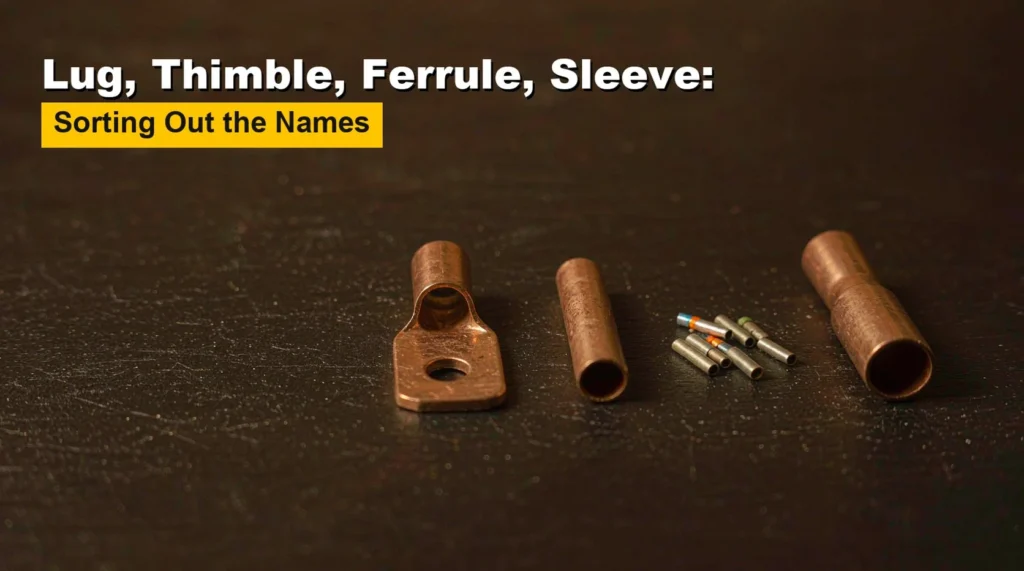
Lug, Thimble, Ferrule, Sleeve: Sorting Out the Names
A purchase order arrives with one line on it: “copper thimble, 95 mm², 12 mm hole, 200 pcs”. The supplier quotes it. The goods arrive. The parts are tube-and-palm lugs with a 12 mm hole, which is what the buyer wanted, and everyone is satisfied until the second order goes out to a different supplier against the same line and comes back as short compression sleeves — a plain copper tube with no palm at all. Both suppliers read the word “thimble” correctly. They read it in different industries.
This is the quiet failure mode in cable accessory purchasing: not a wrong specification, but a right specification carried by a word that means more than one thing. The same drift exists inside a single company, between the drawing office that writes “ferrule”, the store that labels the bin “sleeve”, and the freight forwarder who has to pick a customs description from whatever is on the invoice. None of the five words below is difficult on its own. The difficulty is that they overlap, and the overlaps are not symmetrical.
Why These Names Drift
Three forces push the vocabulary apart. The first is translation. Chinese trade usage compresses several distinct products into one or two words — 线鼻子 covers both the palm-and-barrel lug and the broader terminal family, 铜管 can mean a compression sleeve or a length of copper pipe depending on who is talking. When those terms are rendered into English by different people at different times, the same Chinese word lands on different English words, and the mapping never gets reconciled.
The second is industry. A marine rigger, an overhead line crew and a panel builder all handle “thimbles” and “sleeves”, and they mean three different objects. A catalogue does not announce which trade it was written for.
The third is that the words are descriptive rather than defined. “Ferrule” comes from a band that binds something; “sleeve” is a tube something passes through. Applied to a cable end, both descriptions fit more than one product, so the words were free to drift before anyone wrote a definition.
Cable Lug and Cable Terminal: Parent and Child
Start with the pair that causes the most confusion in English-language purchasing, because the relationship between them is the one most often inverted.
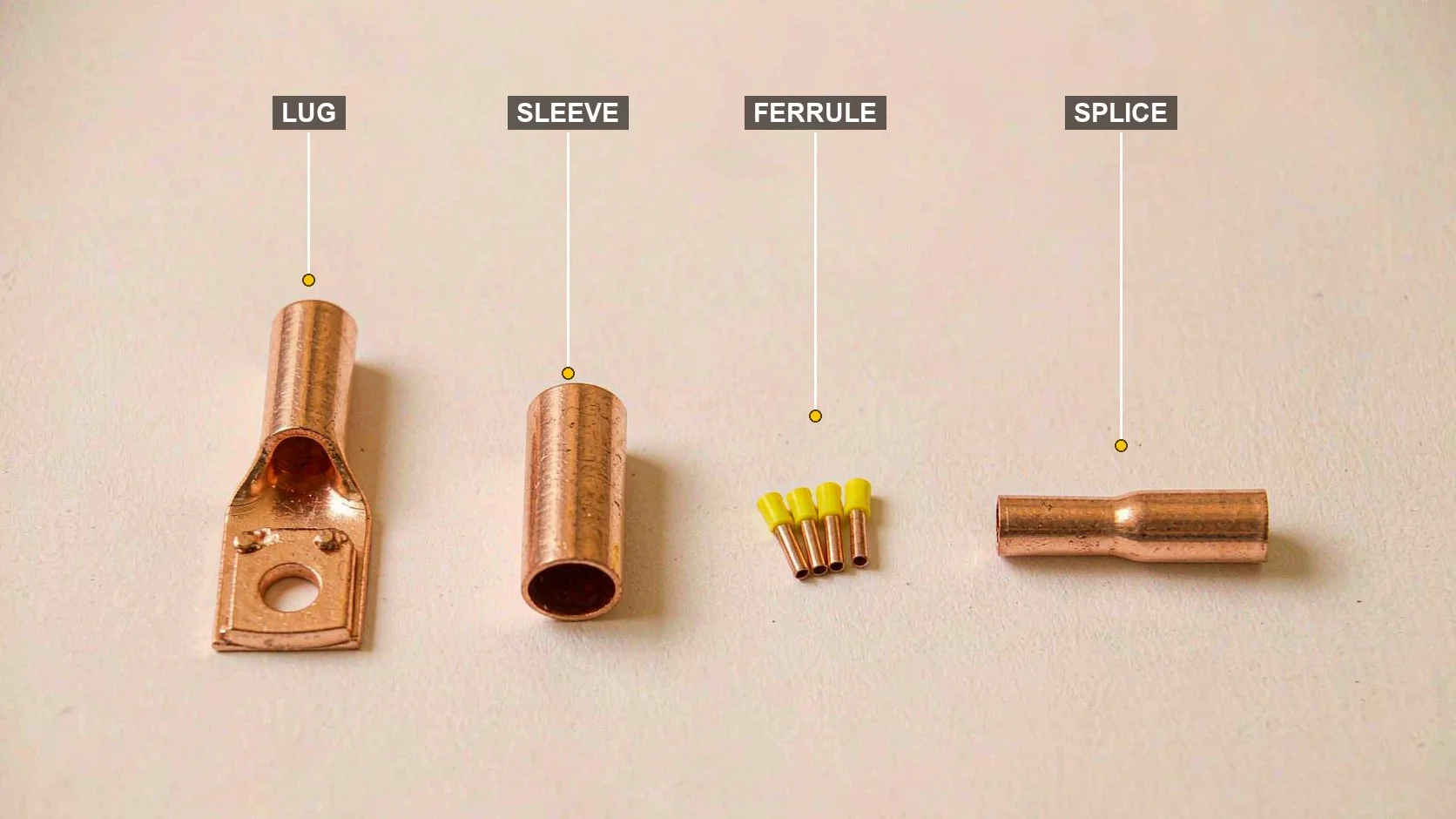
In the IEC tradition, “terminal” is the general term for a device that provides an electrical connection point at the end of a conductor. A cable lug is a specific kind of terminal — the kind with a flat palm pierced by a hole, bolted to a stud or a bar. That makes lug the narrower word and terminal the wider one. A ring lug, a fork lug, a tube lug and a tubular compression terminal are all lugs. A terminal block, a stud terminal on a breaker, a spring-cage terminal and a bolted palm lug are all terminals.
Chinese usage inverts the felt hierarchy even while the words line up on paper. 端子 is the general word and 线鼻子 is the colloquial one, but in a factory the 线鼻子 is the tangible part on the bench and 端子 is what the drawing calls it, so the colloquial word carries more weight in conversation and the formal word carries more weight on documents. When a Chinese buyer writes “terminal lug” in an enquiry, they usually mean the palm-and-barrel part. When an English-speaking panel builder writes “terminal”, they may mean the palm lug or they may mean the DIN-rail block, and the sentence around it is the only clue.
The practical rule: if the part is bolted to a stud through a hole in a flat palm, “cable lug” is unambiguous in every market. If it is something else, name the something else. “Terminal” alone is a category, not a part. The shapes a lug can take are in Cable Lug Types, the function is in What Are Cable Lugs — forms and function, not words.
Thimble: Two Objects Under One Word
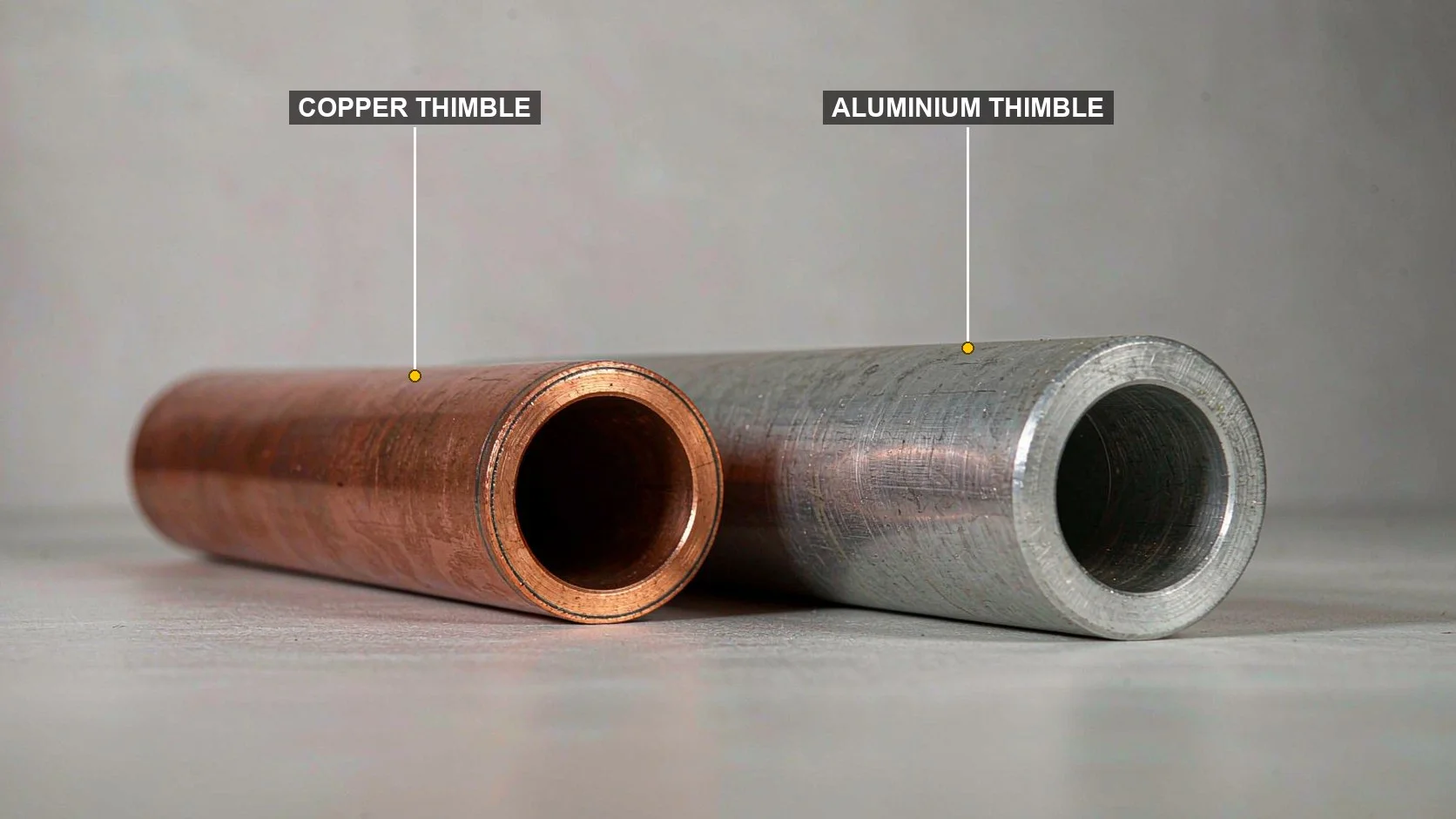
In cable work, a thimble is a copper or aluminium tube closed at one end or formed into a palm, into which a stranded conductor is inserted and then compressed. In rigging work, a thimble is the heart-shaped groove liner that protects a rope or wire rope eye from wear. The two share a name and nothing else. A buyer who orders “thimbles” from a rigging supplier and expects cable terminals is not going to be rescued by the drawing, because the drawing may not exist.
Within cable work, thimble is largely a legacy term for what is now sold as a compression lug or a tube terminal. It survives in older specifications, in shipyard practice, and in markets with long British usage. It is not wrong, only old — and old words get copied forward without being re-examined.
Why Copper and Aluminium Thimbles Are Not Interchangeable
Copper and aluminium thimbles are used for the same purpose and made the same way in outline, but they behave differently under compression, and that difference is the reason a single part number cannot cover both.
Copper is ductile and work-hardens. When a die compresses a copper tube onto a stranded conductor the metal flows around the strands and stays there; a correctly sized die leaves a joint whose cross-section is solid metal with the strand pattern visible inside it.
Aluminium is softer in bulk but carries a stubborn, electrically resistive oxide layer that re-forms within minutes of exposure to air. Compression has to break that layer and extrude fresh metal into contact, which is why aluminium calls for deeper die penetration, more strokes and often a different die profile. Aluminium also creeps under sustained load more than copper, so a joint sound on the day of installation can lose contact pressure over years. Aluminium thimbles are therefore built with longer barrels and heavier walls for the same conductor size, and the two are not dimensionally interchangeable even where the range looks identical.
Bimetallic thimbles — copper palm, aluminium barrel, joined by friction welding or flash welding — exist to solve the transition, and the construction is described in Bimetallic Cable Lugs. The metal-to-metal question underneath all of this is in Copper vs Aluminium Cable Lugs. Neither page is about vocabulary, which is why this one does not repeat them.
Ferrule: A Tube in Two Different Trades
Ferrule is the word with the widest spread, and it causes the most expensive confusion because both of its meanings describe a small metal tube, so a part number lookup can appear to succeed when it has actually landed on the wrong product.
Meaning One: the Wire-End Ferrule
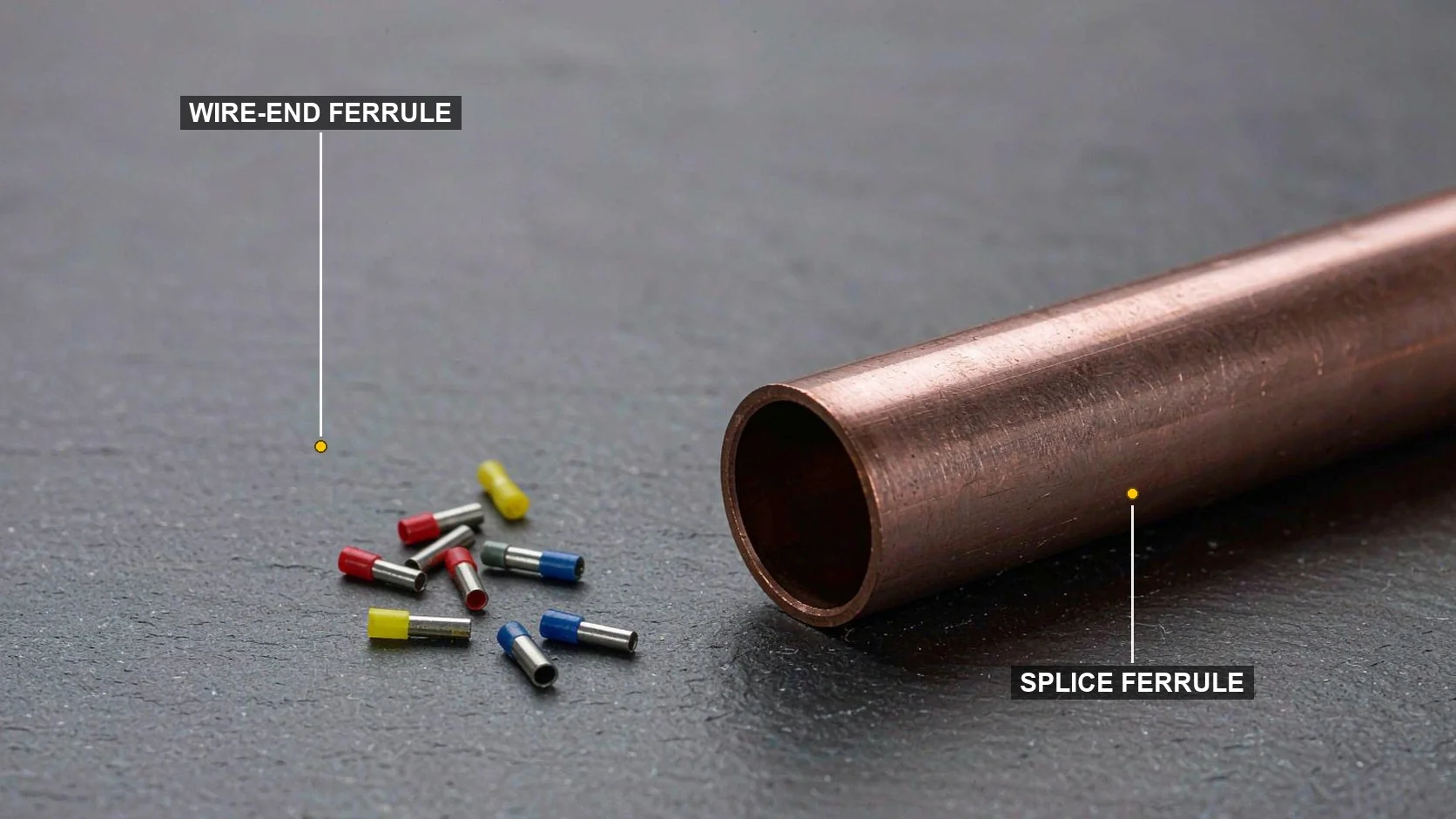
In control panels and equipment wiring, a ferrule is the short thin-walled tube, usually tinned copper with a colour-coded plastic collar, that is slipped over the stripped end of a flexible conductor before it goes into a terminal block. Its job is to consolidate the fine strands so the screw or spring clamp grips metal rather than splaying strands, and to stop strands being cut during clamping. These are small parts. They are measured in tenths of a millimetre of wall thickness and are sold by the thousand. They carry no palm, no hole and no mechanical load. The correct English term is “wire-end ferrule” or “bootlace ferrule”; “ferrule” alone in a panel-building context usually means this.
Meaning Two: the Splice Ferrule
In overhead line and heavy cable work, a ferrule is a full-length tube into which two conductor ends are inserted from opposite ends and compressed, joining them end to end. Its job is to carry the full tensile load of the conductor and to keep resistance across the joint close to that of the uncut conductor. These are large parts, sized in the tens of millimetres, and they are a structural component, not a wiring accessory.
The two are separated by three orders of magnitude in size and by their entire function, but both are “a metal tube you crimp onto a conductor”, so both sit under “ferrule” in a catalogue index. A clerk looking up a 95 mm² splice ferrule and landing on a 0.75 mm² wire-end ferrule has made a mistake the index encouraged.
The disambiguation that works in practice is to attach the function, not the size: “wire-end ferrule” for the panel part, “splice ferrule” or “compression splice” for the line part. If a supplier’s own catalogue uses “ferrule” bare, read the dimensional range before assuming which one is meant.
Sleeve, Splice, and Butt Connector
The remaining three words are easier, but they overlap in a way that shows up on invoices.
A sleeve is the generic word for a tube that something passes into or through. In cable work it usually means a compression sleeve used to join or repair conductors, and it is also used loosely for the insulation sleeve slipped over a finished joint. Both are tubes; one carries current, one does not. A specification that says “sleeve” without saying which is a specification with a hole in it.
A splice is the joint itself, and by extension the part that makes it. In overhead work a splice is a compression or mechanical joint between two conductor ends. In low-voltage wiring a splice can also mean an insulated in-line connector. In both cases the word describes the function — joining two ends — rather than the shape, which is why splices appear in several different product families.
A butt connector is the low-voltage, insulated version: a barrel with an insulation sleeve, into which two flexible conductors are inserted from opposite ends and crimped. It is a splice, but “butt connector” is the term that will be understood in a panel shop and the term that will confuse an overhead line engineer, who will hear “connector” and think of something carrying tension. Where a joint must be reopened instead of cut, the bolted alternative is in Mechanical Cable Lugs.
The Terminology Map
The table below is the one worth keeping next to the quotation file. It maps the Chinese term most often used in trade correspondence to the English words that a supplier or a customs broker will actually apply, and then to the physical product, because that is the only column that cannot be argued about.
| Chinese term in common use | English word(s) used for it | Physical product | Where it is used |
|---|---|---|---|
| 线鼻子 / 接线端子 | Cable lug; cable terminal; palm lug | Flat palm with a stud hole, plus a barrel for the conductor | Bolted to a stud, busbar or equipment pad |
| 铜管 / 压接套管 | Compression sleeve; splice sleeve; ferrule | Plain tube, no palm | Joining two conductor ends, or repairing a damaged section |
| 连接管 / 接续管 | Splice; splice ferrule; jointing tube | Long tube sized for two conductors, sometimes with a centre stop | Overhead and heavy cable, carrying full tensile load |
| 管型端头 / 冷压端子 | Wire-end ferrule; bootlace ferrule; cord end terminal | Short thin tube with a plastic collar, no palm | Flexible control wiring into terminal blocks |
| 铜铝过渡端子 | Bimetallic lug; copper-aluminium transition lug | Copper palm welded to an aluminium barrel | Aluminium conductor terminating on copper equipment |
| 对接端子 / 中间接头 | Butt connector; in-line splice connector | Insulated barrel, crimped from both ends | Low-voltage flexible wiring |
| 设备线夹 | Equipment clamp; terminal clamp; bolted lug | Bolted clamp with a palm or a pad, no crimp | Where the conductor cannot be cut or a die cannot reach |
| 铜排 / 母排 | Busbar; copper bar | Solid rectangular conductor | Panel and switchgear power distribution |
Column three is the arbiter. When two documents disagree about the word, the drawing or the sample decides, and the word gets corrected to match the part rather than the other way round. Doing it in that direction is what stops the error recurring.
The Same Word, Two Products
Four of these words are used for more than one physical object. That is the whole problem, and it is worth stating in one place.
| Word | Meaning A | Meaning B | How to tell which is meant |
|---|---|---|---|
| Thimble | Cable thimble: copper or aluminium tube or palm for terminating a conductor | Rigging thimble: grooved liner protecting a rope eye | Conductor size and palm or no palm. A rigging thimble has no barrel. |
| Ferrule | Wire-end ferrule: short thin tube with a plastic collar for flexible wire | Splice ferrule: full-length tube joining two conductors under tension | Dimensional range and whether the part carries load. A collar means the panel part. |
| Sleeve | Compression sleeve: metal tube carrying current | Insulation sleeve: polymer tube covering a joint | Material and whether it has a wall thickness that could be crimped. |
| Terminal | Any conductor termination, including a palm lug | The specific connection point built into a device, such as a breaker stud | Whether the part is supplied loose or is part of the equipment. |
Where the Wrong Word Costs Money
The cost of this vocabulary problem lands in three places, and only the first is obvious. A request for “ferrule, 95 mm²” read as a splice ferrule when the job needed a palm lug produces a part that bolts to nothing, and the buyer finds out at installation. A wire-end ferrule and a splice ferrule for the same conductor differ in price by a factor that is not small, so a quotation built on the wrong reading is either a loss or an embarrassment. And export documentation needs a description that matches the goods: “copper thimble” on an invoice covering palm lugs is accurate in one trade’s vocabulary and ambiguous in another, which is exactly what invites an inspection hold.
The description should name the object, not the trade’s nickname for it — barrel, palm, hole, material, conductor range. That is also what a technical data sheet should already contain, and the fields to look for are listed in How to Read a Cable Lug Specification Sheet.
There is a fourth cost that is harder to invoice: the rework inside the buyer’s own organisation. Once a part is entered into an ERP system under the wrong noun, the error propagates to every later order, and correcting it means changing a master record several people have already learned. The word on the first purchase order becomes the internal standard whether or not it was right.
Building a Description That Cannot Be Misread
The defence is not better vocabulary. It is a description that does not depend on vocabulary at all, built from five attributes that every cable accessory has and that no two products share in combination.
State the conductor range the part accepts, in square millimetres and in strand class if it matters. State the connection method — compression, bolted, or welded — because a bolted part and a crimped part with the same conductor range are different products. State the interface: palm with a hole of a given diameter, plain tube, threaded stud, or clamp. State the material of both sides where a transition is involved, since a copper lug and a bimetallic lug can otherwise look identical on paper. And state the standard the part is made to, by reference to the project’s own technical specification rather than by quoting a number that may not apply.
Two parts that agree on all five are the same part regardless of what they are called. Two parts that disagree on any one of them are different parts regardless of what they are called. That is the whole method, and it is why the naming argument can be dropped once the description is written properly.
How to Select the Right Model
Use the table below to convert a requirement expressed in loose words into a model enquiry that a supplier can answer without guessing. The left column is what people actually say. The right two columns are what has to be written down.
| What is being asked for | Name to use on the order | Parameters that must accompany it |
|---|---|---|
| Something to bolt a cable onto a stud | Cable lug, palm type | Conductor range; stud hole diameter; palm width; one hole or two, and hole pitch; conductor material; crimped or bolted barrel; plating if the site requires it |
| Something to join two cable ends permanently | Compression splice | Conductor range at both ends; whether the two ends are the same material; whether the joint carries tensile load; barrel length; die series if the project fixes one |
| Something to finish a flexible wire before a terminal block | Wire-end ferrule | Conductor cross-section; wire class; collar colour if the panel schedule specifies it; insertion length |
| Something to join aluminium cable to copper equipment | Bimetallic lug | Aluminium conductor range; copper interface hole and palm; transition method; whether the joint is indoor or outdoor |
| A connection that can be opened without cutting the cable | Bolted lug or equipment clamp | Conductor range; pad or palm dimensions; bolt size and grade; whether the clamp must accept two conductors |
| An earth connection to a structure | Grounding lug | Conductor range; structure material and thickness; bolt or weld fixing; indoor or buried |
Where an item on this list cannot be answered from the drawing, the correct move is to say so and ask, not to fill in a plausible value. A hole diameter guessed at the quotation stage becomes a part that will not fit at installation.
FAQ
Is a thimble the same as a cable lug?
In older cable-industry usage, yes — a copper thimble is a palm-and-barrel lug. In rigging and marine hardware, a thimble is a grooved liner for a rope eye and has nothing to do with cable termination. Ask which trade the word came from before assuming it means a lug.
Why do some catalogues call a wire-end ferrule a “terminal”?
Because it terminates a wire, and “terminal” is the broad functional word. That usage is common in European panel catalogues, where the part is listed as a cord-end terminal or a tube terminal. It is a terminal in the functional sense and a ferrule in the mechanical sense; both descriptions are true.
What is the difference between a sleeve and a splice?
A sleeve is a tube. A splice is a joint. A compression sleeve used to join two conductors is a splice made with a sleeve. An insulation sleeve covering a finished joint is a sleeve that makes no splice. The words answer different questions.
Can a “cable terminal” be something other than a lug?
Yes. Terminal blocks, stud terminals, spring-cage terminals and tab terminals are all cable terminals in IEC usage. Only the palm-and-hole type is a lug. If the requirement is a lug, write lug.
Vocabulary is a coordination problem, not a knowledge problem. Almost everyone in this trade knows what the parts do; the failures come from one document using a word that another uses for a different object. Fixing the description fixes the failure, and it does not depend on winning the argument about which name is correct.
If you are building a bill of materials and want the parts matched to the conductors, the interfaces and the site conditions rather than to a catalogue’s choice of noun, send the conductor range, the connection method, the interface dimensions, the material of both sides and the environment. The models currently listed are on the cable lugs category page, with the wider termination range on the cable terminals category page. Any requirement not covered by a listed model can be confirmed against a drawing before a quotation is issued, and where a figure is not documented it will be queried rather than assumed.